
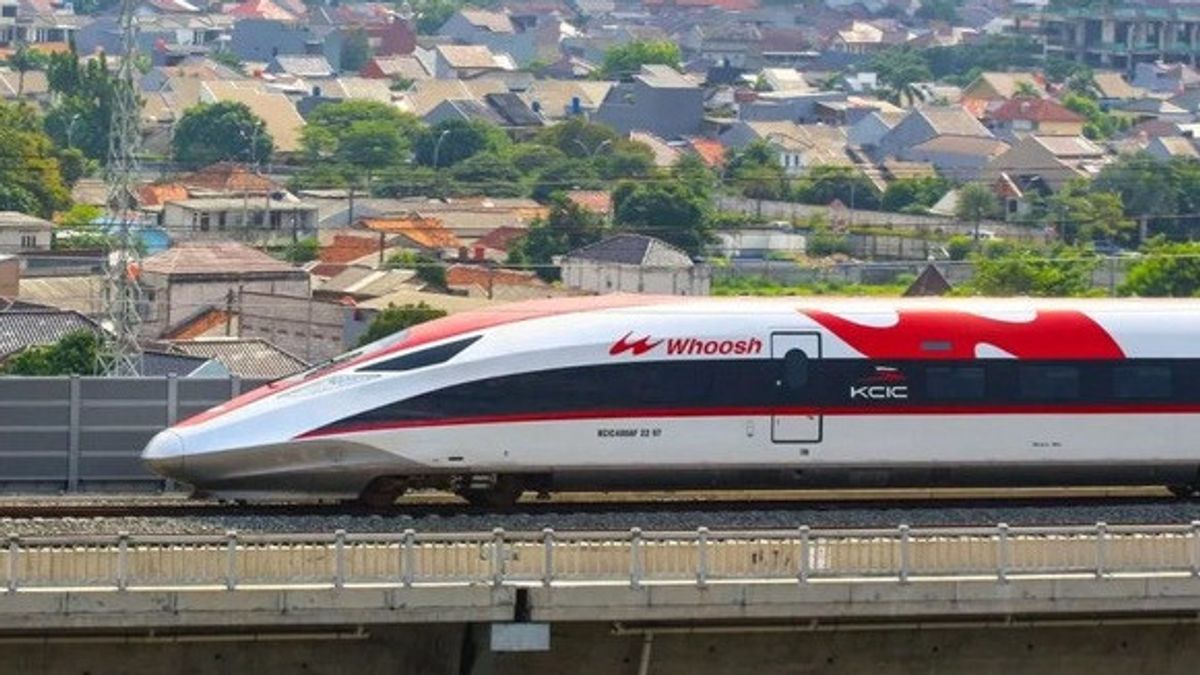


JAKARTA - The late Faisal Basri once said that until the end of the Indonesia-China Fast Train (KCIC) project would not return the capital. Minister of Finance Purbaya Yudhi Sadive emphasized that he did not want to pay KCIC's debt using the State Revenue and Expenditure Budget (APBN).
Purbaya's statement rejecting KCIC's debt payment using the APBN was a response to Danantara's Chief Operating Officer (COO), Dony Oskaria, who proposed a number of schemes to settle the high-speed rail project debt.
The two schemes include injecting equity to PT Kereta Api Indonesia or handing over the fast train infrastructure to the government. For the second choice, it means that the APBN will be sacrificed to finance the operations of
"Then we add the first or then we will hand over the infrastructure as in other rail industries, the infrastructure belongs to the government. Now, we are trying to offer these two options," said Dony.
Purbaya rejected the discourse on using the APBN to pay off KCIC's debt. According to him, the debt of the Jakarta-Bandung high-speed rail project is not the responsibility of the government, but the affairs of the SOEs involved in it.
It was not without reason that Purbaya rejected the plan. He reminded that since the superholding was formed, all BUMN dividends belong to Danantara and are no longer listed as non-tax state revenues (PNBP). He claimed that his value could reach Rp80 trillion per year.
The Jakarta-Bandung high-speed rail project is again in the public spotlight after financial reports recorded enormous losses.
KCJB is a National Strategic Project (PSN) which was built in 2016 and inaugurated in October 2023. From the start, the KCJB project has become a controversy. The construction of KCIC is touted as an ambitious project of the Seventh President of the Republic of Indonesia Joko Widodo (Jokowi).
In carrying out the project, the burden is borne by PT Pilar Sinergi BUMN Indonesia (PSBI). The consortium consists of PT KAI which controls 58.5 percent of shares, followed by PT Wijaya Karya (Persero) Tbk of 33.4 percent, PT Jasa Marga Persero (Tbk) of 7.1 percent, and PT Perkebunan Nusantara VIII (Persero) of 1.03 percent. The polemic and controversy of KCIC began with the cost of construction swelling from Rp86 trillion to Rp118.37 trillion, so that it became a burden on the state budget and the government must provide guarantees for KCIC debt.
SEE ALSO:
-
 | BERNAS
Gonjang-ganjing Kelangkaan BBM di SPBU Swasta saat Kepercayaan Masyarakat Dirusak
14 Oktober 2025, 20:00 -
 | BERNAS
Mempertanyakan Konsistensi Pemerintah dalam Penolakan Atlet Senam Israel di Indonesia
13 Oktober 2025, 12:30



The late Faisal Basri, had criticized the Jakarta-Bandung high-speed rail project as a ridiculous project. "Moreover, I took the high-speed train, I couldn't stop in the middle of the city of Bandung. I had to stop at Padalarang, get off the train by train again. Where is there a ridiculous project in this world. As a result, the cost has swelled, so this is a loss project that I say is until the end," he explained.
The KCIC problem did not end immediately after operating two years ago. This project is faced with a new problem. Losses continue to swell and become a financial burden for the company.
Financial reports as of June 30, 2025 (unaudited) released on the official website of PT KAI, PSBI recorded a loss of IDR 4.195 trillion. PSBI again bears a loss of IDR 1.625 trillion until the first quarter of this year.
When KCIC offered a job development proposal, a feasibility study showed that the number of passengers in the optimistic category could reach 76,000 passengers per day. In a pessimistic scenario,mindy is believed to be able to transport 50,000 passengers per day.
But the reality on the ground is not like that. Currently, only 40-50 percent have been achieved from the pessimistic target, while when viewed from the optimistic target it is only filled with 30 percent. With an occupancy rate of only 40-50 percent of the pessimistic target, ticket revenue of IDR 1.5 trillion per year is unable to cover operational costs and debt obligations. For interest only, KAI has to pay IDR 2 trillion per year.
PT KAI as the majority shareholder in the PSBI consortium automatically bears the greatest burden, both in the form of high-speed train operating costs and debt returns. In other words, most of the losses to the high-speed train project will be patched by KAI.
The burden ofPORTsh's debt has finally become a hot ball that harms anyone who has to bear it. In fact, many parties have always predicted that this mega project will cause problems in the future.
The Director of the NEXT Indonesia Center, Herry Gunawan, likens efforts to overcome the financial burden caused by KCIC to be like a simalakama fruit. Kiri or right will still be victims," said Herry.
Deputy Chairman of Commission VI Adisatrya Suryo Sulisto urged the leaders of KAI and Danantara to discuss the closing of KAI's debt. One of the options that is currently being discussed is to take overminish it into state assets.
However, this option was opposed by many groups, including the Minister of Finance Purbaya. Executive Director of the Center of Economic and Law Studies (CELIOS) Bhima Yudhistira assessed that Purbaya's steps were correct.
"The loss project should not be a burden on the state budget, let Danantara take care of it. Moreover, initially B2B (business to business) did not use state budget money," said Bhima to VOI.
"If it's wrong in the front, then finish it through negotiations with the Chinese business consortium, don't involve the state budget. Moreover, the state budget is already narrow in fiscal space with a sharp increase in deficits," he concluded.
To ease the burden, PT KAI and Danantara were asked to apply for loan restructuring to the China Development Bank, although this was not easy.
Economic observer from Political Economy and Policy Studies (PEPS Anthony Budiawan said that in order to be restructured, Bank China must require KAI to at least pay a number of principal loans first.
"Right now, I haven't paid the details yet, what do you want to restructure?" said Anthony.
"After that, you can restructure debt interest, not two percent and 3.4 percent. You have to lower it, just ask for it like the Japan offer of 0.1 percent. That's just a restructuring, it makes sense," he continued.
The English, Chinese, Japanese, Arabic, and French versions are automatically generated by the AI. So there may still be inaccuracies in translating, please always see Indonesian as our main language. (system supported by DigitalSiber.id)


