
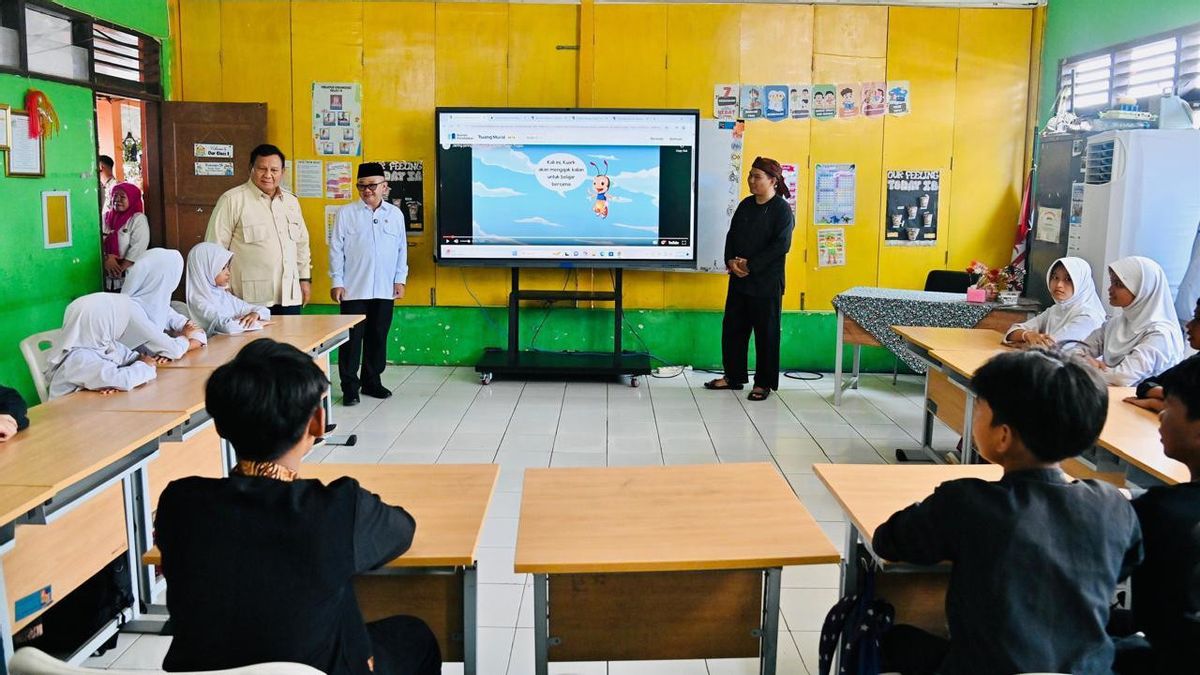


JAKARTA Procurement of smart TV or smart TV to schools is like an old song that is playing again. This policy is not only a waste of budget, but also the government is considered to have no educational perspective in managing education.
Procurement of smart TV for all levels of education that have begun to be distributed by the government shows a number of problems. Observers assess that this procurement shows that the government has failed to understand education issues. Not to mention there is a gap in corruption due to the closed method of procurement of goods without tender.
"The government does not have an educational perspective in managing education. I am afraid that we will fall into the same hole," said Ubaid Matraji, National Coordinator of the Indonesian Education Monitoring Network (JPPI).
Meanwhile, Indonesia Corruption Watch (ICW) considers the procurement of smart tvs this time to have similarities with the case of procuring achromebook. Thechromebook project was predicted to be a breakthrough in digitizing education, but instead it was not on target and was eventually corrupted.
The smart TV assistance program began with President Prabowo Subianto's direction during the commemoration of National Education Day on May 2, 2025. At that time, President Prabowo said the government would distribute a smart TV unit to each school to help distance learning in schools.
Through this interactive digital screen, students in schools that lack teachers can take part in distance learning by competent teachers elsewhere. The President again mentioned the plan to distribute smart television in his speech at the MPR annual match, last August 15. Then Prabowo said as many as 10 thousand schools had received smart TV.
The distribution of smart TV will continue to increase over time, with a target of 330 thousand televisions distributed to schools at all levels of education in the 2025/2026 academic year.
According to the head of state's view, the existence of this smart TV will help school students in the outermost, frontier, and underdeveloped areas or 3T to access quality teachers.
However, this assumption is refuted by the National Coordinator of JPPI Ubaid Matraji. He assessed that this policy shows the government's ignorance of the basic problems of education in Indonesia. According to Ubaid, not all schools in Indonesia, especially in the 3T area, have good electricity and internet facilities. Therefore, he is pessimistic that the existence of smart TVs can improve the quality of education in the area.
In addition, Ubaid also found a number of schools that received smart TVs even though they didn't really need it because they were in big cities.
If distributed to cities, it's the same as not having any benefits. I never knew what kind of smart TV policy (smart TV policy) would be. So, how do we hope to have a good impact on the quality of education if the policies are like-so-called officials," said Ubaid.
SEE ALSO:
-
 | BERNAS
Butuh Political Will Kuat untuk Menggeser Penyerapan Anggaran MBG yang Lelet
09 Oktober 2025, 08:00 -
 | BERNAS
Menjaga Euforia Sirkuit Mandalika di Tengah Minimnya Promosi MotoGP Indonesia
07 Oktober 2025, 14:00 -
 | BERNAS
Syarat Capres dan Cawapres Minimal Lulus SMA Tidak Salah, tapi Mengkhawatirkan
06 Oktober 2025, 22:00

The government should focus on a number of basic things, such as improving the quality and welfare of teachers, opening the widest possible access to education, and improving education infrastructure.
"Children don't go to school, there are still millions. Allocating funds for that will be useful immediately," he said.
JPPI records until May 2024, there were 3,094,063 children who did not go to school in Indonesia, one of which was due to economic limitations. "The policy is said to be right on target if it is in accordance with the needs proposed by the school which can then be used to improve the quality of education, but that doesn't exist," he said. "The government does not have an educational perspective in managing education," said Ubaid.
Indonesia Corruption Watch actually sees the procurement of smart TVs as similar to the procurement of chromebooks in the era of the Minister of Education Nadiem Nakarim. ICW saw various irregularities in the procurement of the smart TV.
ICW said the total ceiling for the procurement of smart TVs reached IDR 8.3 trillion, although several other sources said the value was lower, which was IDR 7.9 trillion. The price per unit for this smart TV reportedly reached IDR 26 million. However, the procurement of this smart TV without a tender.
The company was selected through the direct appointment method, namely Hisense, a company from China that offered a price of IDR 26 million per unit. Meanwhile, its competitor, Acer, gave a price in the range of IDR 40 million per unit.
From these irregularities, ICW sees a smart TV procurement program in the framework of digitizing learning to store various serious problems in the aspects of transparency, accountability, and compliance with government procurement regulations.
"If President Prabowo said that this procurement aims to improve the quality and distribution of education in Indonesia through digitizing learning, especially in remote areas with limited teachers, the answer is clearly not through the procurement of smart TVs," ICW wrote in its report.
The teacher competency crisis is a structural issue that can only be overcome through improving the quality of teacher education, sustainable training, and even distribution of educators. Meanwhile, smart TV is just hardware. Without a teacher who is able to manage learning, the device does not provide added value.
According to ICW, this approach is inappropriate because it does not touch the root of the problems that exist in Indonesian education. In fact, it is very risky to create waste and open up new loopholes for corruption.
The government should have learned from cases of procuring chromebooks that were not on target and eventually corrupted. The chromebook project was originally predicted to be a breakthrough in digitizing education, but in practice it was full of problems: the device was not on target, did not match school needs, and instead enriched a handful of people, "said ICW.
The same pattern now appears to repeat itself on smart TV projects. Instead of closing the gap for irregularities, the government is back on the road where there is a high risk of opening corruption niches," concluded ICW.
The English, Chinese, Japanese, Arabic, and French versions are automatically generated by the AI. So there may still be inaccuracies in translating, please always see Indonesian as our main language. (system supported by DigitalSiber.id)


