
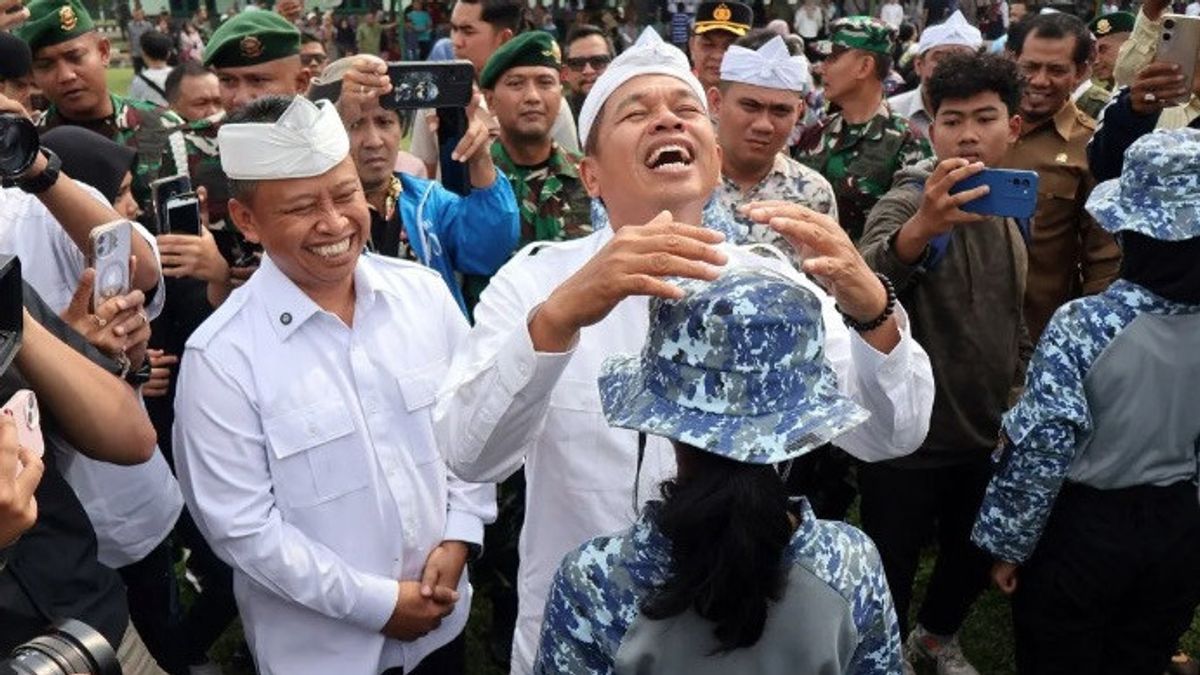


JAKARTA – West Java Governor Dedi Mulyadi has been asked to move beyond mere hype when implementing policies in the education sector.
Since Dedi took office as Governor of West Java on February 20, 2025, school students in West Java have had to adapt to several new regulations. Several of Dedi's policies, particularly in the education sector, have consistently drawn scrutiny, often sparking controversy among the public.
First, the policy of sending children deemed problematic to military barracks for character education. This policy targeted students with specific behaviors, such as brawling, smoking, drinking, and using noisy exhaust pipes.
Dedi Mulyadi then implemented a policy restricting students in his area from leaving their homes between 9:00 PM and 4:00 AM unless necessary. This policy was announced after delivering a public lecture on Cultural Values and Governance at the Faculty of Humanities, University of Indonesia, and will take effect on June 1, 2025.
Other policies that have drawn attention include the change in school start time to 6:00 a.m. in certain areas, plans to eliminate homework for students, placing 50 students in one class to prevent dropout rates, and the ongoing ban on study tours.

The ban on study tours has been protested by workers in the tourism sector, who feel their income has decreased since the policy was implemented.
Dedi Mulyadi's series of policies in the education sector are considered to have failed to address the root of the problem. According to Ubaid Matraji, National Coordinator of the Indonesian Education Monitoring Network (JPPI), Dedi's policies in the education sector are strategic for gaining popularity.
Five Anomalies in the Education Sector
The West Java Provincial Government, said Ubaid Matraji, should open its eyes and ears to the proliferation of objections to policies in the education sector.
According to JPPI records, there are at least five serious anomalies in the West Java education sector. First, West Java ranks first nationally in the category of Children Not in School (ATS), with 616,080 children.
This figure far exceeds Central Java (333,152 children) and East Java (332,844 children). This fact demonstrates a fundamental failure in reaching and retaining children in school. Furthermore, it is evidence that basic education services in West Java are still very poor and require special priority.
The second anomaly is the epicenter of violence in educational settings. West Java is among the top three provinces with the highest number of cases of violence. Sexual violence (38 percent), bullying (29 percent), and physical violence (22 percent) are the most common.

Third, the issue of the worst student brawls. Cases of student brawls are rampant in 41 villages or sub-districts in West Java. This figure far exceeds Jakarta (25 sub-districts) and North Sumatra (20 villages/sub-districts).
Fourth, West Java is the province with the highest number of cases of intolerance in the educational environment. This ranges from a lack of religious teachers for minorities, persecution of students of different faiths, hate speech, to intimidation and stigmatization as "heretics."
Finally, regarding the scandal of withholding diplomas. As of July 2025, JPPI received 612 complaints of diploma withholding by schools. This is the highest number of complaints in West Java compared to other regions.
"These anomalous facts are not just numbers; they are a complex tragedy. Indeed, some of these anomalies have roots in the past, but this tragedy is exacerbated by the West Java Provincial Government's 'Superman' ego, which pretends it can solve everything alone," Ubaid Matraji emphasized to VOI.
Opening Space for Criticism
Ubaid believes that the policies issued by Dedi Mulyadi are public policies that should not be implemented independently, but rather should be participatory. When the government operates independently without listening to the voices of the public, experts, and practitioners, it results in ineffective policies that actually exacerbate problems, Ubaid said.
"Why is it counterproductive and drawing so many protests? Because he doesn't realize that he is now governor and that public policies should be subject to in-depth review and public scrutiny. These participatory processes were not implemented by the KDM, resulting in many parties being disadvantaged, and protests mushroomed," Ubaid said.
The education sector, Ubaid continued, is a highly strategic area for gaining popularity. Instead of involving the public, the man nicknamed the "content governor" is also considered to have ignored the complaints of many and chosen to go his own way.
"Clearly, this is only for sensationalism, creating viral content, and popularity," Ubaid said.
Therefore, going forward, Ubaid urged Dedi Mulyadi to stop the "going it alone" approach to formulating policies. The man, familiarly known as KDM, must also open up the widest possible space for criticism and discussions with civil society, academics, education practitioners, parents, students, and all other stakeholders.
"Stop the defensive attitude and militaristic tendencies that are anti-criticism. Criticism is a vital vitamin for democracy, essential for improvement. Stop deploying digital buzzers full of hate speech and intolerance to silence critical voices, as this actually damages the democratic climate and public trust. Focus on the substance of the problem and its solutions, not on efforts to silence those who express criticism," he emphasized.
The English, Chinese, Japanese, Arabic, and French versions are automatically generated by the AI. So there may still be inaccuracies in translating, please always see Indonesian as our main language. (system supported by DigitalSiber.id)


