
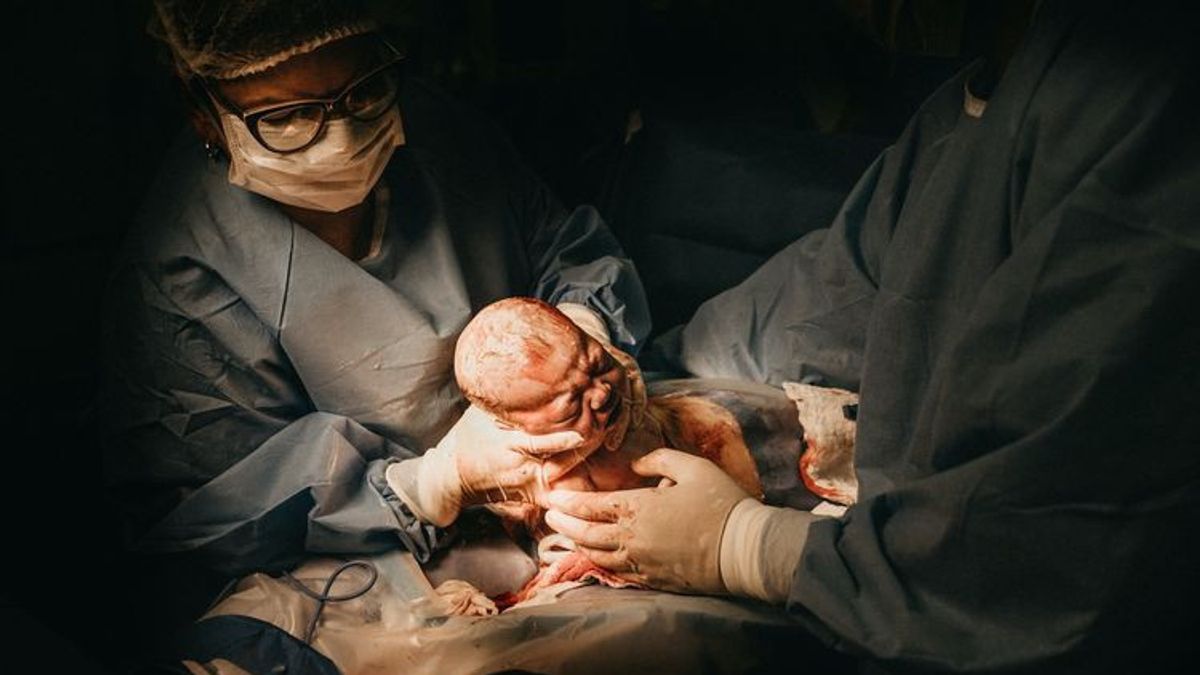


JAKARTA - Minister of Health (Menkes) Budi Gunadi Sadikin has become a conversation because of his controversial discourse, namely training general practitioners, especially in the regions to become Obstetrics and Gynecology (Obgyn).
The discourse of training the section caesarea (SC) action for general practitioners emerged to the public recently. Minister of Health Budi Gunadi revealed the reason why general practitioners could perform caesarean operations.
The proposal, he said, departed from the problem of access to obstetrics that are limited in remote areas.
The Minister of Health also explained that the World Health Organization (WHO) allows the term task shifting or general practitioners to be allowed to take actions to save people's lives.
According to Budi Gunadi, there are many general practitioners in remote areas who find it difficult to support pregnant women who need assistance.
"There is a doctor, but the doctor does not dare to do his job for fear that they will violate the punishment for violating competence. Because his business with people's lives," he said.
However, this discourse invites strong reactions from various circles, ranging from the medical community, professional organizations, to the public.
"Creating an expert general practitioner at SC is not enough for 6 months 1 year ... there are many variations in cases ... and you have to be able to hysterektomi before you can sc because this is important ... the ideal of being proficient is 3-4 years ... it's better to just go to school as a specialist, "wrote an account on platform X.
Health expert from Griffith University, Dicky Budiman firmly said that the plan for caesarean surgery by general practitioners was a mistake. The plan, said Dicky, was inappropriate and tended to be dangerous.
"Currently it is not appropriate and can be dangerous for current policy practices. For what reason? Medical science has developed rapidly," said Dicky.
The practice of caesarean operations, said Dicky, had indeed been carried out in Indonesia in the 1950s to 1980s in remote areas. However, at that time, this was done because of coercion and emergency situations, not because of the approve system.
Dicky explained that this happened because the development of science, ethics, and health systems were not yet established as they are today. Therefore, this story cannot be used as an excuse to implement the caesarean operation policy by general practitioners.
"So they did because it must be remembered that at that time there was no formal or special training for them. Because of the emergency situation and the limitations of the health service system at that time in Indonesia. So the context at that time there was no established specialization system," he said.
It's different now. In the past, the legal system and regulations for the medical profession were not as strict as they are now, nor was there a law on medical practice or a malpractice proof mechanism that can provide legal protection as is currently available.
Therefore, if a general practitioner is again given the authority to carry out major operations without official training and strict certification, the risk is very large, including in terms of law.
"Well, if the logic of thinking like it is currently used is not right and can be dangerous for current policy practices," explained Dicky.
"Regulation is also the Ministry of Health. So that general practitioners are not given the authority to carry out major operations. Except in very emergency conditions, force major. And at that time no other personnel could do it. For example, war, others killed many specialist doctors," he added.
Puspita Wijayanti, a doctor as well as social activist, also said that Puspita's model of Gopstetrician or family physical with SC competence can be found in other countries such as Australia and Canada.
However, they went through a specialfellowship program, strict certification, and were in a solid surveillance system.
No one learns SC in a narrow time just for distribution reasons. In a mature health system, the expansion of competence is always followed by the expansion of responsibility and strengthening of supporting structures, such as anesthetation facilities, NICUs, and so on," Puspita wrote, citing Kompas.
In Indonesia, Puspita continued, this discussion arose amid a major transition after the ratification of Health Law Number 17 of 2023. This law opens space for the flexibility of health services, including the expansion of the role of health workers.
SEE ALSO:



However, it should be noted that the Health Law still emphasizes the importance of accreditation of facilities, a tiered referral system, and the principle of efficiency-based competence.
"If we want to expand access, the method is not to reduce the competency threshold, but to strengthen the training system, provide incentives for the distribution of specialists, and build an adaptive referral ecosystem," said Puspita.
"The burden redistribution must not sacrifice quality. We need to strengthen primary services, not burden general practitioners with big tasks without adequate structural support," he added.
The English, Chinese, Japanese, Arabic, and French versions are automatically generated by the AI. So there may still be inaccuracies in translating, please always see Indonesian as our main language. (system supported by DigitalSiber.id)
Most Popular Tags
#Prabowo Subianto #donald trump #2026 World Cup #Febrie Adriansyah #8791Popular


