
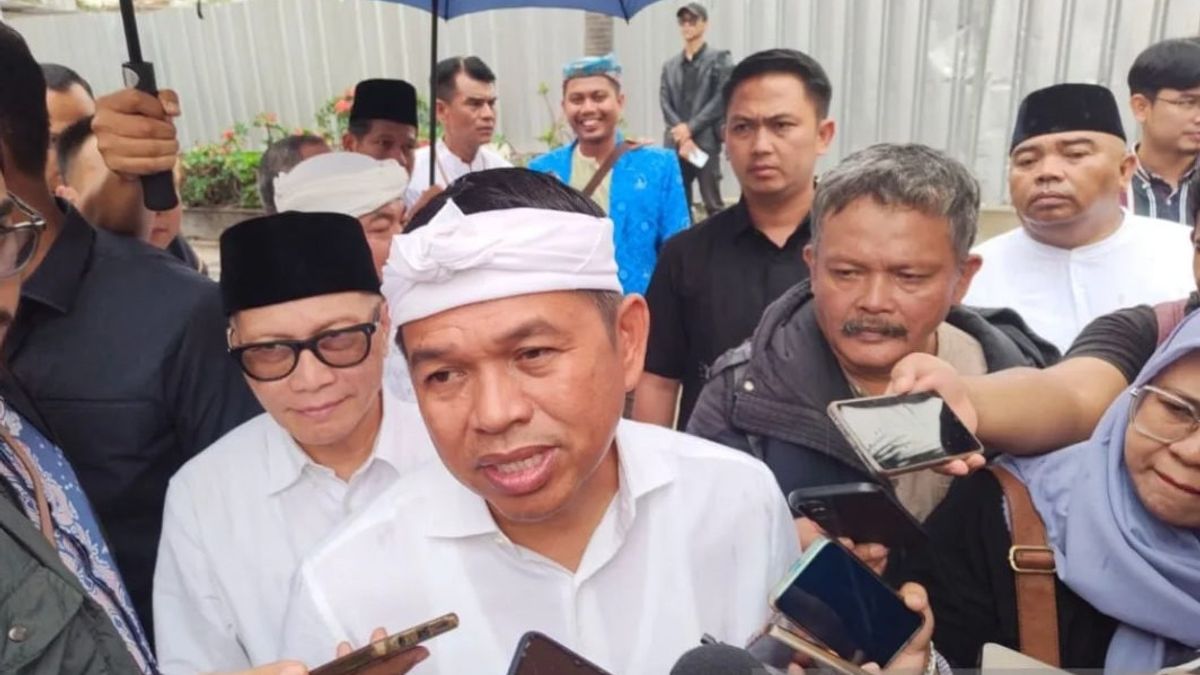


JAKARTA - West Java Governor Dedi Mulyadi's plan to make family planning participation (KB) in men, vasectomi, as a condition for receiving social assistance or social assistance has drawn controversy.
Dedi made the discourse in a coordination meeting in the field of people's welfare entitled "Gawe Rancage Pak Kades jeung Pak Lurah" at Pusdai West Java, Monday (28/4/2025).
In the meeting, Dedi said that KB, especially the male family in the form of a vasectomi, would be a requirement for receiving social assistance. The former Regent of Purwakarta even lured an incentive of Rp. 500,000 to a husband who was willing to undergo the Vaccination KB program.
This was done because he found many welfare families who had many children, even though the needs were not fulfilled. With this policy, said Dedi, the distribution of aid from the government, such as social assistance and scholarships, is more equitable and on target.
However, Dedi Mulyadi's plan immediately received a sharp spotlight. The Indonesian Ulema Council (MUI) of West Java Province emphasized that sterilization in men or vasectomi is very not allowed or haram in Islamic views because it is considered a permanent act of guidance.
"It should not be against sharia, in essence the vasectomi is haram and it is in accordance with the Ijtima Ulama Fatwa Commission throughout Indonesia IV at Pesangren Cipasung, Tasikmalaya, West Java in 2012," said West Java MUI Chairman KH Rahmat Syafei, quoting Antara.
However, Rahmat said the vasectomi might be carried out if there are certain conditions to avoid serious health risks and not cause permanent infertility.
It is also possible for Vasektomi if there is a guarantee of a reproductive function as before if desired, it does not cause harm or harm to the person concerned.
According to Rahmat, the KB requirements for receiving social assistance or various incentives may be carried out, while still observing the requirements that must be passed, especially for the vasektomy.
"For incentives, it's okay, but the important thing is that there was a position of requirement to be allowed, that must be adjusted," said Rahmat.
West Java Governor Dedi Mulyadi's suggestion that the vasectomi as a condition for receiving social assistance received attention from the Padjadjaran University Public Policy Observer (Unpad) Yogi Suprayogi.
According to Yogi, Dedi's plan regarding the vascular KB for men is a requirement for social assistance recipients to be said to be appropriate, but unethical.
"There is no policy ethics, but it's okay to be rational, but there is no ethics, especially with our culture in Indonesia," said Yogi.
In addition, Yogi assessed that the lure of incentives seemed to be coercion for the husbands to carry out a vasectomi KB.
"Then what is ready to be given Rp. 500 thousand, I think (as if) there is coercion, it violates human rights, yes," he added.
In simple terms, the vasexomi is an act of sterilization in boys by cutting or clogging the spermtoozoa channel from the test to the penis.
Thus, manifold water that comes out when a man has ejaculation no longer contains sperm cells.
Yogi views that the proposed vasectomi in men is too risky, for that he encourages Dedi Mulyadi to review the policy. Especially if the purpose of the vasectomi in men is to increase the birth rate and reduce poverty in West Java.
Meanwhile, the Human Rights Naational Commission (Komnas HAM) said that the obligation of the vasectomi could not be exchanged for social assistance or others.
Komnas HAM chairman Atnike Nova Sigito said that the vasectomi is part of human rights. Therefore, if it is required or forced by the government, it has the potential to violate privacy rights.
"It's also privacy, yes, what vaccinations are done to the body is part of human rights. So, it should not be exchanged with social assistance or other things like that," said Atnike.
SEE ALSO:
-
 | BERNAS
Mempertanyakan Integritas Generasi Muda di Tengah Isu Kecurangan UTBK SNBT 2025
29 April 2025, 14:50



He explained, let alone the requirements for receiving social assistance. Punishing criminal offenders is not allowed with penalties that violate privacy rights.
"Just punishment is not allowed, punishment with such a corporal punishment is actually part that is opposed in the discourse of human rights," he said.
"Moreover, it was exchanged with social assistance or it was the body's authority. The forced KB (Family Planning) alone was a human rights violation," Atnike concluded.
The English, Chinese, Japanese, Arabic, and French versions are automatically generated by the AI. So there may still be inaccuracies in translating, please always see Indonesian as our main language. (system supported by DigitalSiber.id)
Most Popular Tags
#Prabowo Subianto #donald trump #Febrie Adriansyah #8791 #giias 2026Popular


