
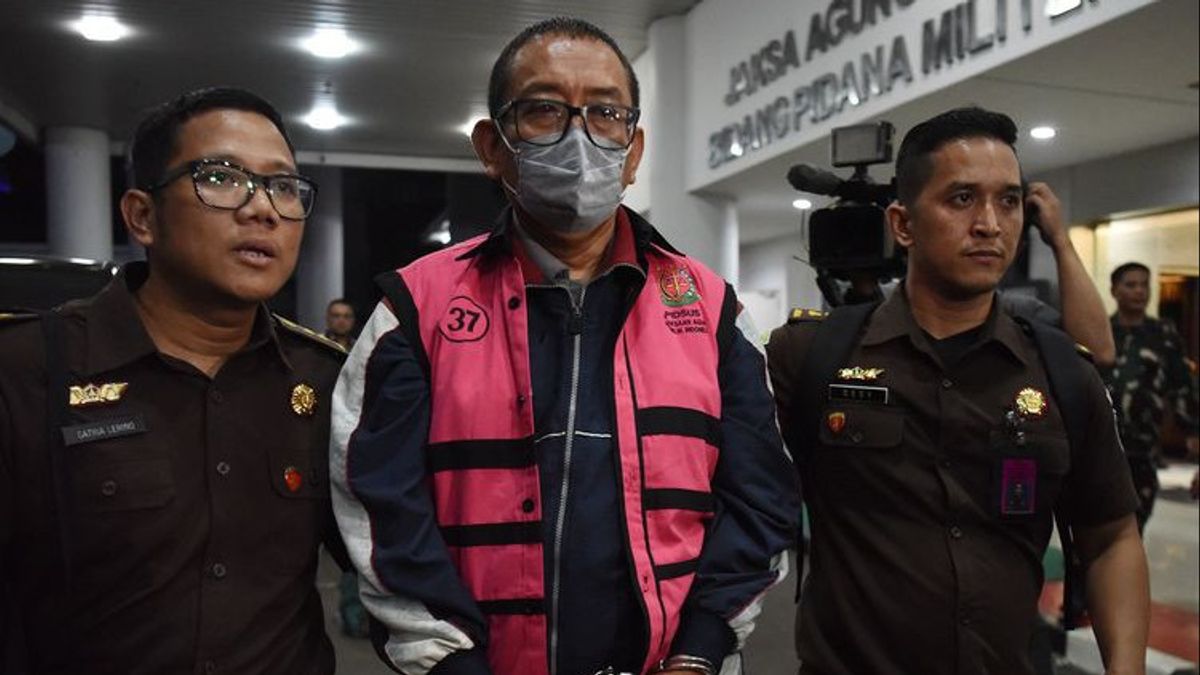


JAKARTA The determination of the suspect Director of the JAK TV broadcast, Tian Bahtiar, has become a polemic. The decision of the Attorney General's Office (AGO) is considered to be able to injure press freedom.
Tian Bahtiar, together with Marcella Santoso and Junaedi Saibih as attorneys, the AGO has been named as suspects in the obstruction to the investigation and prosecution of corruption cases. They are suspected of having committed malicious conspiracy to create news and content on social media that discredits the AGO in handling the corruption case of PT Timah Tbk and importing sugar at the Ministry of Trade.
In this case, Tian is suspected of obstructing the investigation of the cases investigated by the AGO by building public opinion through negative news that cornered the AGO.
The AGO said the news was made by Tian at the request of lawyers Marcella Santoso and Junaedi Saabih for a fee of Rp478,500,000 that went into the Tian periadi pocket.
The modus operandi is that Marcella and Junaedi hold seminars, TALKshows, and demonstrations with negative narratives related to case handling by the AGO. The events mentioned were then covered and published by Tian.
The suspects are suspected of Article 21 of Law in 1999 concerning the Eradication of Criminal Acts of Corruption as amended by Law number 21 of 2021 in conjunction with Article 55 Paragraph 1 of the Criminal Code.
However, Tian Bahtiar's confinement invited polemics. Although the investigation of corruption cases has full support from civil society, when journalistic products are used as evidence of obstruction to investigation, this raises concerns.
The publication of the JAK TV news which was allegedly used as evidence from the AGO was an attempt to hinder and obstruct the legal process or obstruction of justice from being in the spotlight of the Journalist Safety Committee (KKJ).
Delikobstruction of justice on journalistic products raises concerns for journalists, media companies, and other civil society groups, according to a committee of 10 civilian organizations including the Alliance of Independent Journalists (AJI).
"Reporting, public opinion, expressing opinions in public, is clearly not an act of obstruction as referred to in Article 21 of the Corruption Crime Law (Obstruction of Justice)," said Chairman of AJI Indonesia, Nani Afrida in a written statement.
Nani explained that there was no relationship between media coverage and public assessment of the investigator's concentration in handling a case.
SEE ALSO:
-
 | BERNAS
QRIS dan GPN adalah Bukti Kedaulatan Ekonomi Nasional, Jangan Dilemahkan!
24 April 2025, 08:15




"Article 21 of the Anti-Corruption Law must be used carefully because it has the potential to be used as a rubber article against criticism that is often conveyed by the public in the law enforcement process in corruption cases," added Nani, who believes this case is the first time this has happened in Indonesia.
Meanwhile, Mustafa Layong, Executive Director of the Press Legal Aid Institute (LBH) emphasized that news products are not a criminal act, because the journalistic process is a legal expression space.
According to Mustafa, the media is fine to report criticism of the process of investigating certain cases while using journalistic principles regulated by the Press Council, for example by finding and testing the evidence found.
He is worried that the JAK TV report, which is used as evidence of obstruction to the investigation by the AGO, will set a bad precedent in general for press freedom.
"If the logic used by the Attorney General's Office is justified, it could be that me and other media can also be accused of this because they criticize and are not the same as investigators," said Mustafa again.
"It must be distinguished between journalistic work and bribery," he added.
On the other hand, media researcher and journalistic lecturer at Multimedia Nusantara University (UMN) Ignatius Haryanto said that the news issued by JAK TV remains a journalistic product. But what is the problem now is whether this journalistic product violates ethics or not, that's what needs to be investigated further.
To get the assessment, said Ignatius, it must be returned to the Press Council. "Later on, to decide whether this is a journalistic product that has problems or not, that's what the Press Council will do," he said.
He also encouraged the AGO not to use its weapons to punish reports that are considered detrimental to its institutions. This, said Ignatius, would be troublesome if other media criticized the prosecutor's policies.
"And if you don't like it, then the prosecutor will punish you himself," he said.
Criminal law expert Yenti Garnasih actually said that the case against Tian Bahtiar was personal and had nothing to do with the media institution where he worked. He believes the AGO only focuses on the alleged consensus between Tian and the two lawyers.
According to Yenti's assessment, the AGO saw indications or allegations of malicious conspiracy related to the AGO's institution aimed at dropping the AGO's reputation and in the end they did not disclose several corruption cases.
This case, in Yenti's observations, was not included in the provisions of the Press Law, it was just a coincidence that the mode and the one who did it were journalists. Meanwhile, in terms of ethics, he invited the Press Council to take steps according to the law.
"This has nothing to do with the media where Tian works or his profession as a member of the press, only the modus operandi is to use his position as a member of the press and his media room," said Yenti.
However, Yenti still reminded the importance of respecting the steps currently being taken by the Press Council in investigating the case.
"We must also respect the process carried out by the Press Council as an independent institution tasked with protecting press independence and improving the quality of the national press," he concluded.
The English, Chinese, Japanese, Arabic, and French versions are automatically generated by the AI. So there may still be inaccuracies in translating, please always see Indonesian as our main language. (system supported by DigitalSiber.id)
Most Popular Tags
#Prabowo Subianto #donald trump #Febrie Adriansyah #8791 #giias 2026Popular


