

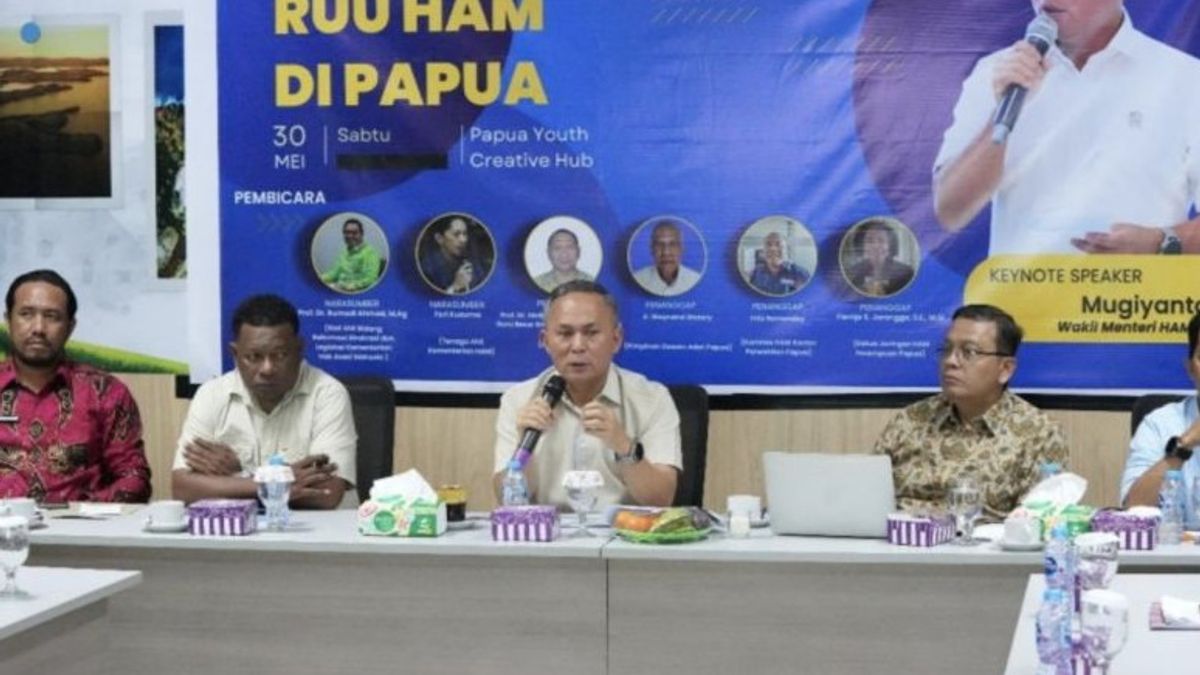


JAKARTA - Deputy Minister of Human Rights (HAM) Mugiyanto ensures that the aspirations of the Papuan people will be an important part of the preparation of the revision of Law Number 39 of 1999 concerning Human Rights (HAM).
This is to strengthen the protection of citizens' rights and respond to contemporary human rights challenges.
"We target that this law revision can be discussed and passed in 2026 because this revision of the Human Rights Law has indeed entered the National Legislation Program (Prolegnas)," said Mugiyanto in his statement in Jakarta, Sunday.
In the public trial of the revision of the Human Rights Law in Jayapura, Saturday (30/5), Mugiyanto said the revision of the Human Rights Law was needed to adapt to the development of time, including the protection of the right to privacy, digital rights, and various new issues that arise along with technological developments.
He explained that the current Human Rights Law was drafted in the context of democratic transition and regulated more on human rights institutions. Therefore, the government encourages a revision so that the law serves as a legal umbrella that strengthens the human rights protection ecosystem nationally.
"This law cannot exceed these limits and does not regulate technical matters. Detailed matters will later be regulated through derivative rules, such as government regulations (PP)," he said.
Mugiyanto said that the various inputs submitted by the Papuan people in the public trial forum would be considered in the preparation of the final draft of the revision of the Human Rights Law, although not all technical issues could be accommodated in a general law.
He added that the spirit of community involvement was in line with various recommendations that emerged in the Strategic Papua Analysis Conference (APS) which was previously held in Jayapura.
"This spirit is very in line with the results of the Papua Strategic Analysis (APS) conference which has just been held, where the proposals in the forum will be very meaningful input for the preparation of the revision of the Human Rights Law," he said.
During the forum, a number of Papuan community representatives highlighted various issues, ranging from the right to customary land, the participation of indigenous peoples in politics, the welfare gap, the protection of women and children, to the impact of illegal mining activities.
Community figures from the Elseng Tribe assess the success of human rights protection not only by the number of regulations issued, but by the extent to which justice and community rights can be felt in a tangible way.
Meanwhile, a number of participants also proposed strengthening the role of national human rights institutions, increasing the representation of the people of East Indonesia in national commissions, the establishment of Regional Technical Implementation Units (UPTD) in new provinces, and transparency in the use of special autonomy funds (Otsus) for the empowerment of women and families.
On the same occasion, the Expert Staff of the Minister of Human Rights for Bureaucratic and Legislative Reform, Rumadi Ahmad, emphasized that the revision of the Human Rights Law must be comprehensively drafted in order to produce strong legal norms while being able to respond to current human rights issues.
"Of course, this norm cannot run on its own, there must be an institution that implements it. The National Human Rights Institution cannot work optimally if it is not supported by the executive power," said Rumadi.
He said that a number of contemporary human rights issues that are being discussed in the revision of the Human Rights Law include the protection of personal data, the impact of the development of artificial intelligence (AI), strengthening the independence of Komnas HAM, as well as plans to establish a permanent fund to strengthen human rights and democracy to support humanitarian programs and strengthening civil society.
The English, Chinese, Japanese, Arabic, and French versions are automatically generated by the AI. So there may still be inaccuracies in translating, please always see Indonesian as our main language. (system supported by DigitalSiber.id)
Most Popular Tags
#Prabowo Subianto #donald trump #firearm #8791 #giias 2026Popular


