

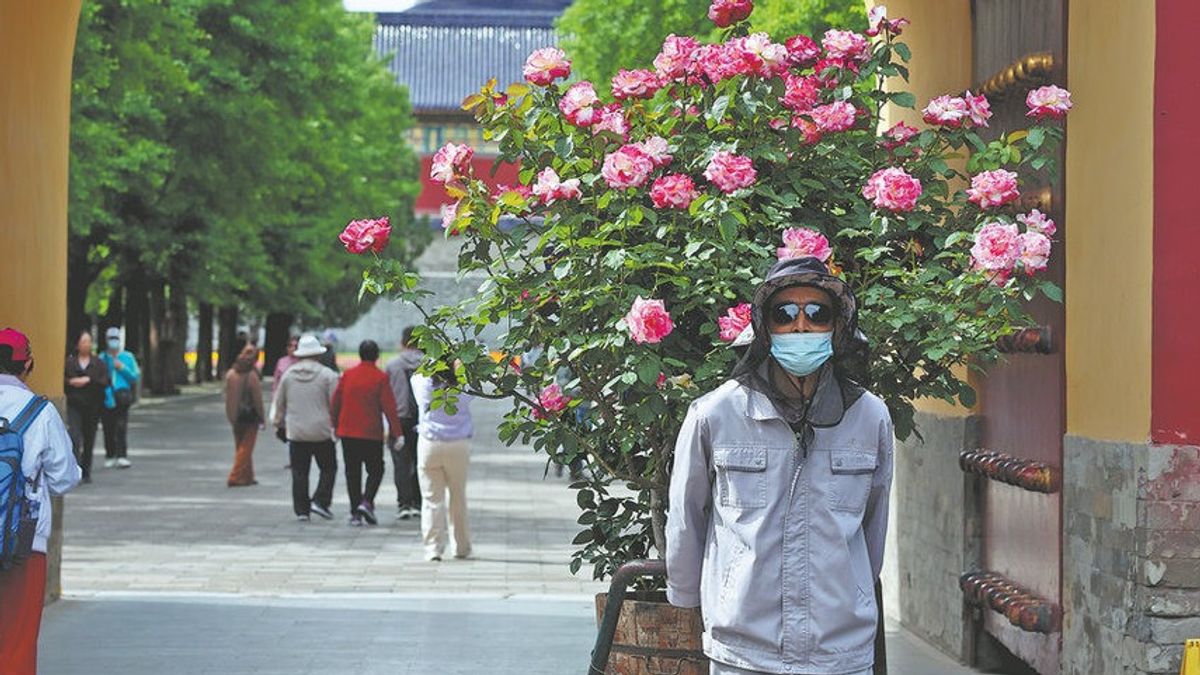


JAKARTA - China's rose also attracted attention during US President Donald Trump's visit to Beijing. While walking with President Xi Jinping in Zhongnanhai, China's historic leadership complex, Trump stopped to admire the flowers that grew in the former imperial garden.
Citing a China Daily report, Tuesday, May 26, Xi told Trump that one of the trees they saw was 490 years old. Xi also said he would send Chinese rose seeds from the garden as a gift.
"I love it; it's incredible," Trump said.
Chinese rose or yueji is not just an ornamental plant. This flower has a history of more than 2,000 years and is said to be one of the foundations of the birth of modern roses that are now spread throughout the world.
According to the China National Forestry and Grassland Administration and the National Park Administration, records on Chinese roses have existed since the Han Dynasty in 206 BC to 220 AD. Its cultivation flourished in the Tang and Song Dynasties.
When the Chinese rose entered Europe, plant breeders crossed it with local roses. This step helped overcome the long-standing problem of European roses, namely a short flowering period and a weak aroma.
From that long process, there are now more than 40,000 varieties of roses in the world. Many of them are rooted in Chinese roses.
In Beijing, Chinese roses are blooming in many corners of the city. The green line of the Fourth Ring Road is polished into a 65.3-kilometer flower corridor. When the project is completed in November, the area is expected to have about 710,000 rose plants.
The Beijing City Forestry and Parks Bureau said the new variety was added to make the flowering period longer, from May to the end of October.
For residents of Beijing, roses are not a luxury item. In the hutong area, Beijing's traditional alley, these flowers grow climbing walls and fences.
Wang Meng, a senior landscape engineer at Taoranting Park, grew up in the Hufangqiao hutong area. He called the Chinese rose a part of the city's residents' memories. "Growing up in the hutong, the Chinese rose was always around me," Wang said, quoted by China Daily. "This flower is part of our environment and memories."
Taoranting Park was established in 1952 and became one of the first large public parks in Beijing after the founding of the People's Republic of China. In the Shengchun Shan Fang rose garden, there are more than 19,000 plants from 20 varieties.
Not far from there, the Heaven Temple also has a large rose garden. In this place, flowers grow side by side with old architecture and hundreds of years old trees.
Fu Yinghui, head of the rose team at the flower center of the Temple of Heaven, has worked in the park for almost 40 years. According to him, the rose garden at the location began to develop since 1956, when Beijing brought roses from southern China.
In 1960, horticulturalist Jiang Endian, known as the "Lady of Roses", helped build a modern rose garden at the Temple of Heaven. Three years later, the area of the garden reached about 13,000 square meters and became the largest public rose garden in China at that time.
Fu said roses began to spread widely in Beijing in the early 1990s. During the 1990 Asian Games, the city's streets began to be decorated with bright-colored roses.
"Previously, roses were considered expensive flowers for city landscapes," said Fu. "Slowly this flower became part of the residents' lives."
Now, Chinese roses are appearing in various spaces in Beijing, from Zhongnanhai, hutong alleys, public parks, to the Heaven's Temple area. The flower is part of the city's history as well as the daily life of its citizens.
The English, Chinese, Japanese, Arabic, and French versions are automatically generated by the AI. So there may still be inaccuracies in translating, please always see Indonesian as our main language. (system supported by DigitalSiber.id)
Most Popular Tags
#Prabowo Subianto #donald trump #firearm #8791 #giias 2026Popular


