

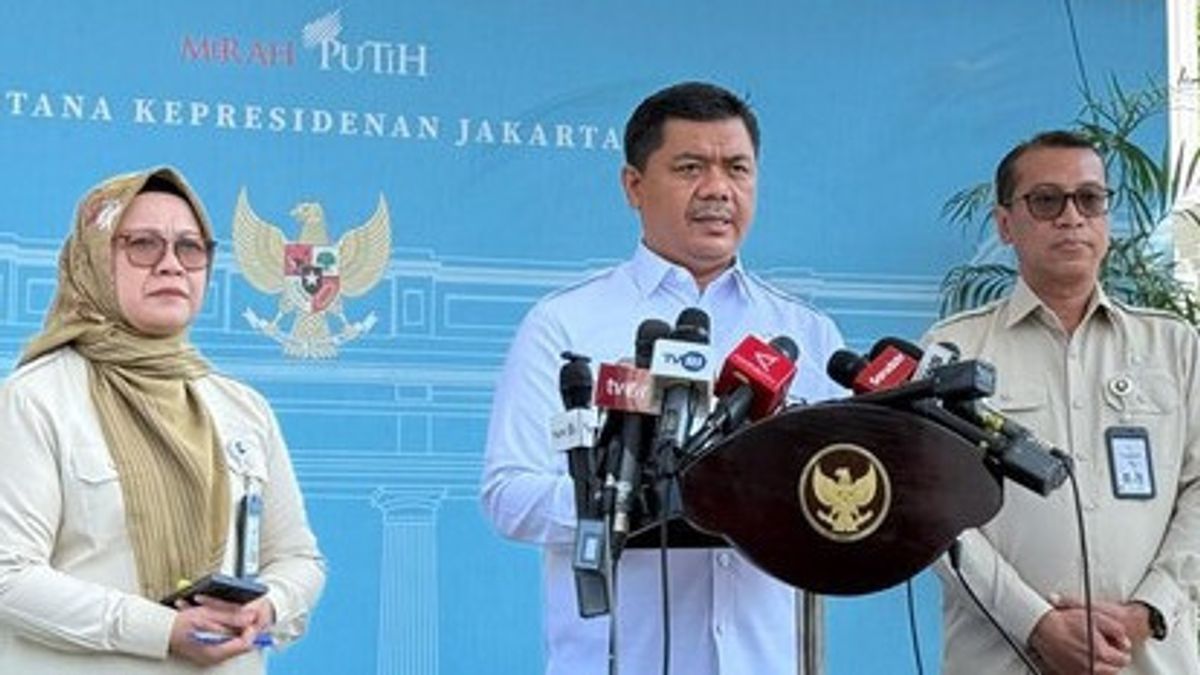


JAKARTA - Deputy Minister of State Secretary Juri Ardiantoro explained that the distribution of sacrificial cows from President Prabowo Subianto to the public on Eid al-Adha this year is part of the Presidential Community Assistance program or Banpres which has been taking place for a long time from year to year.
The jury delivered the explanation in response to public questions that questioned the use of state funds in the procurement of the President's sacrificial cows. According to him, the sacrificial cows are basically government assistance to the community so that residents, especially those in need, can celebrate Eid al-Adha and enjoy the sacrificial meat.
"The meaning of the sacrificial cow from the President is government assistance to the community. The goal is that people in need can celebrate Eid al-Adha by slaughtering sacrificial animals together," said Juri in Jakarta, Wednesday (27/5).
The jury revealed that this year, 1,098 cows were distributed by President Prabowo Subianto to various parts of Indonesia. As an aid to the community, the use of the Banpres budget allocation is common and has become a government practice in previous years.
He emphasized that the sacrificial cow assistance was not intended for the personal interests of the President, but was fully channeled to the community in various regions. The government wants the presence of the state to be felt directly by the people, especially through religious momentum that has high social value such as Eid al-Adha.
The judge also added that personally, President Prabowo still carried out the sacrifice on behalf of himself using his own funds. The President's personal sacrificial animal was also slaughtered and distributed to the community.
Meanwhile, the Indonesian Ulema Council considers the purchase of sacrificial animals by the head of state using state funds or the state budget to be not problematic in Islamic law. Chairman of the MUI Fatwa, Prof KH Asrorun Niam Sholeh, explained that the procurement model has a strong fiqh foundation in Islamic history.
According to Prof. Niam, referring to the Hadith of Imam Bukhari, a leader or imam is indeed prohibited from buying sacrificial animals through the Baitul Mal or state treasury. In the context of a modern state, the APBN can be understood as a form of Baitul Mal that is managed for public benefit.
"In the context of statehood today, the state budget acts as a modern Baitul Mal. So that the sacrifice of this country is intended purely for the benefit and welfare of the wider community. In terms of syar'i there is no question," said Prof Niam.
He added that the mechanism was also logical from the technical side of bureaucracy because it was similar to other social assistance programs provided by the government to the community. The difference is, this time the assistance is realized in the form of sacrificial animals that are distributed to the regions.
"Just like the presidential budget which is realized in the form of basic necessities and then distributed to the community. The logic is the same, this sacrificial animal is not consumed personally by the President, but is directly distributed to the regions," added Prof. Niam.
The distribution of the President's sacrificial cows through Banpres is considered to be part of the government's efforts to strengthen social concern, add the splendor of religious worship, and ensure that people in various regions feel the happiness of Eid al-Adha 1447 Hijriah.
The English, Chinese, Japanese, Arabic, and French versions are automatically generated by the AI. So there may still be inaccuracies in translating, please always see Indonesian as our main language. (system supported by DigitalSiber.id)
Most Popular Tags
#Prabowo Subianto #donald trump #Febrie Adriansyah #8791 #giias 2026Popular


