

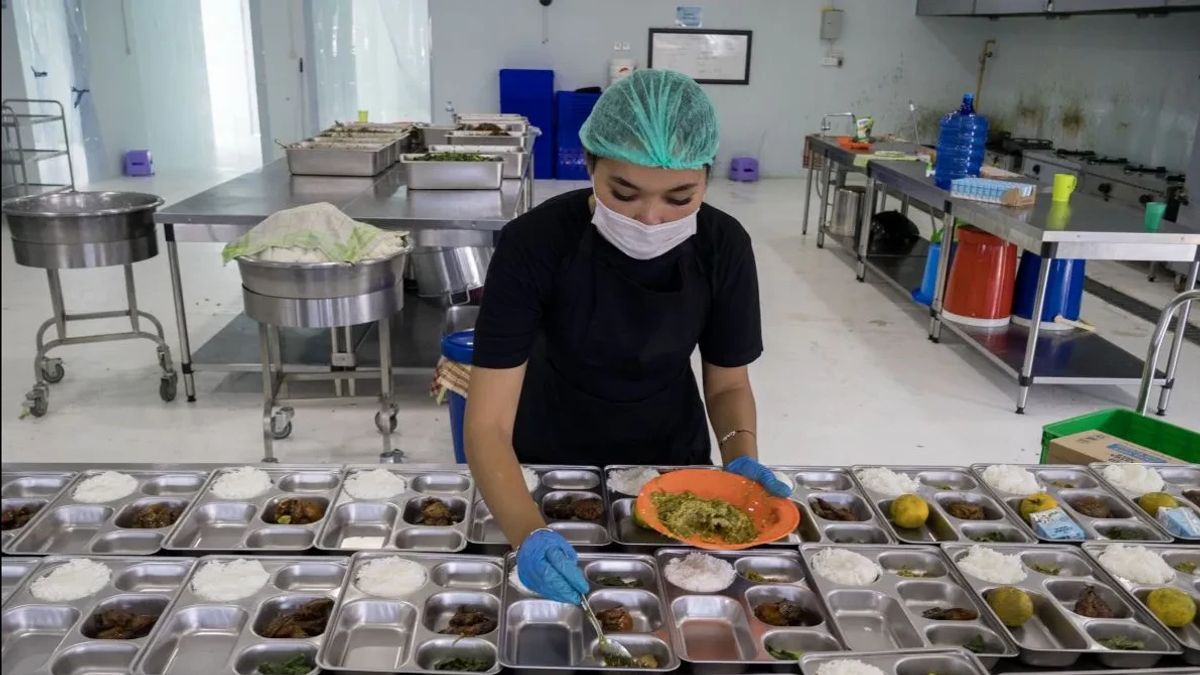


JAKARTA - The DKI Jakarta Provincial Government (Pemprov) has revealed that hundreds of Free Nutritious Meals (MBG) kitchens in the capital city have not yet obtained the Certificate of Sanitary Hygiene (SLHS).
Of the total 609 nutrition fulfillment service units (SPPG) that have been operating until May 10, 2026, only 167 units have obtained certificates from the DKI Jakarta Health Service.
The Special Staff of the Governor of DKI Jakarta for Social Communication, Chico Hakim, said that the limited number of SPPGs that were certified was due to many MBG kitchens that had just started operating in recent months.
"Currently there are 609 SPPG units that have been operating in DKI Jakarta. Of the 609 SPPGs that are operating, only 167 units have obtained hygiene sanitation certificates (SLHS)," Chico told reporters, Tuesday, May 12.
According to him, the process of issuing certificates requires a non-short inspection stage. Starting from field inspection, checking facilities and infrastructure, to repairing facilities if deficiencies are found.
"This figure is still limited because many SPPG are new units that have started operating gradually since the end of 2025 to early 2026. The certification process requires time for field inspections, verification of infrastructure, and necessary repairs," he said.
Not long ago, there was a spotlight on the food safety standards of the MBG program, especially after the case of alleged poisoning of students after eating a meal distributed by SPPG Pulogebang 15, East Jakarta. The DKI Provincial Government, said Chico, is now speeding up the certification process for all MBG kitchens through the Health Office.
"We are very aware of the importance of this acceleration in order to ensure food security for children and the community," said Chico.
In the certification process, each SPPG is required to meet a number of hygiene standards. Starting from the layout of the kitchen, ventilation, lighting, waste management, to the availability of clean water.
In addition, food inspectors are also required to undergo regular health checks and food safety training.
He explained that supervision of food safety of the MBG program was carried out in layers through routine inspections, sudden audits, food sampling, to monitoring daily reports from each SPPG.
"Periodic evaluation of all units, especially after incidents like the one at Pulogebang 15," he said.
The DKI Provincial Government also ensures that there are sanctions for MBG kitchens that do not meet hygiene standards. The sanctions range from temporary suspension of operations to permanent closure if violations occur repeatedly.
"SPPG that has not met the standards can be subject to temporary suspension of operations (suspend), administrative sanctions, permanent suspension of operations if repeated or seriously violated," he added.
The English, Chinese, Japanese, Arabic, and French versions are automatically generated by the AI. So there may still be inaccuracies in translating, please always see Indonesian as our main language. (system supported by DigitalSiber.id)
Most Popular Tags
#Prabowo Subianto #donald trump #firearm #8791 #giias 2026Popular


