

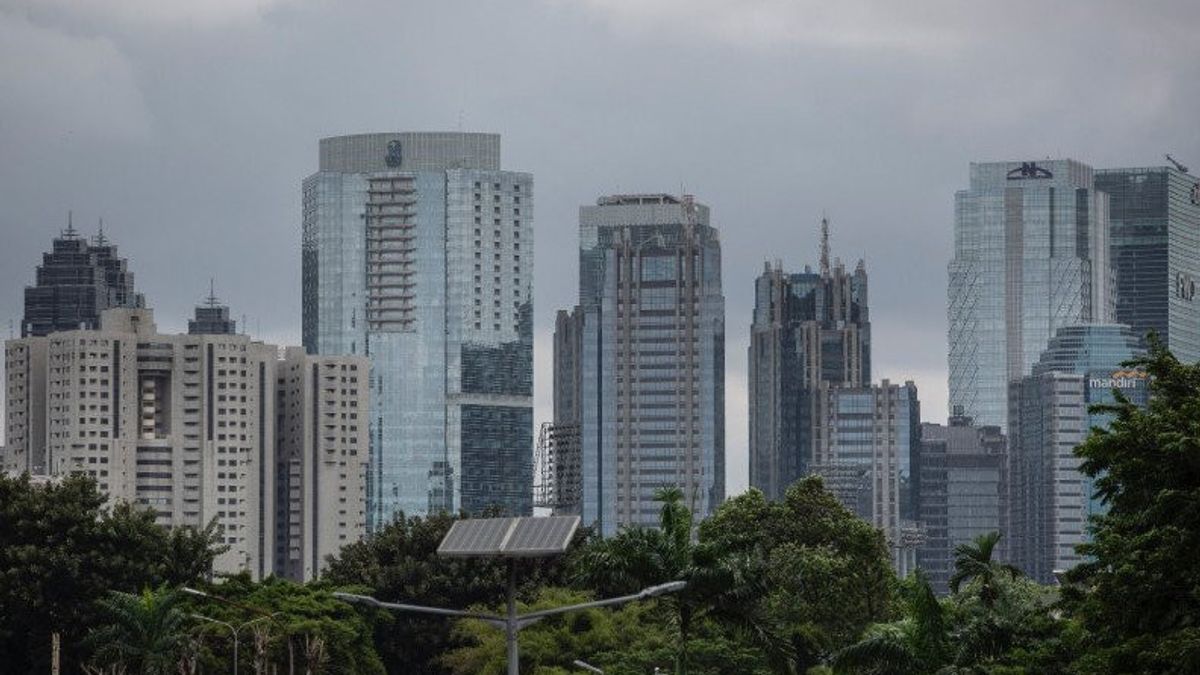


JAKARTA - The phenomenon of more people going out than entering Jakarta after this year's Lebaran is considered normal. Chairman of Commission A of the DKI Jakarta DPRD Inggard Joshua assessed that this condition is actually a signal that the Capital City is too crowded.
According to him, residents who come to Jakarta to find a living but are unsuccessful should return to their home areas.
"We really appreciate it if the immigrants to Jakarta to complain about their fate continue and then fail, yes they should return. Don't let it mean that it will burden him, it will also burden the local government," Inggard told reporters, Thursday, May 7.
He emphasized that Jakarta is still open to anyone who wants to come and contribute. However, the arrival must bring benefits, both for individuals and for the region.
On the other hand, if they are unable to survive, according to Inggard, the decision to return home is a more realistic option than staying in difficult conditions in the capital.
"If this has benefits for him and the local government, of course we are very happy and proud," said Inggard.
"But when he came he just gave up, went back home, yes it was the best way than being left alone in Jakarta," he added.
In addition, Inggard assessed that the current density of Jakarta is already at a worrying point. The addition of population without control will only exacerbate the pressure on infrastructure and public services.
"If you ask me, it has been crowded with capital in Jakarta. If it is crowded, it is not good to be squeezed, it is overloaded," he said.
The Jakarta Office of Population and Civil Registration (Dukcapil) recorded that the number of residents who left the capital was actually more than new arrivals after Lebaran 2026.
In the period from March 25 to April 30, 2026, the number of new arrivals was recorded at 12,766 people. Meanwhile, residents who moved out reached 22,617 people or almost twice as high.
Head of the DKI Jakarta Civil Registry Office Denny Wahyu Haryanto said this trend has been seen in recent years, marked by a decrease in the number of arrivals after Lebaran.
"The data is in line with the predictions as conveyed by the Governor of DKI Jakarta, Pramono Anung. From 2021 to 2023, the number of post-Eid arrivals is above 20,000+ people. This number decreased in 2024 and 2025, namely a total of 16,000+ people," said Denny.
The phenomenon of many residents leaving Jakarta is inseparable from the policy of arranging population administration. The document regularization program according to domicile encourages residents who have actually lived in the buffer area for a long time to adjust their official addresses.
"Many residents who have lived in buffer areas such as Bogor, Depok, Tangerang, and Bekasi for years, but still use the Jakarta KTP-el. Through this program, they adjust the population administration to match their actual domicile," he explained.
Apart from administrative factors, the pressure of living costs and environmental quality in Jakarta also encourages population displacement. Residents are starting to look for housing in buffer cities that are considered more affordable and comfortable, but still connected to public transportation.
The English, Chinese, Japanese, Arabic, and French versions are automatically generated by the AI. So there may still be inaccuracies in translating, please always see Indonesian as our main language. (system supported by DigitalSiber.id)
Most Popular Tags
#Prabowo Subianto #donald trump #2026 World Cup #venezuela #konflik timur tengahPopular


