

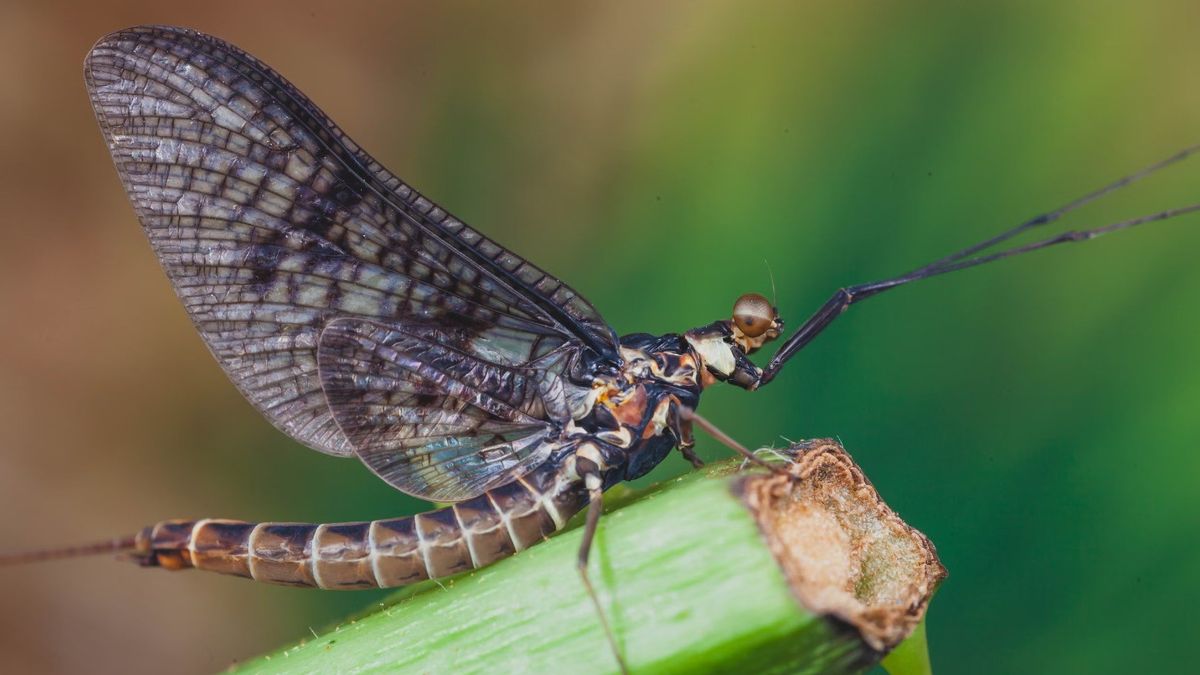


JAKARTA - Scientists have finally found out why male mayflies perform a "dance" up and down in the air. The strange movement that has long puzzled researchers has actually helped them find females in the middle of the herd.
According to a report by The Guardian, Wednesday, April 29, mayflies are among the oldest winged insects in the world. They appeared about 300 million years ago, long before dinosaurs lived on earth.
On a spring evening on the banks of the Thames, thousands of male mayflies are seen flying vertically, turning around, then gliding down with wings and tails open. The pattern is similar to the movement of a small parachute in the air.
Samuel Fabian, a researcher at Oxford University, said the mayfly had likely been performing the dance for hundreds of millions of years. However, the reason behind the behavior is only beginning to be answered.
In research published in the Journal of Experimental Biology, Fabian and a team from Imperial College London recorded a swarm of mayflies in Richmond, London, in 3D. They then analyzed the insects' flight paths.
The Guardian report said the research found that vertical flight patterns helped male mayflies distinguish between males and females. In that way, males rarely fly horizontally over the swarm, which is a characteristic of female movement.
In subsequent simulations, the researchers found that male mayflies stopped pursuing targets that fell below the horizon line.
"The problem is, the male mayfly has almost no filter," said Fabian. "You can give them a beach ball - which I think looks very different from the female mayfly - and the male mayfly will immediately approach that much larger object and try to mate with it."
This behavior is important because the life of a mayfly is very short. They only live for a few hours to a few days. In that short time, they have to mate and pass on their offspring.
However, the story of the mayfly is not just about ancient dance. Its population is now under pressure. In the world there are more than 3,000 species of mayflies that live in rivers, streams, ponds, and freshwater lakes. In England, many of the 51 species of mayflies are declining.
A global review in 2019 estimated that 40 percent of the world's insects are declining. Another study says more than 1 in 10 species could disappear by the end of this century.
The conservation group WildFish noted that limestone streams in England lost an average of 41 percent of mayfly species compared to 1998. The census was conducted in 2015-2021.
Janina Gray, Head of WildFish Science and Policy, said the mass appearance of mayflies that used to mark the start of summer has now drastically reduced in many lowland catchments.
According to him, pollution, sediment runoff, reduced river flow, and rising water temperatures damage the conditions needed for mayflies.
Other research shows that light pollution in many British rivers can kill up to 80 percent of the mayfly eggs laid on the riverbed.
Fabian encouraged Britons to enjoy the ancient spectacle while they still could. Mayflies, he said, still perform dances that may have existed since before Britain separated from the European mainland.
The English, Chinese, Japanese, Arabic, and French versions are automatically generated by the AI. So there may still be inaccuracies in translating, please always see Indonesian as our main language. (system supported by DigitalSiber.id)


