

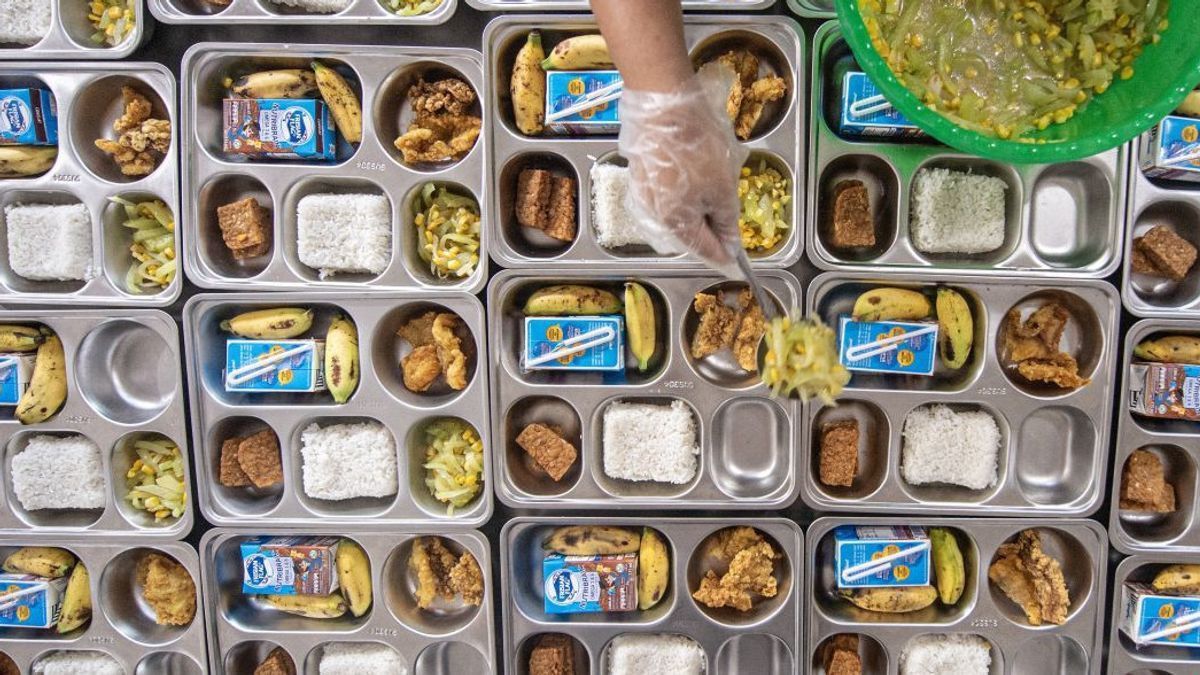


JAKARTA - The National Nutrition Agency (BGN) continues to strengthen the effectiveness of the Free Nutritious Meal (MBG) Program through the acceleration of cross-ministry data validation and integration. This step is taken to ensure that the distribution of assistance is targeted, especially for people in food-prone areas and children in the first 1,000 Days of Life (HPK) category.
Deputy Head of BGN for Operational Nutrition Fulfillment, Sony Sanjaya, revealed that his party is now partnering with four main Ministries/Institutions (K/L), namely the Ministry of Health, BKKBN, Ministry of Religion, and Ministry of Education. This collaboration aims to obtain more valid and up-to-date field data.
"We have data that is much more fixed than before. This integration ensures that the distribution of MBG targets priority groups, in accordance with the directions of President Prabowo Subianto," said Sony in Jakarta, Tuesday (28/4/2026).
Mapping of 405 Priority Areas
Based on data from the Ministry of Health, BGN has mapped 81 food-prone districts/cities, 273 districts/cities with a high number of poor people, and 304 regions with an alarming prevalence of stunting.
In total, there are 405 priority areas that will be the main focus of distribution. The validation system, which previously took 14 days manually, has now been cut to an average of 1x24 hours thanks to the integration of Dukcapil, Dapodik, DTKS, and health data in real time.
Urgency of Crisis Center and Data Transparency
Although the digital system continues to be strengthened, experts assess that the public supervision aspect remains crucial. Adidaya Institute economist, Dr. Bramastyo B. Prasetyo, emphasized that data validation must be accompanied by two main things: the Crisis Center and Data Transparency.
"The government needs to open a crisis center as a channel for public feedback. Public complaints about MBG must be absorbed to find solutions, not just at the counter," said Bramastyo.
He also urged the provision of a MBG dashboard based on real-time data that can be accessed by the general public. The information board ideally includes the cost per portion, the percentage of local raw material absorption, to nutritional indicators.
"Data is the compass of transformation. Without transparency, we don't know if this big program landed in the right place or not," he added.
PIP Data Synchronization for Accuracy
In line with this, Lina Miftahul Jannah, Public Policy Expert at the University of Indonesia (UI), suggested that BGN utilize the data of the Indonesia Smart Program (PIP). Synchronization with schools and PIP is considered effective for identifying children from poor families who most need nutritional interventions.
"Synchronizing PIP with the National Social Economic Data (DTSEN) will provide faster verification. This is the key to ensuring that programs focus on the right targets," explained Lina.
Achievement of MBG Program 2026
Until April 2026, the Free Nutritious Meal Program has reached 82.4 million recipients in 38 provinces in Indonesia. With the target of reducing inclusion and exclusion errors, Bappenas hopes that the acceleration of access to this data will become a strong foundation for the expansion of the program in the next phase.
It is hoped that with more precise validation, the target for reducing stunting and national nutrition fulfillment can be achieved faster and more accountable.
The English, Chinese, Japanese, Arabic, and French versions are automatically generated by the AI. So there may still be inaccuracies in translating, please always see Indonesian as our main language. (system supported by DigitalSiber.id)
Most Popular Tags
#Prabowo Subianto #donald trump #Febrie Adriansyah #8791 #giias 2026Popular


