

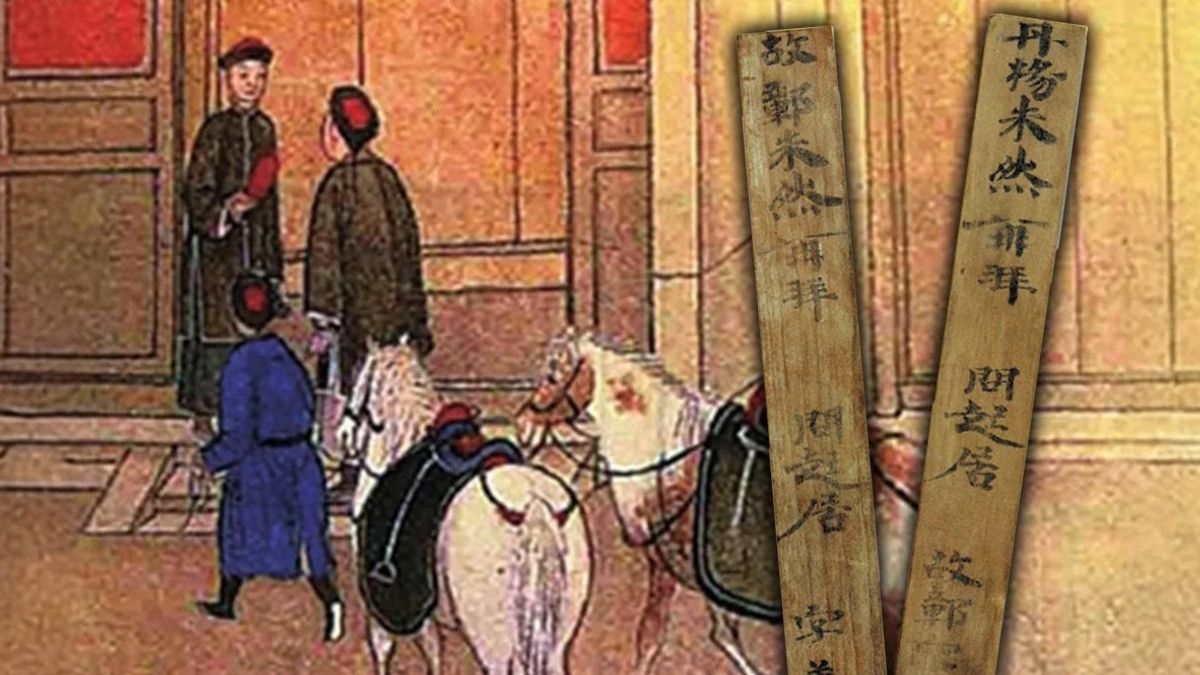


JAKARTA - Chinese New Year greetings used to not be enough to send with one tap. In ancient China, new year greetings were written on bamboo strips, delivered by servants, and even became a marker of social status.
Quoted from the South China Morning Post, Friday, April 24, the tradition of sending greeting cards in China can be traced back to the Han Dynasty, 206 BC-220 AD.
At that time, people wrote their names, ages, hometowns, positions, and self-descriptions on long bamboo or wooden bars. The bar is called ming ci. In Mandarin, ming means name, while ci means stabbing.
In the Han Dynasty, the number of ming ci a person received could indicate their social status. There were also people who put a red bag in front of the gate to receive the greeting blade. Receiving many cards was considered like receiving a blessing.
New Year greeting cards began to be commonly used in the Tang Dynasty, 618-907. At that time, Chinese New Year or the Spring Festival began to be recognized as a national holiday. Paper also began to be popular, so people no longer had to carry bamboo or wooden blades.
In Tang's time, business cards were also used by students to build relationships with teachers. The goal is to open up opportunities to get recommendations for imperial exams.
The tradition became more popular in the Song Dynasty, 960-1279, especially in the capital Bianliang. However, visiting many people in person is clearly exhausting. Then, a practical way emerged in which servants were asked to deliver greeting cards to acquaintances who lived far away.
The greeting delivered by the waiter was called "flying letter". The name is beautiful, even though his job is still a foot servant.
"Flight letters" also have classes. For important people, the servants carry a box containing gifts and greeting cards. For others, the card is simply put into a red bag in front of the house.
The content of the speech at that time was simple. One of the speeches from the poet of the Northern Song Dynasty, Qin Guan, only contained 17 characters. Of those, only two characters mean "Happy New Year".
So popular, this tradition even gave rise to tricks. In Guixin Zashi, a collection of anecdotes by Zhou Mi of the Southern Song Dynasty, it is said that Zhou's uncle wanted to send a New Year's card but had no servants. He then made the guest servant drunk and replaced the servant's employer's card with his own card.
As printing techniques evolved, greeting cards also changed. In the Ming Dynasty, 1368-1644, the New Year's greetings were written on plum-colored paper. The motif was used because it symbolized the noble and elegant character of the educated people.
The old tradition feels close today. The difference is, now the Chinese New Year greetings move through WhatsApp, Instagram, or family groups. In the past, people waited for a bamboo bar in front of the gate. Now, just wait for the notification to come in.
The English, Chinese, Japanese, Arabic, and French versions are automatically generated by the AI. So there may still be inaccuracies in translating, please always see Indonesian as our main language. (system supported by DigitalSiber.id)
Most Popular Tags
#Prabowo Subianto #donald trump #2026 World Cup #Febrie Adriansyah #8791Popular


