

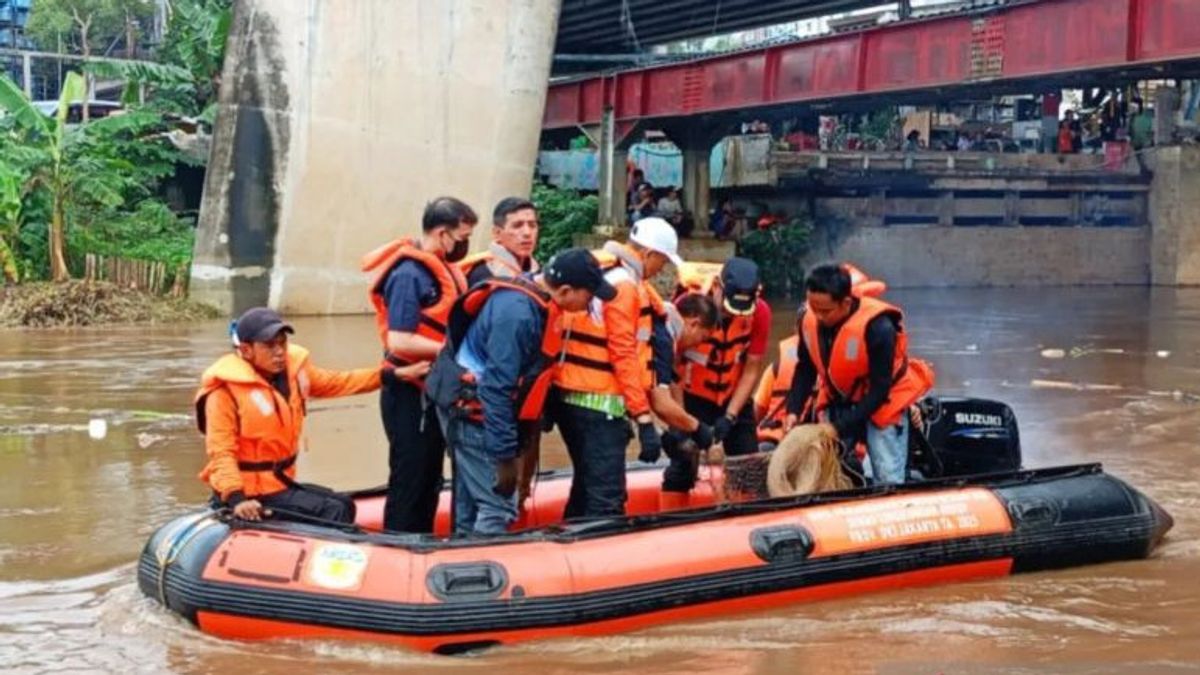


JAKARTA - Head of the DKI Jakarta Food, Maritime, and Agriculture Agency (KPKP) Hasudungan Sidabalok revealed that there was a discussion to work with local governments in the Jabodetabek buffer area to catch and eradicate sapu-sapu fish in rivers.
This is based on data showing that the sapu-sapu fish is now "dominating" the Ciliwung River, whose flow is not only in Jakarta, but also in buffer areas such as Bogor, West Java.
"Yes, in the form of discourse (will invite the buffer area to catch sapu-sapu fish," said Hasudungan in a short message, Wednesday, April 22.
However, before making an appeal to the buffer area, the DKI Provincial Government will first coordinate with the Ministry of Maritime Affairs and Fisheries (KKP) in preparing the next planning.
Considering that the implementation is based on the Minister of Forestry Regulation Number 19 of 2020 concerning the Prohibition of the Importation, Cultivation, Circulation, and Expenditure of Types of Fish that are Dangerous and/or Harmful.
"If the central government, the coverage is wider and can reach all of Indonesia," said Hasudungan.
It is known that the DKI Jakarta Provincial Government is preparing further steps to control the population of sapu-sapu fish that are increasingly dominating the capital's waters. One of them is by forming a special team from the elements of handling public infrastructure and facilities (PJLP).
DKI Jakarta Governor Pramono Anung emphasized that the handling of invasive fish would not stop at a mere ceremonial activity. The capture operation will be carried out regularly and expanded. This was revealed by Pramono when he led the simultaneous capture operation of sapu-sapu fish in five administrative cities in Jakarta.
"In particular, we will assign PPLH who are specifically tasked to reduce the dominance of sapu-sapu fish. Later, there will be a special assignment for PJLP to handle these sapu-sapu fish," said Pramono in Kelapa Gading, North Jakarta, Friday, April 17.
Pramono revealed that one of the main challenges in controlling the sapu-sapu fish is its ability to develop very quickly. In one reproduction, this fish is able to produce hundreds to thousands of eggs.
This condition makes it necessary to carry out control efforts consistently. Otherwise, the population of mop-mop fish has the potential to dominate again in a short time.
Pramono admitted that the current population of sapu-sapu fish was worrying. Based on a study by the Ministry of Marine Affairs and Fisheries (KKP), the number of sapu-sapu fish in Jakarta is estimated to have exceeded 60 percent of the total fish population in the waters.
"From the results of the investigation from the KKP, it is estimated that more than 60 percent of the fish are now in Jakarta and all of them may also be in other areas," he said.
Pramono assessed that the presence of these fish threatened the ecosystem. Its invasive nature made it difficult for local fish to survive because their eggs were eaten. In addition, the mop-mop fish is also considered dangerous if consumed. The government found that the content of residues was quite high, namely above 0.3.
The English, Chinese, Japanese, Arabic, and French versions are automatically generated by the AI. So there may still be inaccuracies in translating, please always see Indonesian as our main language. (system supported by DigitalSiber.id)
Most Popular Tags
#Prabowo Subianto #donald trump #Febrie Adriansyah #8791 #giias 2026Popular


