
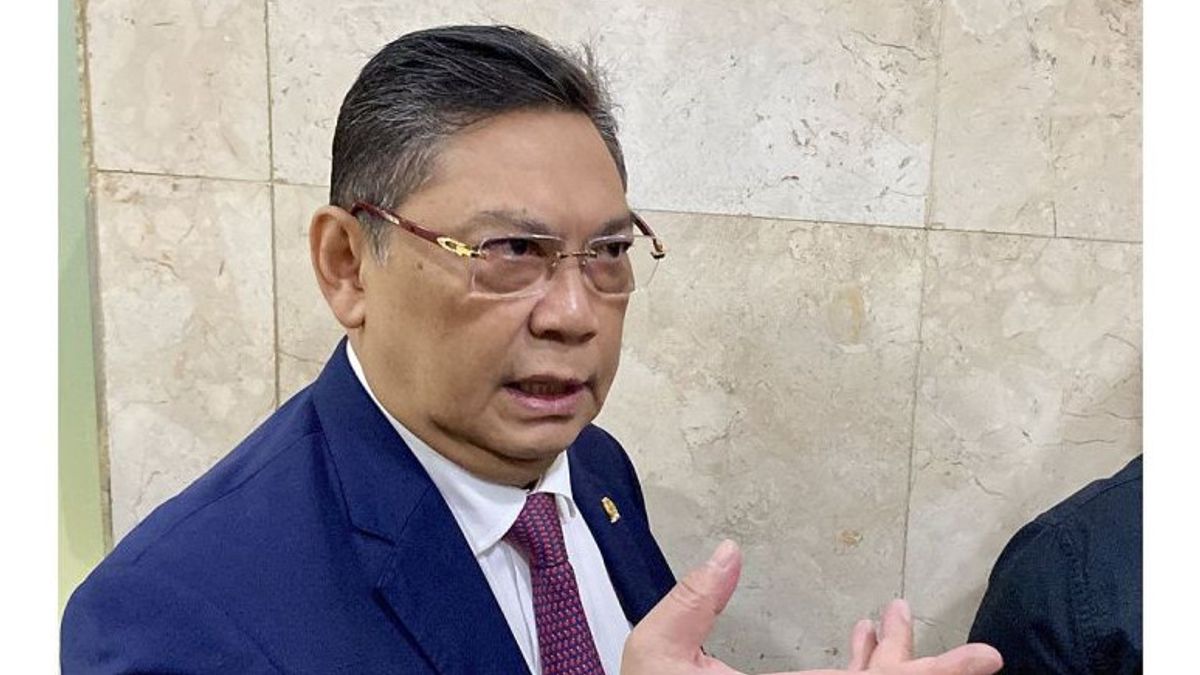


Chairman of Commission I of the Indonesian House of Representatives, Utut Adianto, proposed to the Ministry of Foreign Affairs (Kemenlu) to create a special unit to explain Indonesia's diplomatic position in the global arena.
He said Indonesia's diplomatic position is now beginning to be questioned by the international community, especially regarding Indonesia's joining the BRICS economic bloc. According to him, the question came from a delegation of German and Dutch parliamentarians who met with him.
"This unit is tasked with explaining Indonesia's position in a straightforward manner so that we are not considered as satellites or proxies of certain countries," said Utut in a statement in Jakarta, Saturday, April 18, as reported by ANTARA.
He emphasized that Indonesia's joining BRICS was purely to expand economic opportunities, not a form of political partisanship. To avoid negative perceptions, a special unit from the Ministry of Foreign Affairs could explain Indonesia's diplomatic position.
"Usually, if a country is considered to be on one pole, they are difficult to be accepted by the other party," he said.
On the other hand, he appreciated President Prabowo Subianto's economic diplomacy which succeeded in bringing investment commitments of Rp800 trillion through a series of overseas visits.
He also assessed Indonesia's strategic move to start the accession process to the Organization for Economic Co-operation and Development (OECD) in early 2025 as an effort to maintain the balance of power.
However, he admitted that there were limitations on parliament's access to high-level diplomacy.
"We don't always know the details of the President's conversations with world leaders, including with Vladimir Putin," he said.
Meanwhile, member of the House of Representatives Commission I TB Hasanuddin reminded the government to be extra careful, because the character of modern war has shifted to "total war" which involves political, economic, military and information dimensions. Indonesia, he said, has a strategic position in Southeast Asia.
"We must not appear to be leaning towards one side. Free and active politics must be carried out consistently so as not to be trapped in the rivalry of global powers," said Hasanuddin.
The English, Chinese, Japanese, Arabic, and French versions are automatically generated by the AI. So there may still be inaccuracies in translating, please always see Indonesian as our main language. (system supported by DigitalSiber.id)


