

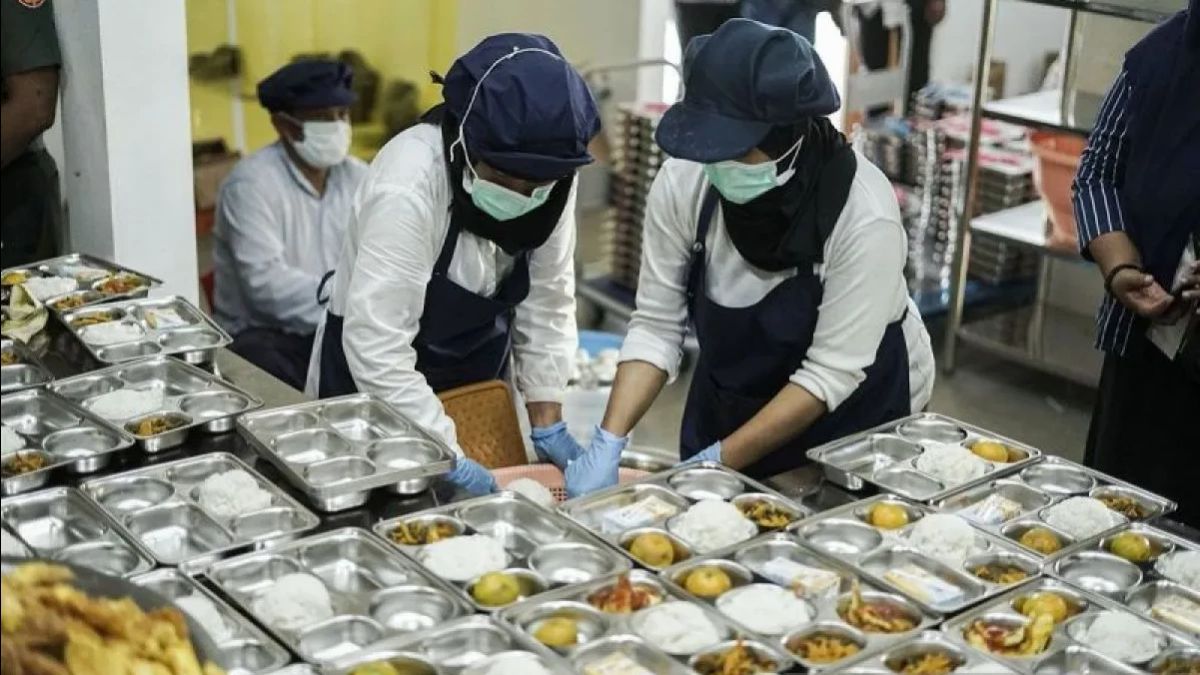


JAKARTA - The policy of the National Nutrition Agency (BGN) which provides an incentive of Rp. 6 million per day for each Nutrition Fulfillment Service Unit (SPPG) or Free Nutrition Meal (MBG) program kitchen has attracted attention.
This policy emerged after BGN previously gave the status of PPPK (ASN) to related personnel and electric motorcycle facilities for the head of the SPPG. The daily incentive scheme is said to aim to maintain the operational readiness of the kitchen with a production capacity of up to 3,000 servings per day.
However, this policy triggered criticism from the Indonesian Teachers' Union Federation (FSGI) which assessed that the fiscal burden was very large, especially since the MBG program budget was partly sourced from the education sector in the State Budget.
FSGI calculates that if one kitchen receives Rp6 million per day for 20 days of operation, the total will reach Rp120 million per month or Rp1.44 billion per year. Assuming there are 23,000 SPPG units, the budget requirement for incentives alone is said to be able to reach Rp33.12 trillion per year.
"This figure of Rp. 33.12 trillion will increase in value if the beneficiaries reach 82 million from 32,000 SPPG," said FSGI Chairman Fahriza Marta Tanjung in his statement, Monday, April 13.
FSGI compared this amount with the budget ceiling of the Ministry of Basic and Secondary Education which is in the range of Rp. 33 trillion in 2025.
"Thus, the total SPPG incentive is effectively equivalent to financing one ministry of education for a full year, which includes employee salaries, national programs, and various operational assistance for Education," said Fahriza.
In its analysis, FSGI also highlighted the potential opportunity costs of using the budget. If diverted to the education sector, the Rp33.12 trillion fund is considered to have a significant impact.
With reference to the KIP Kuliah budget of Rp. 14.9 trillion for about 1 million students, the amount is equivalent to financing about 2.2 million students.
"This means that the capacity of the program can more than double compared to the current coverage, covering the cost of UKT up to IDR 12 million per semester for certain study programs as well as monthly living assistance until graduation," explained the Chairman of the FSGI Expert Council, Retno Listyarti.
FSGI also calculated the impact if it were used for employee spending in the education sector. Assuming the average salary and allowance of teachers is Rp. 2.75 million per month or Rp. 33 million per year, the budget can finance more than 1 million educators.
"This figure is close to the national scale in the context of the distribution of teaching staff and has the potential to have a systemic impact on the quality of basic and secondary education," said Retno.
In terms of infrastructure, FSGI assessed that the funds were also equivalent to the repair of tens of thousands of schools.
"Thus, the budget of Rp. 33.12 trillion is equivalent to the improvement of about 20,300 schools, almost double the capacity of the existing annual program," said FSGI Secretary General Mansur.
FSGI assessed that the size of the incentive budget showed the consequences of policies that needed to be considered carefully, especially for the education and human resource development sectors.
"The amount of Rp. 33.12 trillion is not only significant in nominal terms, but also reflects a very large trade-off against various policy alternatives with wider social and economic impacts," he concluded.
The English, Chinese, Japanese, Arabic, and French versions are automatically generated by the AI. So there may still be inaccuracies in translating, please always see Indonesian as our main language. (system supported by DigitalSiber.id)
Most Popular Tags
#Prabowo Subianto #donald trump #firearm #8791 #giias 2026Popular


