

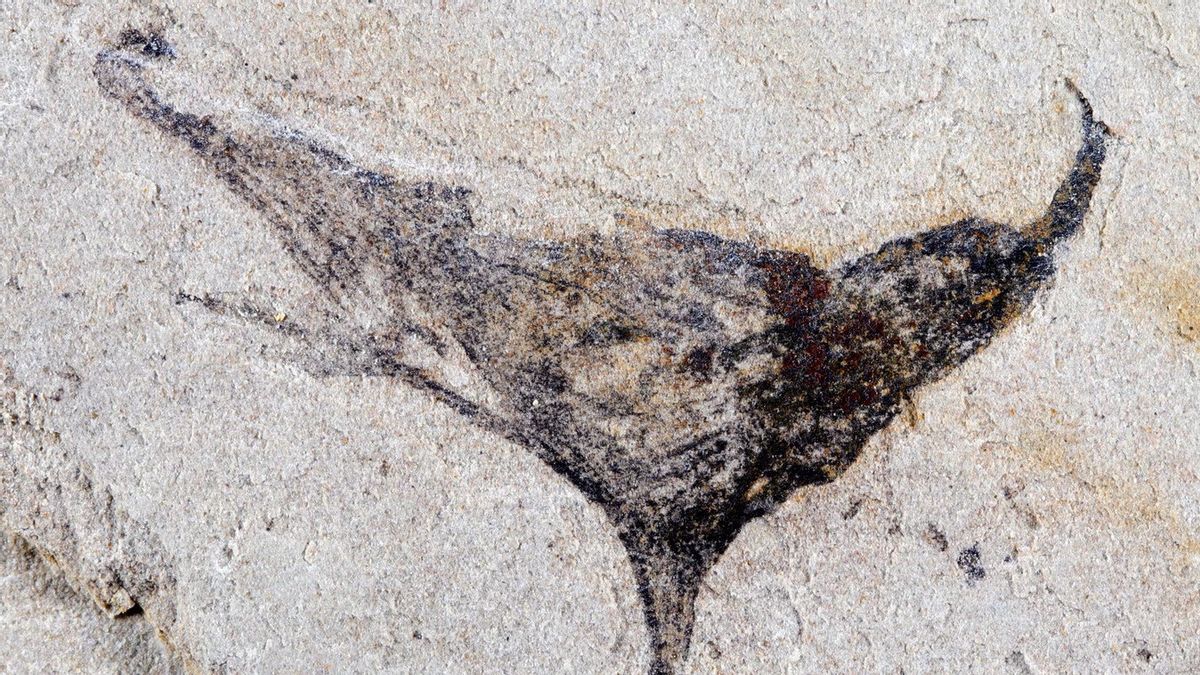


JAKARTA - The discovery of more than 700 fossils in China has provided new clues about the emergence of complex animal life on Earth. This finding suggests that the change from simple life to more complex life may have occurred around 539 million years ago, or at least four million years earlier than previously estimated.
The fossils were found in Yunnan Province, southwest China, and the results of the study were published in the journal Science. Until now, the end of the Ediacaran period was understood as the time when simple animals lived in a relatively flat marine environment. However, these new findings show a more advanced picture.
The Independent report, quoted Tuesday, April 7, said that many of the fossils found were the remains of animals that were suspected of being able to move in water, find food, and live in a more three-dimensional pattern. Such characteristics were previously believed to have only emerged in the Cambrian period, a period widely known for the explosion of complex animal life.
The author of the study from the Museum of Natural History at Oxford University, Frankie Dunn, said this finding provides an important insight into how the modern animal-dominated biosphere began to form. According to Dunn as quoted by The Independent, the change occurred very quickly in geological time.
One of the important points of this finding is the emergence of early organisms with a left and right symmetrical body. This body pattern is now possessed by almost all modern animals. Previously, scientists only found traces of it through fossil tracks, not the animal's body directly. "Now we know what made the trace, because for the first time we have the fossil," said another author, Ross Anderson, as reported by The Independent.
This finding also reinforces a long-standing debate in paleontology known as "rocks versus clocks". So far, genetic analysis has shown that the early ancestors of humans and starfish likely existed in the Ediacaran period, but fossil evidence has not been found. This new site suggests that the genetic record and the fossil record may be more in line than previously thought.
Even so, not all scientists agree. In its report The Independent also said, a number of researchers outside the study team assessed that the existing evidence was not enough to immediately call the fossils complex animals. However, many other experts consider this finding strong enough to change the way of looking at the important transition period in the history of life on Earth.
The English, Chinese, Japanese, Arabic, and French versions are automatically generated by the AI. So there may still be inaccuracies in translating, please always see Indonesian as our main language. (system supported by DigitalSiber.id)
Popular


