

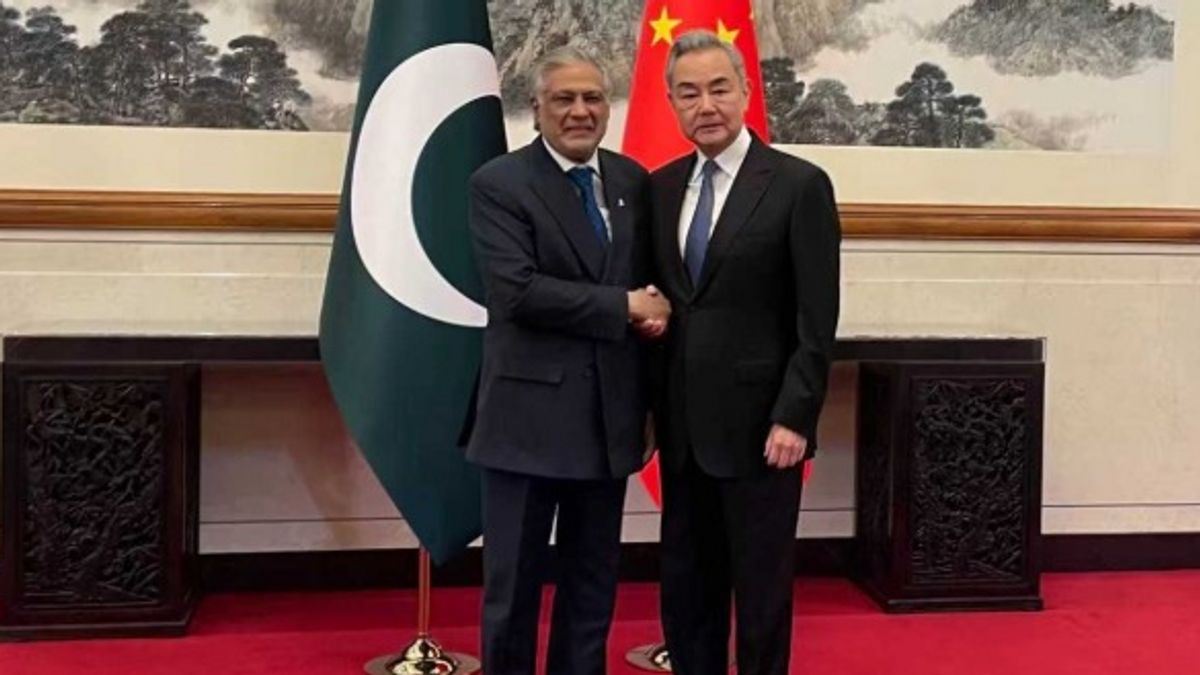


China has stepped up diplomacy in the Iran war by submitting a five-point proposal with Pakistan, embracing the Gulf countries, and rejecting a proposal at the United Nations to open the Strait of Hormuz by all means, including military force.
However, according to a Kyodo News report quoted on Monday, April 6, Beijing's moves have so far not greatly excited Washington. The administration of President Donald Trump is said to be not very enthusiastic about the opportunity for China to appear as a mediator in the midst of a heated conflict.
Director of the China Program at the Stimson Center, Sun Yun, assessed that the Iran war is now a concern for many countries, both within and outside the region. "This is an opportunity that China will not miss to show its leadership and diplomatic initiative," Sun said, quoted from Kyodo News.
A sharper tone came from former senior US diplomat Danny Russel. He assessed that Chinese diplomacy was more about building an image than producing breakthroughs. Russel compared China's five-point proposal for the Iran war with Beijing's 12-point plan for Ukraine in 2023 which, according to Russel, "was full of nonsense but was never implemented."
"What we see from China is a political message, not mediation," Russel also quoted from Kyodo News.
China rejects the notion. Still referring to the same source, Chinese Embassy spokesman in Washington, Liu Pengyu, said Beijing has worked "tirelessly for peace" since the war broke out.
On the other hand, three US officials quoted anonymously said the Trump administration was not interested in giving China a bigger stage in the Middle East. One official said Washington's position on the China-Pakistan initiative was still "agnostic", not yet supportive, but also not yet rejected.
For Beijing, a prolonged war also carries risks. Trump previously postponed a visit to China that was originally scheduled for late March. "There is no guarantee that Trump will not delay his visit to China again if the war continues to rage," said Sun.
China is temporarily considered more resistant to shocks in the Strait of Hormuz than many other countries. Its dependence on Iranian oil is only about 13 percent. Beijing has also diversified its energy sources and has large strategic oil reserves.
Even so, a long war could still hit China's interests. "An escalation of the conflict will begin to harm China's interests," said Russel. According to Russel, prolonged energy shocks and shipping disruptions will raise costs and put pressure on China's export-oriented economy.
Since the war began, Chinese Foreign Minister Wang Yi has actively contacted a number of countries, including Iran, Israel, Saudi Arabia, Russia, and the United Arab Emirates. Beijing also stressed that resolving the Strait of Hormuz issue requires a ceasefire, not additional military action.
Until now, China's proposal with Pakistan has not received a meaningful response from Washington. In the eyes of the US, the plan is still too vague to be called a road map for peace.
The English, Chinese, Japanese, Arabic, and French versions are automatically generated by the AI. So there may still be inaccuracies in translating, please always see Indonesian as our main language. (system supported by DigitalSiber.id)
Most Popular Tags
#Prabowo Subianto #donald trump #2026 World Cup #Febrie Adriansyah #8791Popular


