

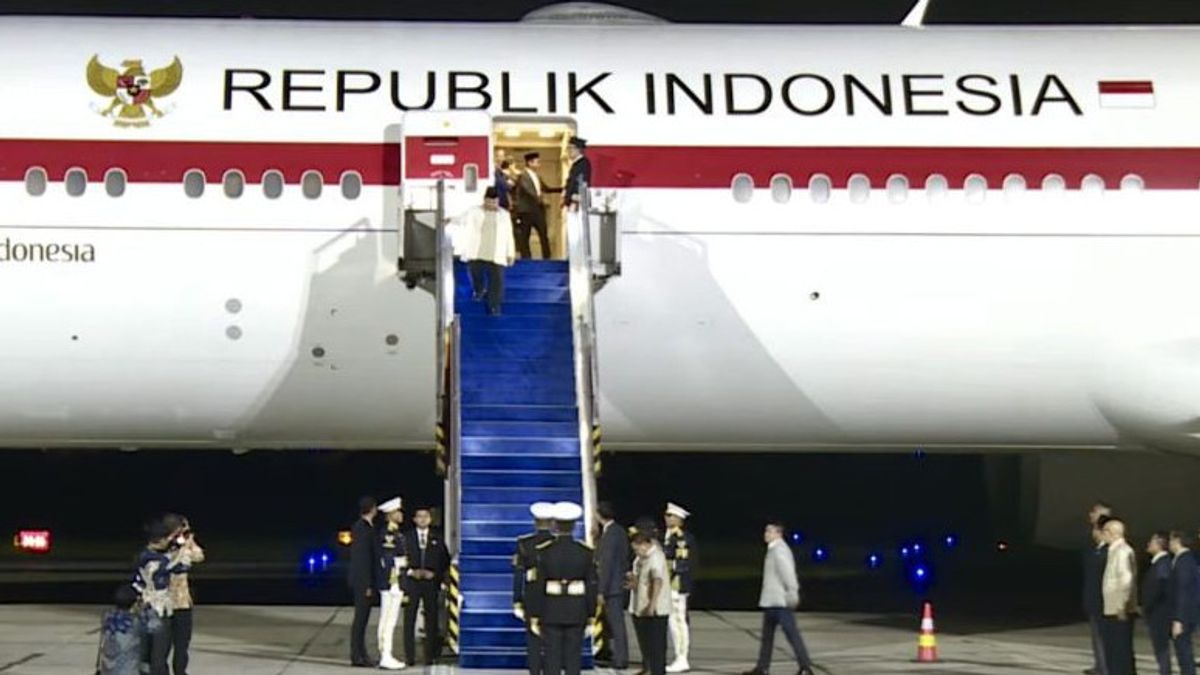


Member of the Indonesian House of Representatives from the Gerindra Faction, Azis Subekti, highlighted the visit of the President of the Republic of Indonesia, Prabowo Subianto, to Japan for four days starting from March 29 to April 1, 2026. According to him, there are journeys that are not measured by the length of the day, but by the depth of the meaning left behind.
"Four days in Tokyo, then one step further to Seoul - March 29 to April 1, 2026, is a kind of thin line that separates the old Indonesia from Indonesia which is beginning to dare to formulate itself," said Azis, Saturday, April 4.
"When Prabowo Subianto landed in Tokyo on March 29, it was not just a state visit. He was the reopening of an old relationship, which now demands a new interpretation," he added.
Azis assessed that the first meeting with Naruhito at the Imperial Palace was not just a ceremony, but a meeting with time itself, with a continuity that made Japan stand in its identity, even when the world changed too quickly. In that space, according to Azis, politics seemed to slow down, giving way to the awareness that inter-state relations are not only built by interests, but by memories that are maintained.
"From that silence, the steps continue to a more assertive space," he said.
Meanwhile, in a bilateral meeting with Japanese Prime Minister Sanae Takaichi, continued Azis, the conversation moved from symbols to substance. "Japan speaks through precision, Indonesia answers with direction. No one really raises their voice, but behind the neatly arranged sentences, there are more honest negotiations than ever before," said Azis.
"The peak is not in words, but in what is witnessed together," he added.
Azis said that as much as 23.63 billion US dollars, or around Rp380 trillion in the strategic cooperation agreement between Indonesian and Japanese business actors, was emphasized in front of the President. However, what makes it different is not only a large number, but its changing character: clean energy, electric vehicles, and future infrastructure that is no longer just building space, but building direction.
Azis assessed that the meeting with Indonesian-Japanese business circles was a reinforcement that often escaped the spotlight. There, the country is no longer standing alone; he met with actors who really drive the economy, and it is precisely at that point that it is seen: this relationship is not only maintained by diplomacy, but by interests that are beginning to be coordinated.
"Indonesia is no longer just opening the door. It is starting to determine how and for whom the door is opened," he said.
"After the entire series in Tokyo is completed on March 31, the journey continues to Seoul - and that's where the rhythm changes. If Japan is about calm precision, South Korea is about conscious acceleration," Azis added.
At the Blue House, continued Azis, President Prabowo met with Lee Jae-Myung on the morning of April 1, 2026. According to him, the meeting was not only symbolic but directly touched the core of the future of cooperation between the two countries.
"The agreement reached does not stand in one sector. It spreads: economy, defense, to artificial intelligence. Ten memorandums of understanding were signed, from comprehensive strategic dialogue, economic cooperation 2.0, critical mineral partnerships, to digital development and AI for basic health. There, technology is no longer a complement. It becomes the foundation," he said.
Clean energy cooperation, carbon capture and storage (CCS), offshore power generation industries, to intellectual property rights protection and financial partnerships all form a common thread: the future cannot be delayed. For Indonesia, according to Azis, this is not merely an expansion of cooperation. This is a step into a space that has been dominated by those who moved first.
"But in the midst of all this great architecture, there is a story that was not born from the negotiation room. About an Indonesian migrant worker, Sugianto, who in South Korea saved people from a fire disaster. He was not present in the negotiation room. He did not sign a memorandum of understanding. But in one act born from human instinct, he explained something that often escapes diplomacy: that trust never really comes from documents, but from the courage of humans to take care of each other," said Azis.
"Indonesia's relationship with Japan and South Korea, in the end, is not just alive between countries. It grows in work, in discipline, in dreams brought home by those who study and work away from home. Japan teaches consistency. Korea shows the courage to jump. Indonesia is now between the two - no longer just learning, but starting to choose directions," continued the member of Commission II of the DPR who dealt with domestic governance.
Azis added, this visit is not about what is completed on April 1, 2026 but about something that is beginning to take shape. That Indonesia is no longer enough to be a market, it must become a player.
"That Japan is not enough just to be stable, it must open up a more equal partnership space. That South Korea is not enough just to be fast, it must ensure that its speed brings sustainability. And from Tokyo to Seoul, the world can read one lesson that is not always spoken: that the partnership that lasts is not the strongest, but the one that is most capable of strengthening each other without weakening each other," he said.
"The journey may be over. But what is left is not just an agreement, but a new way of looking at each other. And that's where, slowly but surely, the future begins to be written," concluded Azis.
The English, Chinese, Japanese, Arabic, and French versions are automatically generated by the AI. So there may still be inaccuracies in translating, please always see Indonesian as our main language. (system supported by DigitalSiber.id)
Most Popular Tags
#Prabowo Subianto #donald trump #2026 World Cup #Febrie Adriansyah #8791Popular


