



JAKARTA - Escalation of the conflict in the Middle East involving the United States, Israel, and Iran has shaken the stability of global energy supply and created uncertainty in world oil prices.
As a net oil importer, as reported by Antara, Indonesia is in a vulnerable position to a price spike that has the potential to squeeze the country's fiscal space and threaten national economic stability.
Without anticipatory measures, people's purchasing power is at risk of being eroded by rising logistics costs. This condition requires a solid fiscal protection policy so that the domestic economy is not trapped in a crisis.
The current nadir of concern lies in the Strait of Hormuz, the world's energy artery that carries 20 percent of global oil trade, which is now under tight Iranian control.
This emergency situation is understood by the President of the Republic of Indonesia, Prabowo Subianto, as an opportunity to strengthen energy sovereignty. Saving is no longer an option, but rather a self-reliance effort to stand on one's own feet.
The responsive strategy formulated by the government aims to keep the pulse of the national economy beating steadily, without having to be hostage to fluctuations in energy prices on the increasingly wild international stage.
Domestic efficiency
Indonesia's big step starts with the public sector as a pioneer of the efficiency movement. This effort aims to present a real institutional example before inviting the wider community to take similar steps.
The transformation includes the implementation of a flexible work scheme for state civil servants (ASN), which is run in parallel with the strengthening of digital platforms, strict restrictions on official travel mobility, and the optimization of office building operations.
This step is not merely an emergency response, but part of the modernization of a digital-based bureaucracy to reduce physical mobility which contributes significantly to transportation fuel consumption.
The utilization of technology is now the main instrument for modernizing work governance. This allows for a reduction in the frequency of physical travel without disrupting the quality of inter-agency coordination.
In the world of education, the government also adjusted the online and offline learning methods according to the characteristics of the subjects. However, activities that are practical are still directed to take place face to face to maintain the quality of student competence.
All of these public sector savings are scheduled to start taking effect in April 2026. The main target is a consistent reduction in fuel and electricity consumption across state agencies.
This step is strengthened by the preparation of energy saving strategies in the education sector to public services. As a follow-up to the President's direction, this policy is expected to become a catalyst for national efficiency with far-reaching impacts.
The option of flexible work or work from home is being studied in depth by the government. This step is considered effective in reducing the mobility of residents who contribute to the consumption of transportation fuels.
In addition to technical aspects, strengthening the culture of energy conservation is the key to national resilience; changing consumption behavior into a noble and responsible lifestyle.
Subsidized fuel prices are maintained to remain stable as a strong social cushion, while the public is urged not to engage in hoarding or panic buying which could disrupt market stocks.
Currently, the national fuel stock is reported to be safe at the level of 21 to 25 days, and is continuously updated through regular supplies from domestic production and imports.
Diversification of energy supply
In addition to measurable efficiency, Indonesia strengthens the energy resilience structure through a diversification strategy of import sources. This step is taken strategically to mitigate the risk of dependence on a certain geopolitical region that is currently turbulent.
In an effort to strengthen the supply, some crude oil imports are now being diverted from the Middle East to the United States and open options from other partner countries such as Russia, as long as they provide competitive economic value.
This diversification tactically reduces the risk of shipping in vulnerable routes such as the Strait of Hormuz, which previously accounted for 20-25 percent of total national imports.
As a concrete form of strengthening, Indonesia has secured a commitment to energy spending worth 15 billion US dollars through trade agreements with the United States.
This strategy focuses on switching supply sources (switch) to ensure the security of the line, without having to increase the total national import volume.
The large commitment includes the procurement of processed fuel products worth 7 billion US dollars, crude oil for national reserves of 4.5 billion US dollars, and the LPG sector worth 3.5 billion US dollars. All of these transactions are carried out with consideration of very competitive market prices and are beneficial to the country's finances.
Flexibility in finding the most advantageous source of supply ensures national energy resilience is not hostage to certain regional conflicts. This effort becomes a strategic cushion so that energy sovereignty remains maintained in the midst of global dynamics.
In line with this, the government continues to strive to pursue the Energy Buffer Reserve (CPE) target for 90 days. This target is a vital instrument to provide more breathing room for the national economy in the event of a sudden global supply disruption in the future.
Energy diplomacy and accelerating the transition
National energy resilience cannot be fought alone in global isolation. For this reason, Indonesia is actively strengthening international diplomacy, especially with Indo-Pacific countries, to ensure the security of global energy shipping routes.
This regional communication is a vital instrument for mapping market risks while improving Indonesia's bargaining position in the midst of global energy dynamics.
The diplomacy also opens up opportunities for technology transfer. The country needs strategic partnerships to accelerate the development of more stable and clean alternative energy sources. A crucial pillar of this strategy is the energy transition, in which dependence on fossils is gradually reduced through the development of Renewable New Energy (EBT).
Currently, the national EBT share has only reached 15.75 percent by the end of last year. The government has set an ambitious target to increase the EBT mix to 17 percent to 21 percent by 2026.
In order to accelerate the energy transition and cut bureaucratic barriers, President Prabowo appointed Minister of Energy and Mineral Resources (ESDM) Bahlil Lahadalia as the Chairman of the National Energy Transition Acceleration Task Force (Satgas). This strategic step ensures that the implementation of clean energy policies can run much faster and more measurable.
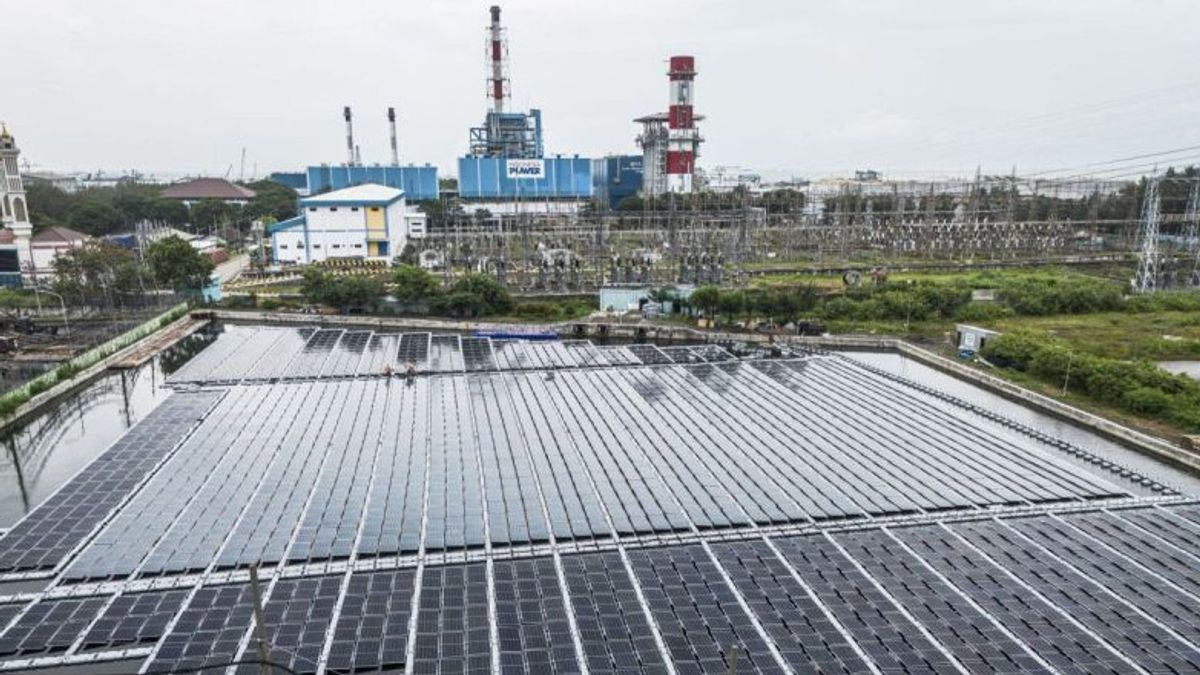
The target set is very progressive, where the Task Force focuses on pursuing clean energy implementation, including a 100 Gigawatt (GW) program for solar power plants (PLTS). The main focus is directed at accelerating the development of PLTS in schools and villages.
Indonesia stands on a "treasure" of extraordinary solar energy with a potential of up to 3,217 GW. However, the realization of its utilization is currently very minimal. Therefore, the Task Force now prioritizes large investments in green infrastructure to bridge the gap between the massive potential and the national clean energy needs.
The development of large-scale PLTS is now being accelerated, especially on remote islands as an effort by the government to level the access to clean energy to difficult-to-reach areas.
In addition, the conversion to electric vehicles and the expansion of bioenergy production, such as biodiesel and bioethanol, are priorities to reduce fossil imports that drain foreign exchange. The geothermal sector, as a "green gem" with a capacity exceeding 2.6 gigawatt, remains a key pillar of sustainable national electricity.
Meanwhile, in terms of security, one thing that must be underlined is the importance of protecting critical infrastructure. The security of the electricity and government data network must be fortified with cutting-edge cyber technology, because modern wars often begin by crippling vital national facilities.
Currently, the government is combining efficiency, diversification, diplomacy, and energy transition in a measured national orchestration.
The energy storm from the Strait of Hormuz is a test for the nation's resilience. Energy sovereignty is no longer just a jargon, but the result of tactical courage in rearranging the supply map and spurring independence.
President Prabowo's decision to be sovereign in energy confirms Indonesia's position of refusing to be dragged into global uncertainty.
The synergy between firm policies and smart community participation will be the main fuel for the revival of energy self-sufficiency towards a stronger and more resilient Indonesia.
The English, Chinese, Japanese, Arabic, and French versions are automatically generated by the AI. So there may still be inaccuracies in translating, please always see Indonesian as our main language. (system supported by DigitalSiber.id)
Most Popular Tags
#Prabowo Subianto #donald trump #2026 World Cup #Febrie Adriansyah #8791Popular


