

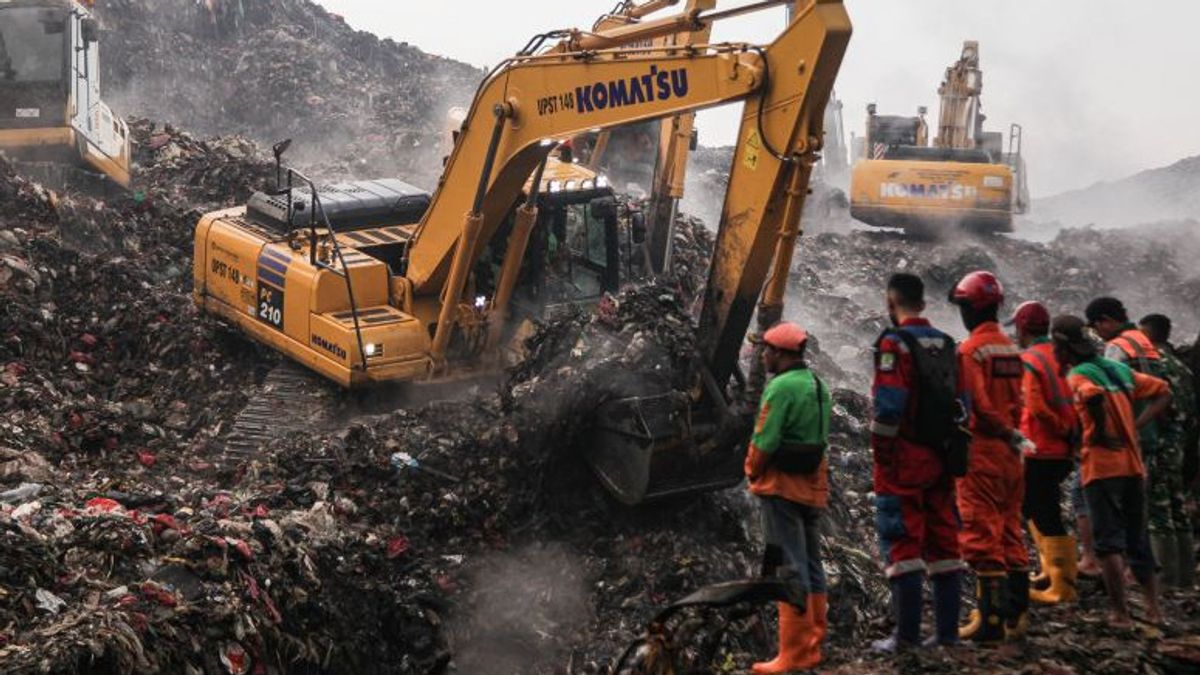


Member of Commission XII of the House of Representatives, Elpisina, asked the government to immediately carry out a total reform of the national waste management, following the tragedy of the landslide of the garbage pile at the Bantargebang Final Processing Site (TPA) which caused four people to die.
He assessed that this heartbreaking event showed that waste management in Indonesia had entered an emergency status.
"We also mourn the death of the four victims in Bantargebang. This incident is a sign that our waste problem is already an emergency. The government must move quickly to carry out comprehensive governance reforms so that similar tragedies do not continue to happen," Elpisina told reporters, Monday, March 9.
Elpisina emphasized that extreme dependence on the waste accumulation system at the landfill without adequate processing has created a time bomb that threatens people's lives. According to him, the traditional pattern of 'collect-transport-dispose' must be immediately abandoned and replaced with a modern processing system from upstream to downstream.
"As large as the landfill is, if the management is still based on traditional methods, it will definitely be full one day," he said.
The PKB legislator also highlighted the data of the National Waste Management Information System (SIPSN) which showed that the volume of waste reached 25.1 million tons per year. Unfortunately, said Elpisina, about 63.97 percent of its management still depends on the open dumping or open dumping system.
He assessed that this system is very risky because it creates a pile of unstable and prone to landslides, as well as polluting groundwater through toxic liquid waste.
"In addition to endangering human safety, poor governance threatens public health around the landfill through groundwater pollution. The accumulation of large-scale waste without adequate processing is no longer relevant and very dangerous," he said.
Elpisina also assessed that the implementation of Law Number 18 of 2008 concerning Waste Management, is still far from optimal. He criticized the limitations of modern waste processing facilities at the regional level which are not commensurate with the rapid increase in daily waste volume.
"The government and local governments must strengthen coordination. Implementation of rules should not only be on paper. We need to strengthen the sorting, recycling, and construction of advanced waste treatment infrastructure so that the burden on landfills is drastically reduced," said Elpisina.
He also emphasized that this reform cannot be delayed any longer. According to him, the safety of residents and environmental sustainability must be the top priority above merely moving garbage from the city to the landfill.
"The state must ensure that the waste management system no longer threatens life," concluded Elpisina.
The English, Chinese, Japanese, Arabic, and French versions are automatically generated by the AI. So there may still be inaccuracies in translating, please always see Indonesian as our main language. (system supported by DigitalSiber.id)
Most Popular Tags
#Prabowo Subianto #donald trump #2026 World Cup #Febrie Adriansyah #8791Popular


