

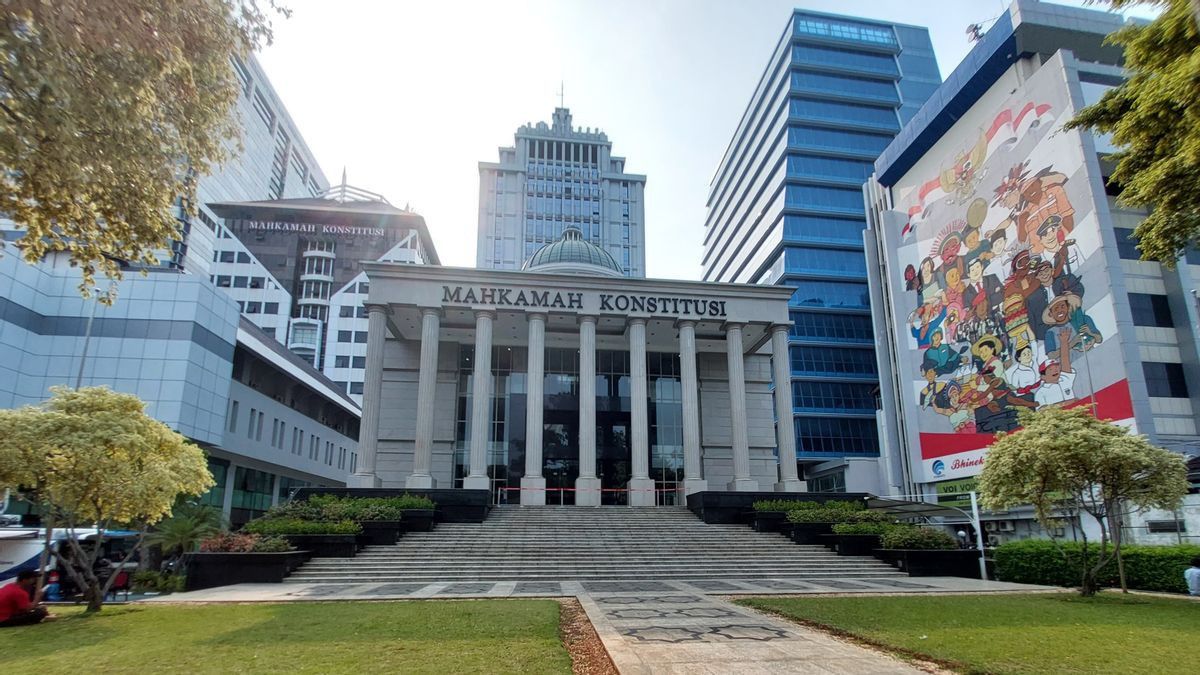


JAKARTA - The Constitutional Court (MK) again stated that it could not accept the material test related to the parliamentary threshold in Law Number 7 of 2017 concerning General Elections because the application submitted was premature.
The prematureness was because the mandate of the Constitutional Court's decision in the previous material test application which ordered the formation of a law to re-regulate the parliamentary threshold had not been implemented.
"Declaring application number 37/PUU-XXIV/2026 inadmissible," said Chief Justice Suhartoyo reading the ruling, reported by ANTARA, Monday, March 2.
This application was filed by the Electoral and Democratic Watch (KPD). The applicant tested Article 414 paragraph (1) of the Election Law regarding the parliamentary threshold which had previously been interpreted by the Constitutional Court in the decision number 116/PUU-XXI/2023.
Deputy Chairman of the Constitutional Court Saldi Isra explained that when this application was submitted, the DPR and the government had still not made changes to Article 414 paragraph (1) of the Election Law, as mandated by the previous decision.
Therefore, according to the Court, as long as the law-maker is still in the process of carrying out its constitutional obligation to revise the norm of the article, in fact the testing space for Article 414 paragraph (1) of the Election Law has not yet opened.
"Application number 37/PUU-XXIV/2026 is premature," said Saldi.
Article 414 paragraph (1) of the Election Law stipulates that political parties must meet the threshold of obtaining at least 4 percent of the national valid votes to be included in determining seats in parliament.
Then, the Constitutional Court's decision number 116/PUU-XXI/2023 stated that Article 414 paragraph (1) of the Constitutional Electoral Law for the 2024 DPR Election and conditionally constitutional to be applied in the 2029 DPR Election and subsequent elections as long as changes have been made to the norm and the amount of the parliamentary threshold.
This means that the Court ordered the law-makers to change the parliamentary threshold before the 2029 DPR member elections.
However, the KPD considers that the Constitutional Court's ruling still opens up room for diverse interpretations because it does not clearly establish the maximum limit of the constitutional parliamentary threshold.
The absence of a maximum limit, according to the applicant, creates legal uncertainty because the law-maker has a very loose space to raise the threshold without clear constitutional parameter signs.
Therefore, in his petition, KPD asked the Constitutional Court to determine the exact threshold for parliament as a continuation of the decision number 116/PUU-XXI/2023.
"We are here asking for the equilibrium point (the balance of the parliamentary threshold) to be between 1.5 to 2.5 percent," said KPD Chairman Miftahol Arifin when met after submitting the application at the Constitutional Court building, Jakarta, Wednesday (21/1).
Before the KPD, the Constitutional Court also could not accept the petition for a test of the threshold limit of parliament submitted by the Labor Party. The reason was the same, namely the petition was considered premature by the Court.
The English, Chinese, Japanese, Arabic, and French versions are automatically generated by the AI. So there may still be inaccuracies in translating, please always see Indonesian as our main language. (system supported by DigitalSiber.id)
Most Popular Tags
#Prabowo Subianto #donald trump #Febrie Adriansyah #8791 #giias 2026Popular


