

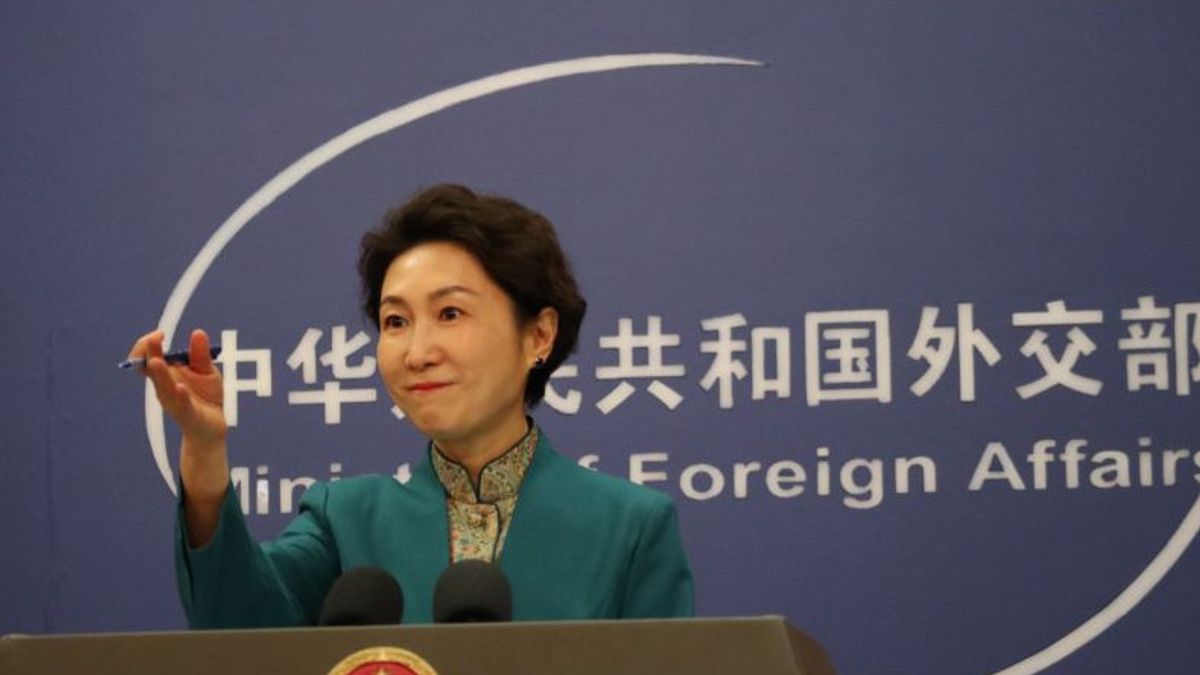


JAKARTA - The Chinese Foreign Ministry explained that the implementation of an export ban on 20 Japanese entities and 20 others on the watch list was to prevent the country from having nuclear weapons and remilitarizing.
"The goal is to stop Japan's efforts to remilitarize and have nuclear weapons. What China is doing is completely legitimate, justified, and legal," said Chinese Foreign Ministry spokesman Mao Ning in Beijing, Tuesday, February 24, reported by ANTARA.
China on Tuesday (24/2) banned the export of dual-use goods to 20 Japanese defense-related entities, triggering protests from Tokyo.
China's Ministry of Commerce said any related activities currently underway must "immediately be stopped," adding that overseas organizations and individuals were prohibited from exporting dual-use goods originating in China to the 20 entities at once, claiming they were "involved in improving Japan's military capabilities."
"This is done to protect national security and interests and to fulfill international obligations such as nuclear non-proliferation, China takes these steps in accordance with laws and regulations," said Mao Ning.
The products, which can be used for both civilian and military applications, could include rare earths that are essential for the manufacture of high-tech products ranging from electric vehicles to weapons. China dominates the global supply of the minerals.
Subsidiaries of Mitsubishi Heavy Industries Ltd. and Kawasaki Heavy Industries Ltd., are included in the newly added entities.
In addition, the Chinese Ministry of Commerce also released a list of export monitoring that was just added to the list, including 20 Japanese companies and organizations, such as Subaru Corp., TDK Corp., and Hino Motors Ltd.
The ministry stated that the end-users and the end-use purpose of the dual-use goods sent to them could not be verified.
Beijing will implement stricter screening of dual-use goods exports to these entities, he added.
In addition to companies, the Japan National Defense Academy and the Japan Aerospace Exploration Agency are also listed on the list of prohibited exports of dual-use goods, while the monitoring list includes the Tokyo Institute of Science.
The latest measures follow China's January 6 move to tighten dual-use goods exports to Japan. At the time, Beijing did not reveal specific entities that would control their shipments.
The ministry explained that the measures introduced on Tuesday aimed to curb Japan's "remilitarization" and nuclear ambitions, and defended the measures as "fully justified, reasonable, and legitimate."
It is stated that only a small number of Japanese entities are the targets of these new measures, and then "normal economic and trade exchanges" between the two Asian countries will not be affected in the future.
"Japanese entities acting in good faith and in compliance with the law need not worry at all," the ministry said.
The diplomatic dispute began with Prime Minister Takaichi's statement in parliament in November that hinted at an attack on Taiwan, an island claimed by China, could trigger a response from Japanese defense forces.
Beijing has stepped up economic pressure on Tokyo and expressed caution over the policies of Takaichi, a hardline security hawk, who could boost Japan's defense capabilities and accelerate debate on amendments to Japan's post-war pacifist Constitution.
Japan has lodged a protest against China's actions and Japan's Deputy Chief Cabinet Secretary Kei Sato called China's move "absolutely unacceptable and deeply regrettable."
The English, Chinese, Japanese, Arabic, and French versions are automatically generated by the AI. So there may still be inaccuracies in translating, please always see Indonesian as our main language. (system supported by DigitalSiber.id)
Most Popular Tags
#Prabowo Subianto #donald trump #Febrie Adriansyah #8791 #giias 2026Popular


