

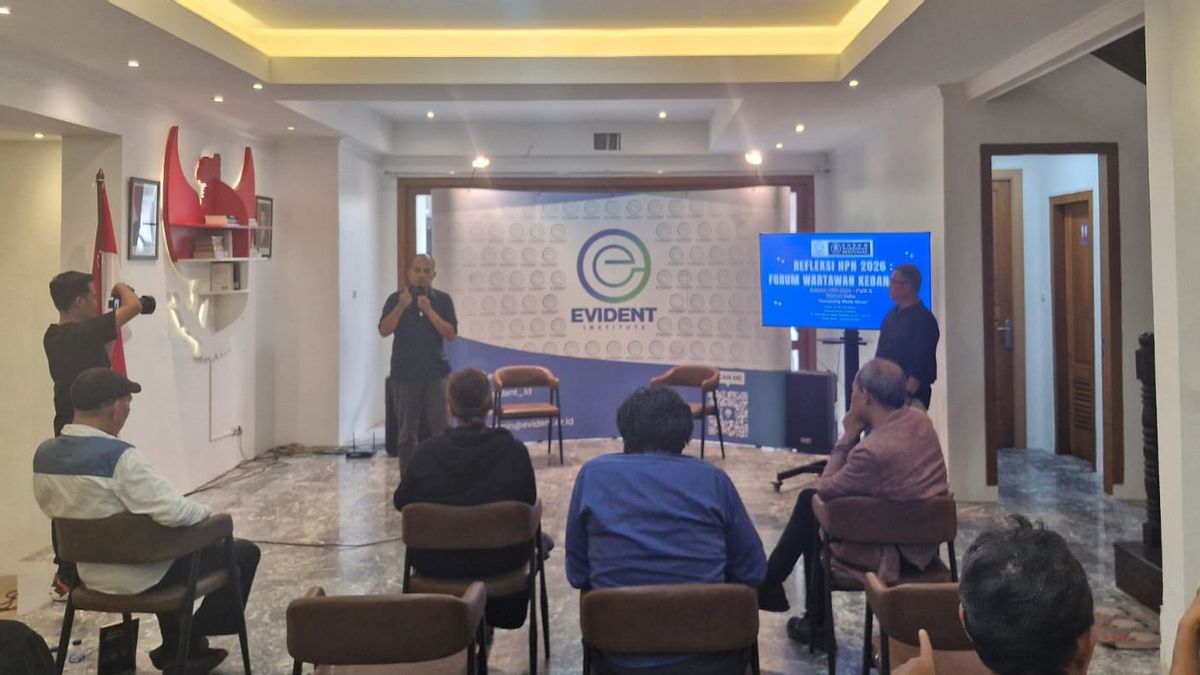


JAKARTA - The national news TV industry is considered to be "withering" in the midst of digital disruption, but some management is stuck in a contradictory attitude, namely considering the global platform to be a business destroyer, then utilizing it without a clear strategy. The criticism was delivered by Taufan Hariyadi during a book surgery that he wrote entitled Connecting Mass Media at the Evident Institute, Tebet, Jakarta, in commemoration of National Press Day by the National Journalists Forum, Friday (13/2).
According to Taufan, the pressure comes in layers: disruption of global platforms, erosion of advertising revenue, shrinking TV audiences at home, changes in the way audiences access news, to floods of false information. This situation forces news TV to rethink its role - not just repeating the old pattern that is "increasingly obsolete".
He emphasized that news TV can no longer rely on "its own" technology to collect, produce, and publish. Conventional TV is sticky, making the audience passive, while global digital platforms that are spreadable make the audience active - even encouraging the audience to become a spreader.
The problem, he said, "in the midst of the increasingly closed face of the national TV news industry, top management considers global platforms as business destroyers. Then suddenly use various global platforms as they please. "In fact, the platform has become the public's first gateway to consuming information.
Taufan, who is also still a producer at TV One, said the idea for the book came from research since 2019 about convergence at the place where he worked. His findings are that convergence often stops as a "new channel", instead of changing into a work culture. "At that time, convergence was still half-hearted," he said, assessing that new media continues to trigger social changes that hit the comfort of the TV news business.
He then offered the concept of newskestraroom - a newsroom that pursues the harmony of news, not only the content and packaging, but also the delivery until it reaches the public's hands. Conventional newsrooms, said Taufan, are too dependent on one medium, while newskestraroom presents many platforms as distribution channels for news products.
Taufan outlined three key changes. First, news TV is no longer determined by who holds the camera, but by who can make the public care, "editing the shared reality" and disseminating it. At this point, he places conventional media as a second screen as well as a validation instrument - which means TV is no longer the main screen of the audience and "advertising revenue will decline."
Second, the editorial team must produce multi-content for multi-platforms, with a global platform as the first screen of the publication, but still bring the typical curation of journalists so that content can be spreadable and create media engagement. Third, TV news is asked to open collaboration with the audience who hold the first source of information, making the platform screen a content showcase for the audience before going to the TV screen which is stickiness.
Within that framework, Taufan closes with one shift he considers inevitable: when breaking news first appears in the hands of an audience, news TV must be ready to be present on the "first screen" of a global platform - or be prepared to be abandoned by an audience that has moved first.
The English, Chinese, Japanese, Arabic, and French versions are automatically generated by the AI. So there may still be inaccuracies in translating, please always see Indonesian as our main language. (system supported by DigitalSiber.id)


