

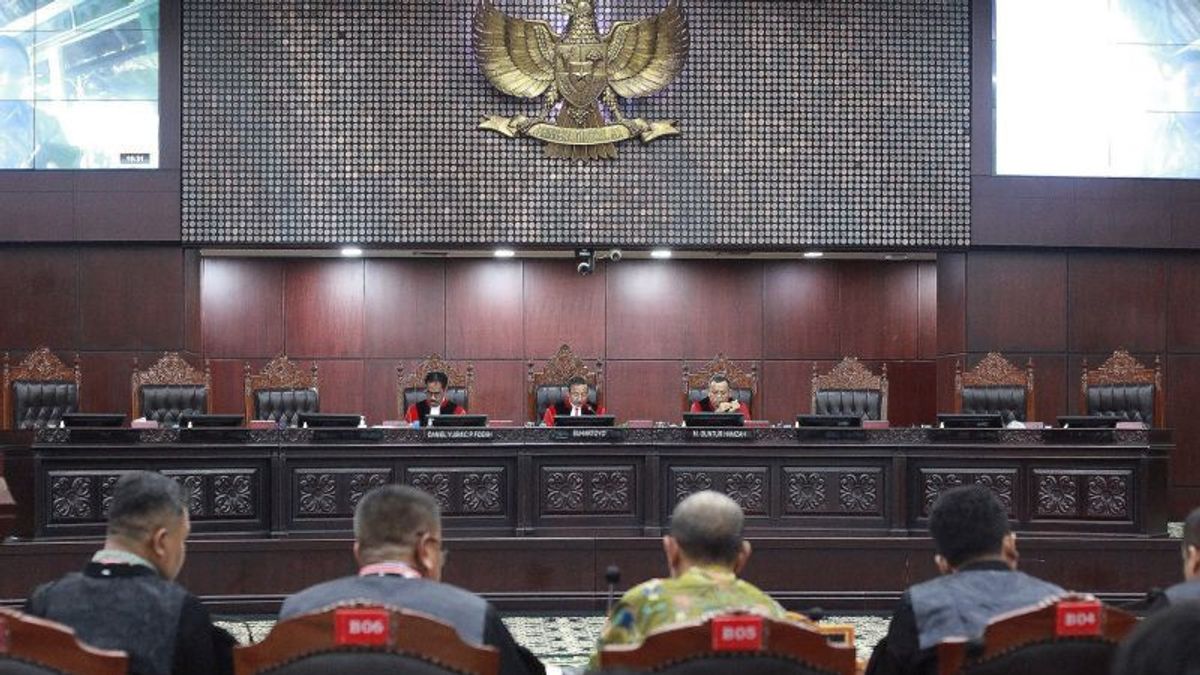


JAKARTA - Nine students from the Faculty of Law at Universitas Terbuka tested Articles 240 and 241 of the Criminal Code (KUHP) to the Constitutional Court (MK) because they considered the limits between criticism and insulting the government still unclear.
Articles 240 and 241 of the Criminal Code regulate the criminal threat for acts of insulting the government or state institutions. These two articles are considered to have the potential to hinder the freedom of expression of citizens.
"The ambiguity of the boundaries between legitimate criticism and insults makes the public vulnerable to the subjective interpretation of law enforcement officials," said the lawyer for the applicants, Priskila Octaviani, in a preliminary hearing in Jakarta, Wednesday, January 14, reported by ANTARA.
According to the applicants, Articles 240 and 241 of the Criminal Code do not have clear, objective, and measurable limits. This ambiguity is said to cause citizens to be unable to rationally predict whether their criticism or opinion can be criminalized.
The definition of insulting, said Priskila, is associated with the honor or image of the government which is abstract and subjective. This condition is considered to open up room for criminalization of public criticism so that it has the potential to revive the "rubber article".
Because it is not accompanied by clear parameters, the applicants infer that both articles can cause fear for citizens in expressing their opinions.
"In fact, restrictions on freedom of expression can only be justified if there is a clear and present danger (real and actual threat) to public order," said Priskila.
In addition, according to the applicants, the applicability of Articles 240 and 241 of the Criminal Code also has the potential to limit the flow of political information and communication which should be open in a democratic rule of law.
They view that criminal threats against the delivery of information that is considered insulting to the government or state institutions can hinder the public oversight function of state administration.
On the other hand, the law students tested the two articles were not in line with the mandate of the Constitutional Court's decision No. 6/PUU-V/2007. In the decision, the Court stated that Articles 154 and 155 of the old Criminal Code were unconstitutional.
Article 154 and Article 155 of the old Criminal Code regulate the criminal threat against activities of conveying feelings of hostility, hatred, or contempt against the government.
At that time, the Constitutional Court decided that the two articles in question were contrary to the constitution because they did not guarantee legal certainty, which in turn hindered the freedom to express thoughts, attitudes, and opinions.
According to the applicants, although Articles 240 and 241 of the Criminal Code only include the element of "causing riots in society", the element is considered abstract and without objective criteria so that it still opens up room for prosecution of expressions.
"Thus, the a quo norm (the article) has not fully been in line with the ratio decidendi (legal considerations) of Decision Number 6/PUU-V/2007 and still raises legal uncertainty," he said.
Therefore, the applicants in their petitum asked the Constitutional Court to declare that Articles 240 and 241 of the New Criminal Code are contrary to the Constitution of the Republic of Indonesia in 1945 and do not have binding legal force.
This application is recorded with case number 282/PUU-XXIII/2025. The applicants, among others, are Tania Iskandar, Sila Fide Novira Nggebu, Muhammad Restu, Yuni Wulan Ningsih, Ika Minawati, Putra Muhamad Fadilla, Tasya Ayu Hapsari, Mawar Prasiska Nur Rizki, and Riesa Zhafirah.
The English, Chinese, Japanese, Arabic, and French versions are automatically generated by the AI. So there may still be inaccuracies in translating, please always see Indonesian as our main language. (system supported by DigitalSiber.id)
Popular


