

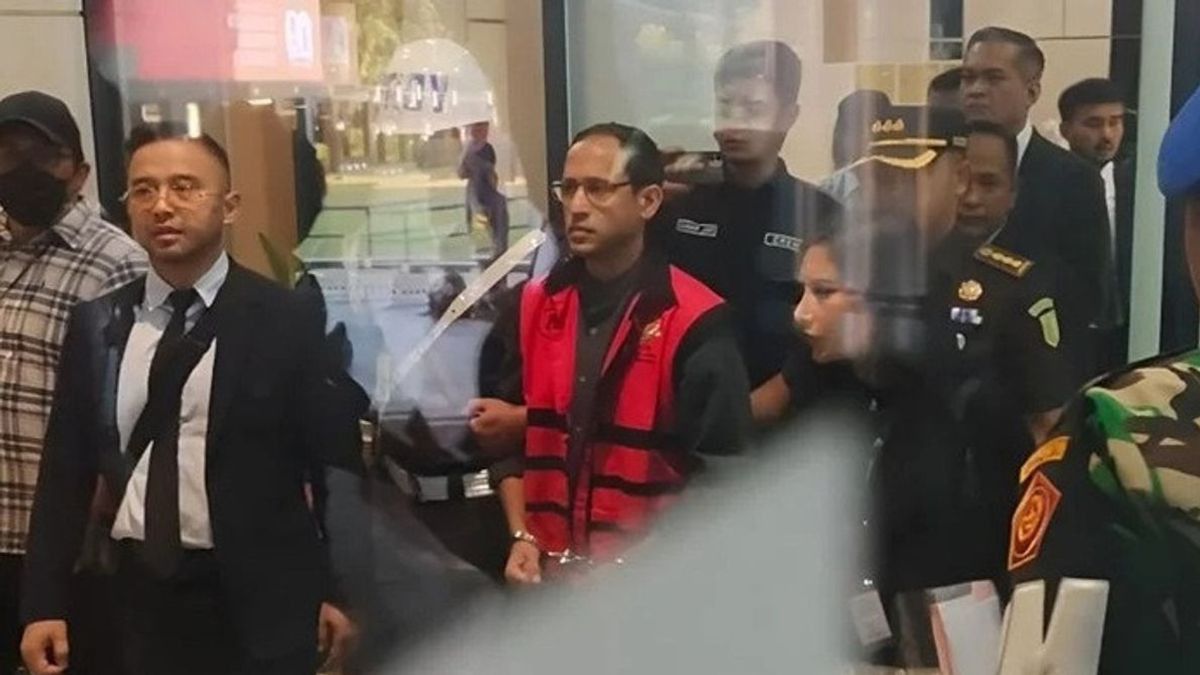


JAKARTA - Indonesian Audit Watch (IAW) assessed that the claim of former Education Minister Nadiem Makarim who stated that he did not receive a penny in the Chromebook procurement case had the potential to mislead the public and was part of a defense strategy in the trial.
The Founding Secretary of IAW, Iskandar Sitorus, said the statement was delivered as a direct rebuttal to the public prosecutor's accusation that there was a value of Rp809 billion in the alleged corruption case for the procurement of educational technology devices.
According to Iskandar, the public needs to understand that the case of the procurement of Chromebooks worth Rp17.42 trillion cannot be seen as a conventional crime which is always marked by the transfer of cash directly.
He explained that the pattern of corruption today often takes place through complex economic policies and schemes, so that perpetrators do not have to receive money physically or through personal accounts.
"Modern-day crime is no longer whispering. It hides behind seemingly modern policies, tempting technology, and invisible streams of profit," said Iskandar, Tuesday, January 13.
IAW assessed that focusing solely on the search for funds into personal accounts is risky to obscure the substance of the case. This approach, said Iskandar, could actually make the alleged abuse of authority escape from proof.
He highlighted Nadiem's role before serving as a minister, when the person in question was said to have succeeded in convincing the technology company Google to invest hundreds of millions of dollars. Topics about the future of digital then continued in a number of meetings with representatives of Google Asia Pacific.
According to IAW, the realization of the procurement project was carried out when Nadiem served as Minister of Education. The project is considered locked in one technology ecosystem, namely Google's Chrome OS and Chrome Device Management.
This condition, continued Iskandar, raises the suspicion of potential conflicts of interest and should be tested, especially related to the decision-making process and the possibility of other alternative systems that are more open and economical.
IAW emphasized that the articles applied by the prosecutor, namely Article 2 and Article 3 of the Corruption Crime Law, do not focus on the acceptance of money, but on unlawful acts and abuse of authority that result in financial losses to the state.
Based on the Financial Audit Report, there were indications of unreasonable prices, unused assets, and locked technical specifications. From these findings, the prosecutor submitted an estimate of state losses of IDR 2.18 trillion.
Iskandar assessed that the rejection of the panel of judges against the defendant's objection was a signal that the prosecutor's indictment had a sufficiently strong legal basis to be further tested at trial.
Regarding the figure of Rp809.59 billion proposed by the prosecutor, IAW said that the value was not money transferred to a personal account, but a legal construction to measure the economic benefits allegedly enjoyed by the corporation affiliated with the defendant.
The economic benefits, according to IAW, can take the form of increased asset values, commercial rights, and long-term royalty flows received by entities in related technology company networks.
IAW encourages the panel of judges to investigate the parties who proposed the project, the arguments in the decision-making process, and the communication between ministry officials and the private sector before and after taking office.
"Current corruption is a high-level chess game. It hides behind the jargon of innovation, digitization, and efficiency," said Iskandar.
The English, Chinese, Japanese, Arabic, and French versions are automatically generated by the AI. So there may still be inaccuracies in translating, please always see Indonesian as our main language. (system supported by DigitalSiber.id)
Most Popular Tags
#Prabowo Subianto #donald trump #Febrie Adriansyah #8791 #giias 2026Popular


