
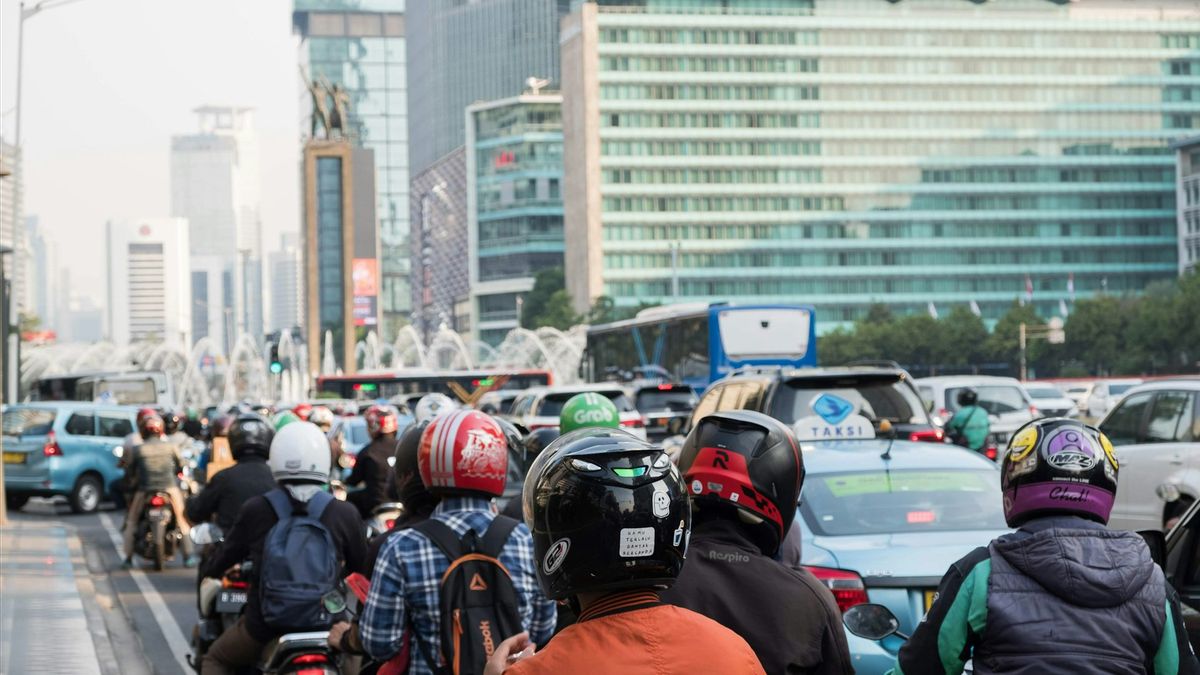


JAKARTA - The latest report by the United Nations (UN) on the prospects for urbanization states that Jakarta ranks as the largest city in the world with a population of 41.9 million, followed by Dhaka, while Tokyo drops to third place.
The Japanese News Agency, Kyodo, Thursday, January 1, quoting a UN report, reported that the growth of the population of the Japanese capital was slower than that of Jakarta and Dhaka.
As a result, Tokyo's ranking as one of the world's most populous cities fell from first place in 2000 to third in 2025, according to a UN report that uses a special assessment method to facilitate international comparisons.
In the future, the number of residents in Tokyo's urban areas is expected to shrink from 33.4 million in 2025 to 30.7 million in 2050. With this decline, Tokyo is projected to fall to seventh place.
Meanwhile, Dhaka is expected to become the largest city in the world with 52.1 million inhabitants, followed by Jakarta, Shanghai, New Delhi, Karachi, and Cairo.
Referring to the UN report, the term "city" is defined as any agglomeration of geographical areas that are adjacent to a minimum density of 1,500 inhabitants per square kilometer and a total population of at least 50,000.
Based on the methodology used by the United Nations Department of Economic and Social Affairs (DESA), the calculation for Tokyo only includes urban areas, including urban areas in neighboring prefectures such as Saitama, Chiba, and Kanagawa. Meanwhile, the official population of the Tokyo administrative area is around 14 million people.
The estimation of the population is aimed at providing data for policymakers and researchers in designing the future of cities, where the ability to manage urban growth sustainably is considered important, not only for urban residents but also for global progress in achieving climate targets.
The report notes that the world is increasingly urbanized with cities now home to about 45 percent of the world's total 8.2 billion people. The current number has more than doubled its proportion in 1950.
In addition, about two-thirds of the world's population growth between 2025 and 2050 is projected to occur in urban areas, while most of the rest is in small cities.
However, in the coming decades, more and more countries are expected to experience a significant decline in urban population by 2050. The United Nations says Japan and China are among them, mainly due to the continued low birth rate and overall population decline.
Tokyo and Seoul are the only cities among the world's 10 largest cities by 2025 that are expected to experience a population decline by the middle of the century, according to the report.
The English, Chinese, Japanese, Arabic, and French versions are automatically generated by the AI. So there may still be inaccuracies in translating, please always see Indonesian as our main language. (system supported by DigitalSiber.id)
Most Popular Tags
#Prabowo Subianto #donald trump #firearm #8791 #giias 2026Popular


