

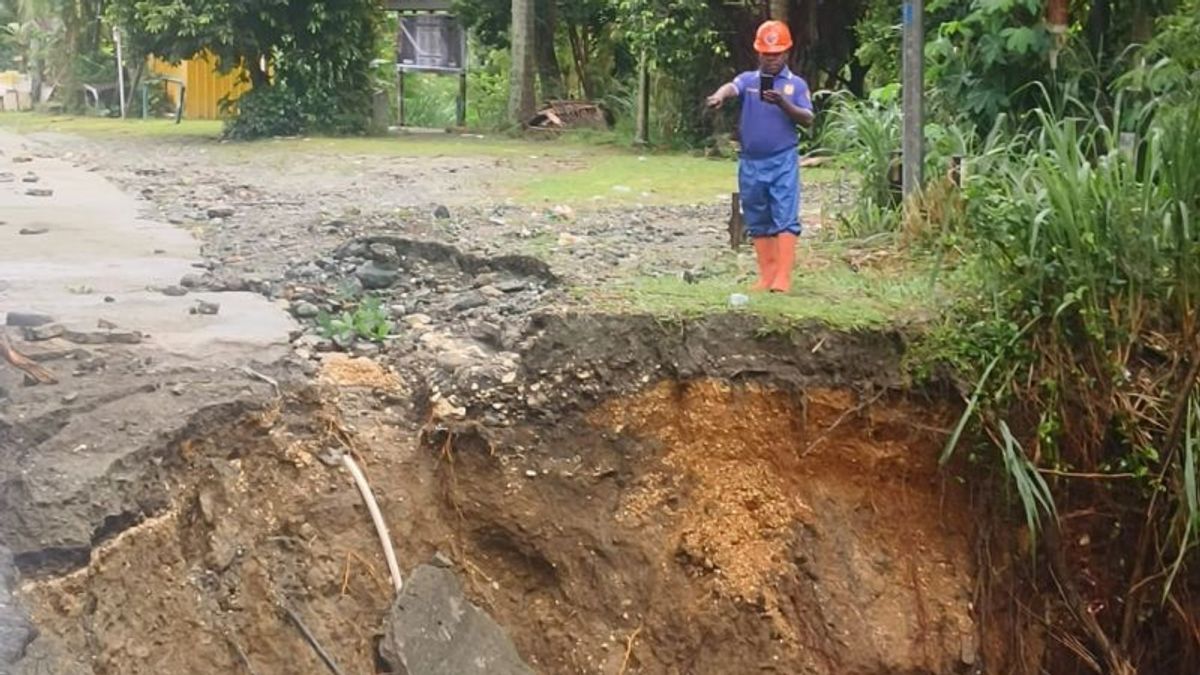


JAKARTA - The Meteorology, Climatology and Geophysics Agency (BMKG) has asked local governments (pemerda) to respond quickly to potential hydrometeorological disasters, such as floods, landslides, and strong winds.
Head of BMKG Teuku Faisal Fathani said that the potential for hydrometeorological disasters still overshadows a number of regions in Indonesia as the dynamics of extreme weather increase, so that in these conditions the early warning weather issued by BMKG becomes an important instrument to help local governments and the community anticipate risks early.
"BMKG routinely monitors the development of weather systems, including the potential for heavy to extreme rain, strong winds, high waves, and increased risk of flooding and landslides in various regions, then conveyed to stakeholders at the center and the region," he said in a statement received in Jayapura, Thursday, quoted by Antara.
According to Faisal, a number of local governments have shown good readiness to minimize the risk for the community, one example is the Tangerang City Government (Pemkot) which consistently makes the BMKG early warning as a basis for decision-making.
"Through cross-departmental coordination, the Tangerang City Government has taken proactive steps such as cleaning water channels, preparing flood control pumps, strengthening the drainage system, and disseminating information on vigilance to residents in vulnerable areas," he said.
He explained that this step was considered effective in reducing puddles and speeding up handling when extreme rain occurred.
BMKG recorded a number of flood and landslide disasters that occurred in Aceh, North Sumatra, and West Sumatra, triggered by extreme rainfall due to the influence of weather systems, including the Tropical Cyclone Senyar.
"We can actually predict the Senyar Tropical Cyclone about eight days before the formation process and the warning is given eight days, four days, and two days before the event," he said.
Based on data/monitoring by BMKG, he said, even though Indonesia is not a major area of tropical cyclones, atmospheric anomalies can trigger extreme weather and in the case of Senyar, the interaction of several weather systems caused heavy rain to last more than two days.
"At the Langsa Aceh Post, BMKG recorded rainfall of 380 millimeters in one day, equivalent to the average monthly rainfall," he said.
The Center for Policy Studies' Prasasti Research Institute assesses the need for strengthening disaster risk mitigation, especially in the face of the potential for tropical cyclones in the northern part of Indonesia.
The Board of Experts for Inscriptions, Arcandra Tahar, said based on data on storm trajectories for 150 years, the northern Sumatra region to the Malacca Strait has indeed been crossed by tropical cyclones. This shows that similar events can recur in certain periods.
"This tropical cyclone is an important reminder for Indonesia to ensure the robustness of infrastructure, spatial planning, and emergency response protocols at all levels," he said.
Prasasti Executive Director, Nila Marita, said Indonesia already has a strong early warning system foundation through BMKG.
"So the challenge ahead is to ensure that the scientific data is followed by spatial planning policies, regional readiness, and integrated crisis communication," he said.
Meanwhile, the Chairman of Commission V of the Indonesian House of Representatives, Lasarus, encouraged the improvement of the early warning system for disasters by relevant ministries and agencies.
His party emphasized the importance of updating early detection technology and mapping residential areas in high-risk areas.
"Inter-agency synergy is very important in determining the speed of response in the field and should not only focus on post-disaster handling, but also prevention," he said.
Towards the end of the year, BMKG again issued early warnings of extreme weather in a number of regions. In this regard, BMKG urges that the warning be followed up seriously by the local government to minimize the risk and impact of disasters on the community.
The English, Chinese, Japanese, Arabic, and French versions are automatically generated by the AI. So there may still be inaccuracies in translating, please always see Indonesian as our main language. (system supported by DigitalSiber.id)
Most Popular Tags
#Prabowo Subianto #donald trump #Febrie Adriansyah #8791 #giias 2026Popular


