

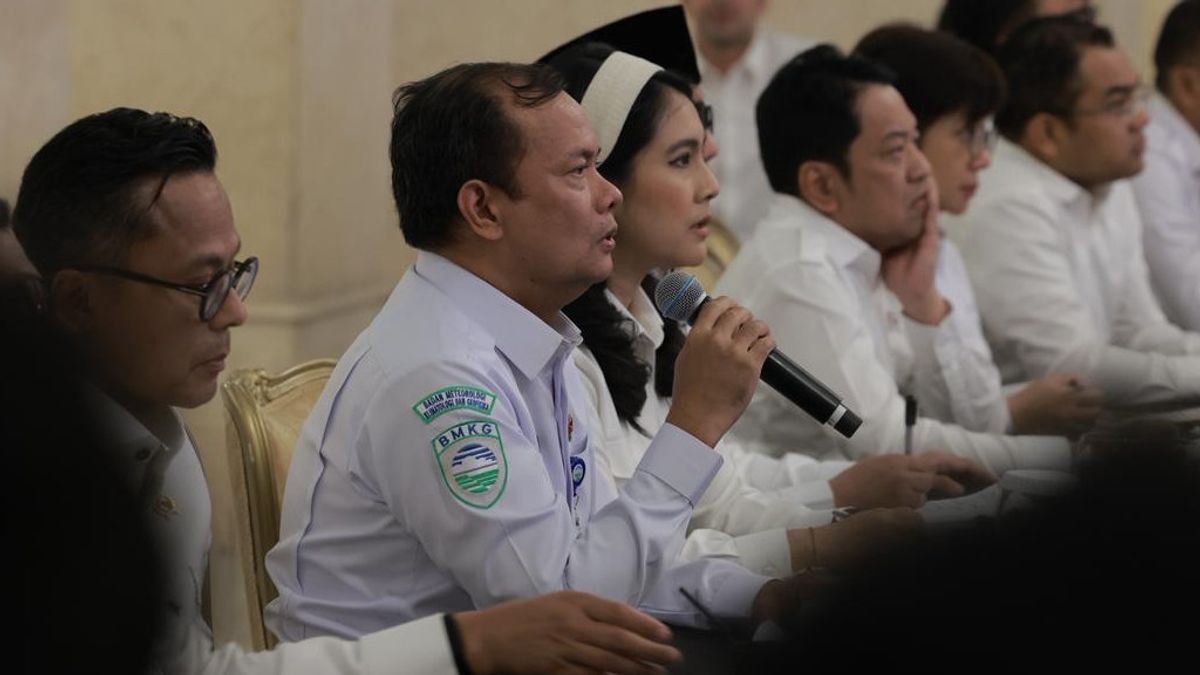


JAKARTA - The head of the Meteorology, Climatology and Geophysics Agency (BMKG) Teuku Faisal Fathani revealed that there are currently three cyclones surrounding Indonesia. The three of them are the Bakung Tropical Cyclone, the 93S cyclone seed, and the 95S cyclone seed which have the potential to trigger extreme weather in a number of areas.
This was conveyed by Faisal in a plenary session with the President of the Republic of Indonesia Prabowo Subianto at the State Palace, Monday, December 15.
"Currently there are three cyclones besieging Indonesia, Mr. President. The first is the Bakung Cyclone," said Faisal.
He explained that the Bakung Cyclone was observed to develop in the southwest of Lampung and move away from Indonesia. However, BMKG noted that the cyclone had increased in intensity from category 1 to category 2.
According to Faisal, this condition should be wary of because the tropical cyclone Senyar which previously caused extreme weather in Sumatra was only recorded in category 1.
"This Bakung cyclone status has risen from category 1 to category 2. For comparison, the Senyar cyclone that had a major impact on Sumatra yesterday was only category 1," he said.
BMKG predicts that Cyclone Bakung still has the potential to move closer to Indonesian territory in the next two to three days. Therefore, intensive monitoring continues to be carried out to anticipate the impact on rainfall.
"We will continue to monitor the dynamics. Hopefully it will not enter or approach Indonesian territory so that it does not significantly affect rainfall," he said.
In addition to Cyclone Bakung, BMKG also detected the presence of a 93S cyclone seed in the Bali, Nusa Tenggara, and East Java regions. Meanwhile, the 95S cyclone seed was observed in the southern Papua region.
Faisal said the presence of cyclones and cyclone seeds has the potential to increase rainfall with high to very high intensity, as well as triggering high waves in a number of Indonesian waters.
"This condition increases the potential for heavy rain and high waves. Therefore, we continue to coordinate with BNPB, BPBD, and Basarnas so that the community remains calm, but always vigilant," he said.
He added that Indonesia was not alone in facing the cyclone siege. Currently, Indonesia has been appointed by the World Meteorological Organization (WMO) as a *Tropical Cyclone Warning Center*.
In this capacity, BMKG actively communicates and exchanges data with a number of countries, such as Australia, Japan, and India, to monitor the development of Cyclone Bakung.
"On December 14, Cyclone Bakung was recorded as category 3 with wind speeds reaching 65 knots. This is very dangerous. But then it went back down to category 2, and hopefully it will continue to weaken to category 1," concluded Faisal.
The English, Chinese, Japanese, Arabic, and French versions are automatically generated by the AI. So there may still be inaccuracies in translating, please always see Indonesian as our main language. (system supported by DigitalSiber.id)
Most Popular Tags
#Prabowo Subianto #donald trump #2026 World Cup #Febrie Adriansyah #8791Popular


