


JAKARTA - Palestinian Agriculture Ministry officials say Israeli attacks since the latest conflict broke out two years ago destroyed the Gaza Strip agricultural sector, more than 90 percent of livestock were destroyed.
An estimated 95 percent of the livestock have been killed, both in airstrikes and massacred out of despair during Israel's supply blockade for months. Only 43 percent of sheep survived, and 99 percent of poultry have died.
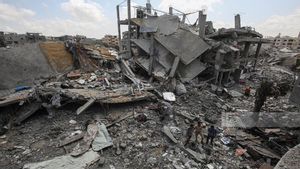
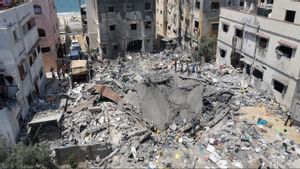
This damage is not only measured in the dollar or tonnage of production that is lost, but is also equivalent to the collapse of the economy that supports tens of thousands of families. The farm, which used to provide red and white meat, milk, and eggs for Gaza, is now nothing more than a crater and a warped metal.
"War is not just killing animals," the ministry official told The National, as quoted November 26.
"The war has destroyed all means of life," he said.
Prior to the war, 15,000 cows, 55.000 sheep, and millions of chickens supplied local markets. However, Israeli military tactics led to starvation in Gaza, and the return of aid trucks gradually failed to resolve the crisis completely.
All areas that used to be the main source of Gaza's food production, especially Khan Younis in the south and northern governorship, have become military zones controlled by Israeli soldiers.
In fact, if the reconstruction of the Palestinian enclave begins today, officials say, the livestock industry will take up to decades to recover as before Israeli aggression.
For livestock traders Tamer Al Kafarna (51) from North Gaza, the destruction of two of its farms to the east of Jabalia was not only a financial disaster, but also a loss of its life goals.
"Before the war, I had two farms that cost around $350,000 to build," he told The National.
"Both of them accommodate about 5,000 cows and sheep. I spend every day there with my sons and grandchildren. That's our life," he said.
He continued, in the first days of war, Israeli airstrikes destroyed everything to ashes.
"All the animals were killed," he said in a loud voice.
"My loss is more than 700.000 US dollars. But the bigger loss is that fresh meat is no longer available in Gaza. People are starving. Children are getting weaker. War is not only killing our agriculture, but also our health," he explained.
Currently, Al Kafarna, like most traders, has no income and there is no way to rebuild its business.
"Borders are closed, livestock imports are prohibited, and troops control all land to the east of the Yellow Line," he said, referring to the ceasefire line that limits Israeli-controlled territory.
"We have been cut off from our own livelihoods," he said.
Meanwhile, in Gaza City, Yahya Al Sawafiri (43), still struggles to accept the fact that the family business, a poultry kingdom passed down from generation to generation, has gone out of business.
Prior to the war, Mr. Al Sawafori, his brothers and cousins owned 22 chicken farms, totaling a total value of 3 million US dollars, which supplies 700,000 chickens per month to the market. But within days, everything disappeared due to the bombing.
"The Israeli army destroyed everything," he said.
"They don't even allow poultry supplies to enter Gaza now. How can we rebuild if we can't get chickens, animal feed, or equipment?" he said.
For Al Sawafori, this loss is very personal.
SEE ALSO:
-
 | BERITA
Presiden Trump Ungkap Perbedaan Terkait Rencana Perdamaian Ukraina Tinggal Sedikit
26 November 2025, 14:15 -
 | BERITA
Pelapor Khusus PBB Sebut Penghancuran Rumah di Gaza sebagai Domicide
26 November 2025, 09:45 -
 | BERITA
Rusia Peringatkan Eropa Harus Mengembalikan Aset Moskow atau Dianggap Pencuri
26 November 2025, 09:15

"These farms are more than just jobs. These farms are our legacy, something our father and grandfather built. We are proud to feed Gaza. Now, these farms have gone missing, and with him, some of our identities," he said.
Without fresh meat, milk, and eggs, Gazans face an increasingly severe nutritional crisis. Children, pregnant women, and the elderly are the most at risk, as the scarcity of protein exacerbates the effects of hunger and disease.
"Even if the war ends today, international interventions for years and billions of dollars are needed to rebuild this sector," said a Ministry of Agriculture official.
"However, without an open and safe crossing for farmers, recovery is impossible," he added.
The English, Chinese, Japanese, Arabic, and French versions are automatically generated by the AI. So there may still be inaccuracies in translating, please always see Indonesian as our main language. (system supported by DigitalSiber.id)


