

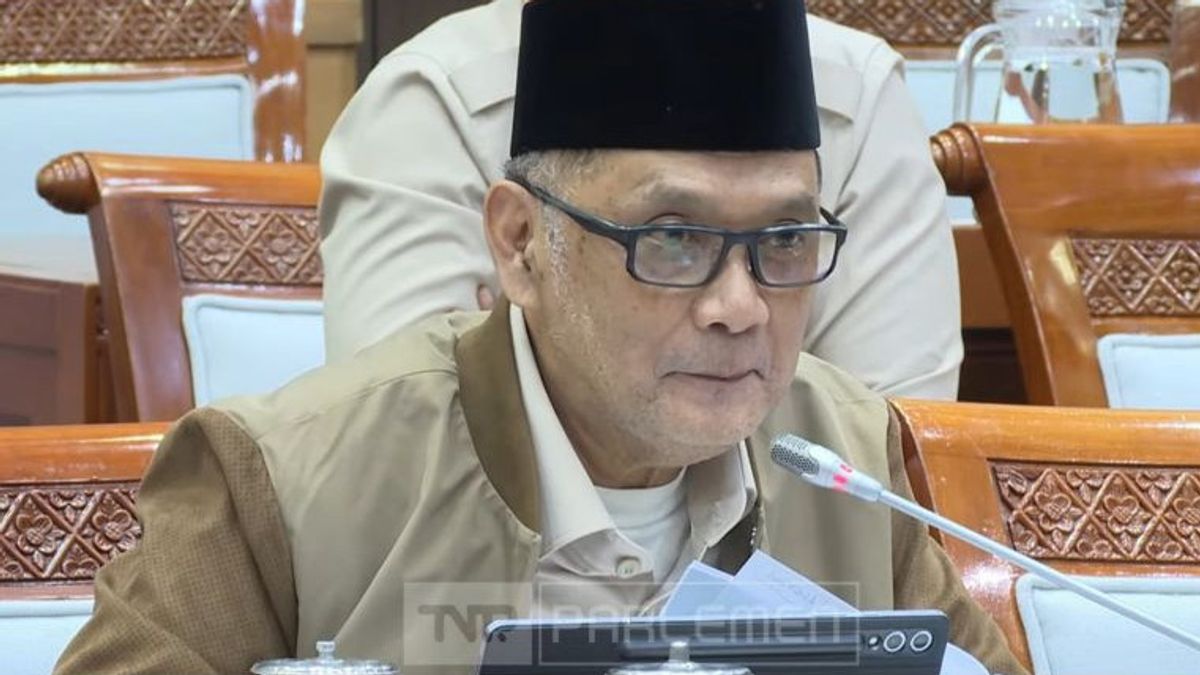


JAKARTA - Minister of Hajj and Umrah Mochamad Irfan Yusuf emphasized that the distribution of regular Hajj quotas between provinces in the implementation of Hajj 1447 Hijri/2026 AD carries the principles of justice and proportionality.
"Law Number 14 of 2025 strictly regulates that the distribution of regular Hajj quotas between provinces must reflect justice and proportionality," said Minister of Hajj Irfan Yusuf in response to the addition and reduction of regular hajj quotas in a number of provinces in the 2026 Hajj.
According to Gus Irfan, his nickname, in Article 13 paragraph (2) of Law Number 14 of 2025, it is stated that the distribution of quotas can be carried out with three approaches. First, based on the proportion of the number of waiting lists for pilgrims between provinces.
Second, based on the proportion of the Muslim population between provinces. Third, through a combination of the two which was further determined by the Minister of Hajj and Umrah.
"With this new provision, Law 14/2025 presents fundamental reforms in the hajj quota distribution system, ensuring that each prospective pilgrim gets the opportunity to depart more fairly and measurably, according to the registration time and demographic conditions of each province," said Gus Irfan.
Reported by ANTARA, Tuesday, November 18, Gus Irfan explained that the government has set the option of monitoring the list (waiting period) as the basis for distributing the hajj quota because this approach is considered to meet the most sense of justice, certainty, and benefit for prospective Indonesian pilgrims.
The decision, he said, was born from studies, discussions with the DPR, and public input that highlighted the length of the waiting period in many regions. So far, the distribution of quotas based on the proportion of Muslim population has created a wide gap between provinces.
"This also answers social unrest and public demands. Many pilgrims have been waiting decades without certainty. The option of waiting list provides concrete answers to people's aspirations," he said.
According to him, the government chose the waiting list because it is most relevant to factual conditions and the spirit of justice regulated in the law, and has proven to be able to suppress the disparity of the national waiting period to be more reasonable and equitable.
"WATING list-based policies are not only a choice of technocratics, but also a moral and social step, to ensure that the implementation of the pilgrimage runs more fairly, transparently, and in favor of the people," said Gus Irfan.
The government through the Ministry of Hajj and Umrah uses a national listing data base sourced from the Integrated Hajj Information and Computerization System (SISKOHAT) as the main basis in calculating the Hajj quota of 1447 Hijri/2026.
Gus Irfan explained that the sharp disparity between the 2026 and 2025 hajj quotas was not actually due to the change in the number of national quotas, but because of the fundamental changes to the formula for its distribution.
The English, Chinese, Japanese, Arabic, and French versions are automatically generated by the AI. So there may still be inaccuracies in translating, please always see Indonesian as our main language. (system supported by DigitalSiber.id)


