
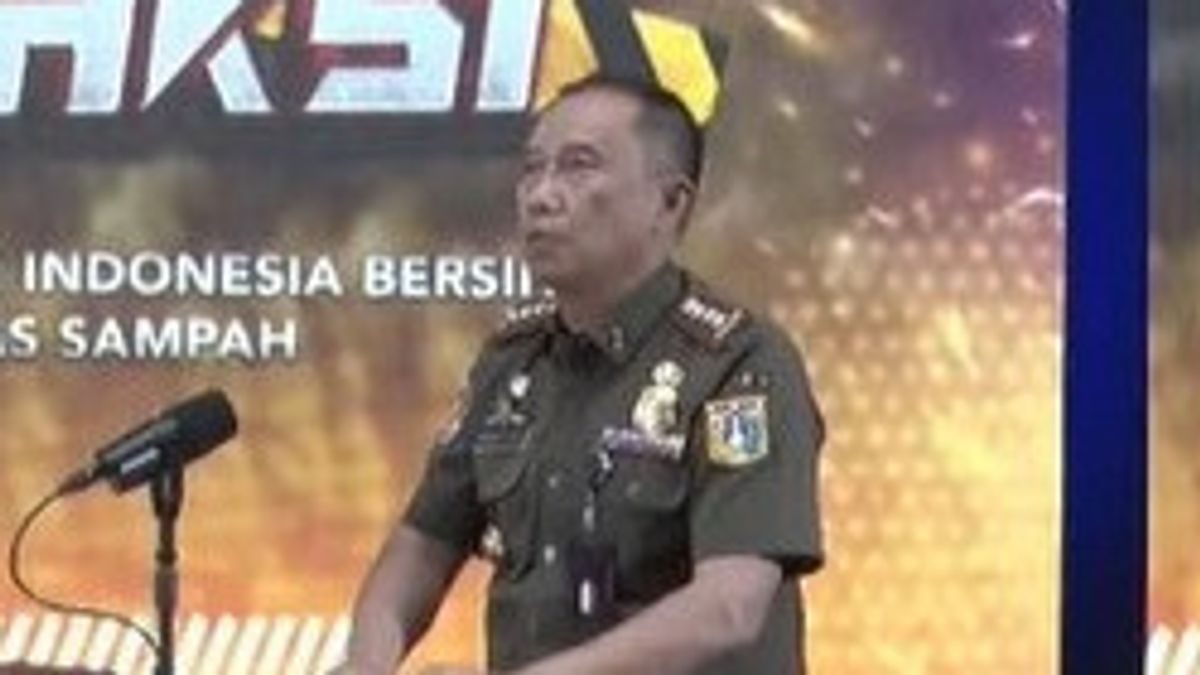


JAKARTA The Civil Service Police Unit (Satpol PP) strengthens synergies with the Ministry of Environment and various community communities in the context of implementing the National Clean Indonesia Movement (GNIB). This step is part of the government's ongoing efforts to create a clean, healthy, and orderly environment through cross-sectoral collaboration between the central government, local government, and society.
GNIB is one of the national priority agendas that aims to create a clean, healthy, orderly, and beautiful environment. This movement not only emphasizes cleanliness in a physical sense, but also visual cleanliness and urban planning, including the arrangement of public spaces from the existence of billboards, banners, billboards, and other props that are often installed irregularly.
As a regional apparatus that has a mandate in enforcing regional regulations/perkada, Satpol PP plays an important role in supporting the GNIB through two main routes, namely enforcement of regional regulations on cleanliness and waste management, as well as controlling props that do not comply with the provisions. The success of the GNIB is very dependent on the synergy of physical and visual hygiene which is a shared responsibility.
"Satpol PP cannot work alone to create a clean environment physically and visually. Therefore, we collaborate with the Environment Agency, the Ministry of Environment, as well as various agencies and communities," said Rahmat Efendi Lubis, Head of Regional Regulation Enforcement and Regional Regulation of Satpol PP, in the Talkshow on Strengthening Satpol PP Capacity in the Regions in Enforcement of Regional Regulation Law Regarding the Implementation of GNIB and Waste Management.
For example, Rahmat highlighted the situation after the 2024 General Election of Regional Heads, where Jakarta was flooded with no longer used waste from Campaign Performance Equipment (APK).
After a decline by Satpol PP in all areas of the capital city, the amount of waste collected is very large. To overcome this, Satpol PP collaborates with communities that have the ability to recycle used materials.
SEE ALSO:
-
 | BERITA
Komite Percepatan Reformasi Polri Lakukan Pertemuan dengan Kapolri Siang Ini
10 November 2025, 13:33 -
 | BERITA
Khotbah Jumat di Masjid SMAN 72 Kelapa Gading Diwarnai Ledakan, 1 Orang Diamankan
07 November 2025, 14:29 -
 | BERITA
22 Saksi Kasus Kematian Terapis SPA Diperiksa, Termasuk Rekan Seprofesi
03 November 2025, 12:01 -
 | BERITA
Polisi Ungkap Kronologi Siswi SD Ditemukan Tewas Usai Diperkosa Tetangganya
14 Oktober 2025, 16:38
"We invite the community to use the waste of props as raw material for furniture such as tables and chairs. That way, waste is not immediately disposed of, but reprocessed into useful products," explained Rahmat.
Meanwhile, Herbita Simanjuntak, Functional Environmental Extensioner of the Ministry of Environment, explained that GNIB was born out of concern about national hygiene conditions that still require serious attention.
According to him, Indonesia produces around 56 million tons of waste every year. Of this amount, about 63 percent are still managed with an open dumping system at the Final Processing Site (TPA), while around 22 million tons are still scattered in residential areas and water bodies.
"This problem cannot be resolved only by the central government. Strong collaboration is needed between local governments and the community. This is where the role of Satpol PP is very important, because they are parties who interact directly with the community in an effort to increase awareness of waste management," said Herbita.
As part of strengthening the role of education, Satpol PP also runs the 'Satpol PP Goes To School' program, which aims to provide socialization to high school students regarding the importance of maintaining cleanliness, public order, and city aesthetics.
Through this approach, Satpol PP seeks to raise awareness from an early age so that environmentally caring behavior becomes part of people's culture.
With these various steps, the Satpol PP affirms its commitment to continue to support the implementation of the GNIB in a sustainable manner. Synergy between the central, regional and community governments is expected to accelerate the realization of a clean, orderly, and comfortable environment for all Indonesian citizens.
The English, Chinese, Japanese, Arabic, and French versions are automatically generated by the AI. So there may still be inaccuracies in translating, please always see Indonesian as our main language. (system supported by DigitalSiber.id)


