
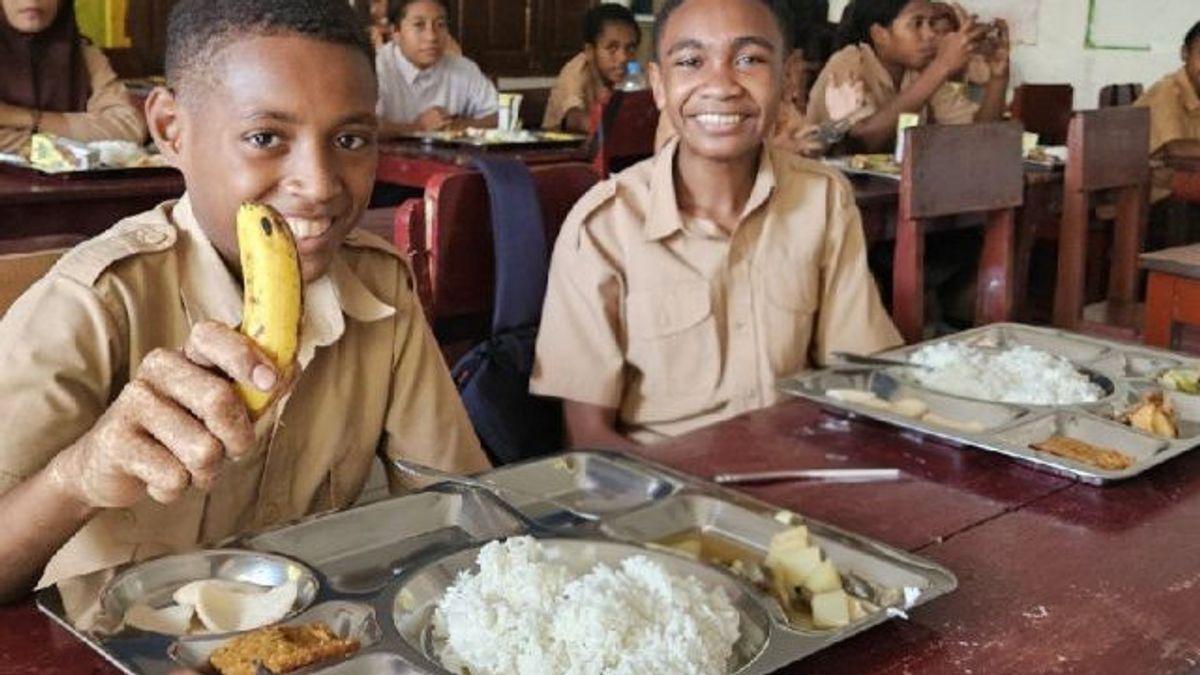


JAYAPURA - The Nutrition Food Program (MBG) in various regions in Papua is a real step for the government in accelerating the improvement of children's nutrition which is realized through cross-sectoral collaboration between local governments, educational institutions, and the community. All of this is an effort to realize Indonesia's golden generation from Papua in 2045.
The government places Papua as one of the priority areas because the nutritional challenges faced are relatively heavy compared to other regions.
Based on the 2023 Indonesian Health Survey (SKI), the prevalence of stunting in Papua is 28.6 percent, higher than the national average of 21.5 percent.
SEE ALSO:
-
 | BERITA
Aparat Kepolisian Geledah Sebuah Ruko yang Diduga untuk Palsukan Nampan MBG
01 November 2025, 12:05 -
 | BERNAS
Sentimen Positif Publik untuk Gaya Koboi Menkeu Purbaya Yudhi Sadewa, Perlukah Diubah?
01 November 2025, 08:00 -
 | BERITA
Alami Mual dan Diare, 800 Siswa SMK di Batang Semarang Keracunan Menu MBG
31 Oktober 2025, 17:24
This figure shows that about three out of 10 children in Papua experience growth disorders due to chronic malnutrition. Therefore, nutrition improvement measures in this area must be taken thoroughly and sustainably.
Therefore, the government views that the issue of nutrition is not just a matter of food, but concerns the future of generations who will support the development of the nation.
"The problem of nutrition in Papua is complex and the problem is not only due to lack of food, but also due to parenting, disease, and environmental conditions. Therefore, the approach must be integrated and cross-sectoral," said Deputy Governor of Papua Aryoko Rumaropen.
For this reason, strengthening capacity needs to be done so that food safety standards, preparation of balanced menus, and monitoring of children's growth and development are things that can be considered together.
In addition to schools, community-based approaches are also carried out through kitchens for Providing Additional Food (PMT) Kitchens from local governments managed by community cadres and focused on serving pregnant women and toddlers.
The program emphasizes that food ingredients are taken from the local gardens and seas so that they grow an independent and sustainable attitude.
MBG menus and Kitchen PMT are usually served in the form of yellow soup fish, which are usually served using rice or tubers, such as cassava, as well as additional tofu or tempeh side dishes.
Then for vegetables served in the form of vegetables or kale, papaya flowers, while for children at school kale tumis are served.
In addition, the menu that is often served is a panai fish that is processed into suir fish. The fish is processed into sweet suir fish, or spicy sweet and spicy suir fish. Usually served with light corn capur vegetables.
Another menu provided by SPPG is fried mujair fish combined with cassava (kasbi) or petatas (ubi jatar) as well as siam labu vegetables.
Results
The program has now begun to show results, such as in Jayapura City, according to data from the health office which recorded a reduction in stunting rate from 21.3 percent in 2023 to 15.15 percent in September 2025.
Although there are still areas with high prevalence, such as North Jayapura and Hamadi, this positive trend is proof that school and community-based nutrition interventions are starting to be effective.
With great natural potential and a society rich in cultural value, Papua has strong capital to produce a superior generation, especially when the government presents MBG as an important social investment to produce a healthy, intelligent, and resilient young generation facing global change.
However, a number of challenges still need to be faced, starting from geographical access to remote areas where there is still a need to find a way out in an effort to distribute fresh foodstuffs. In addition, the lack of professional nutrition workers at the puskesmas for monitoring children's growth and development.
All these challenges should not be seen as obstacles, but rather as an encouragement for all stakeholders to be creative and innovative, so that all problems must have a solution.
Collaboration
Nutrition problems in Papua are complex, because this is not only a problem of poverty or food shortages, but also related to parenting and environmental health conditions.
Head of the Jayapura City Health Office, Juliana Napitupulu, emphasized that this program requires a cross-sectoral approach as the main key, including presenting this MBG, in accordance with local characters and the availability of local foodstuffs to be more sustainable.
The local government, in the success of this children's nutritional fulfillment program, seeks to present menus, both in MBG and at PMT Dapur, by utilizing local foodstuffs, such as marine fish, vegetables, green beans, and tubers that are easily accessible to the local community.
The United Nations institution in the field of child protection assesses that the MBG program in eastern Indonesia, which has been running in collaboration with various parties, has the opportunity to become an example of the national implementation of school nutrition programs.
Many studies prove that nutritious feeding in schools can increase the presence of students and increase academic achievements. Papua can be a model if the synergy of all parties continues to be maintained properly and sustainably.
Therefore, the local government targets all elementary and secondary schools in Papua to have implemented nutritional services standards and food safety ready-to-eat in the next five years.
At the same time, the National Nutrition Agency (BGN) has prepared a digital-based integrated monitoring system that can monitor the achievements of the MBG program to the village level.
This government program also has an impact on increasing concern, as well as the spirit that the responsibility to build the future of Papua is not only in the hands of the government, but also in schools, families, and communities.
Every nutritious food plate served at the school dining table and in pregnant women is a symbol of hope that big changes can start from small steps, from a plate of healthy rice, from the smile of a child who grows passionately.
In the long term, MBG has become a strategic means of instilling a healthy eating habit for Papuan children. MBG does not just provide food, but builds a healthy culture and cares for each other.
The English, Chinese, Japanese, Arabic, and French versions are automatically generated by the AI. So there may still be inaccuracies in translating, please always see Indonesian as our main language. (system supported by DigitalSiber.id)


