

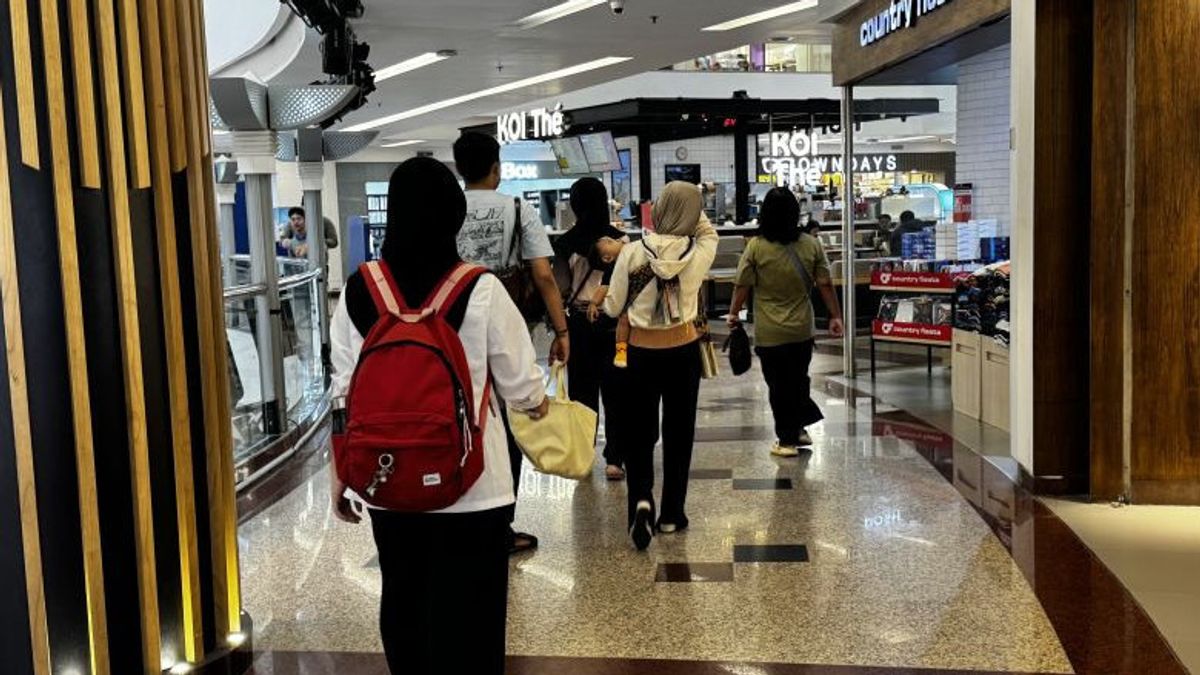


JAKARTA - The KedaiKOPI Survey Institute released a survey entitled "Consumption Behavior Survey & Middle Class Community Buying Power". The survey noted that middle class household spending has increased in the last three months.
As a result, the budget shifts to basic needs and education, while fashion spending, eating outside, and recreation is cut or postponed.
The survey was conducted using the online-CASI method on October 14'19, 2025, against 932 respondents.
"One sentence that describes the most striking changes with middle class consumption is the focus on basic needs," said Ashma Nur Afifah, a senior researcher at the KedaiKOPI Survey Institute as reported by ANTARA, Tuesday, October 28.
According to Ashma, three of the five respondents felt spending increased. This increases the portion of basic needs and narrows the shopping space for discresioners in the majority of middle class households.
"The food price is increasing, and this transportation continues to affect changes in temporary behavior in terms of paying capacity, which is increasingly unstable," said Ashma.
The habit of comparing prices is even more massive. As many as 94.5 percent of respondents compare offline and online prices, especially for fashion and cosmetics. This encourages transaction shifts to e-commerce and traditional markets.
"This wallet pressure is the main factor, because so far people want it to be cheaper so they must compare," said Ashma.
SEE ALSO:



Even though the mall is still crowded, three of the five respondents admit that they often go for 'rohana/rojali', aka traveling without shopping. They considered the price expensive and discounts less attractive, so that the intention of shopping at physical retail weakened.
"In the end, the mall changed its function from the place of purchasing to the place to try the goods," he said.
In terms of finance, one in two respondents used paylaters; one third had non-KPR bank debts; and a quarter had access to online loans (pinjol). This shows quite high consumptive credit access in this group.
"Why do so many Paylaters use it? Because it's easy, it's easy in terms of requirements compared to credit cards, now the risk is if everyone fails to pay or the majority fails to pay," said Ashma.
Regarding the government's alignment, 58 percent of respondents considered the government to be still in favor of the middle class (10 percent strongly in favor, 48 percent quite sided). Meanwhile, 37 percent considered it not in favor, and 5 percent did not know.
"Education and health policies are also needed in the middle class, but keep in mind that such basic needs are less relevant for the middle class," said Ashma.
KedaiKOPI recommends: stabilization of basic prices through market operations; expansion of incentive assistance such as free health checks and public schools; optimization of digital public communication; as well as mitigation of the impact of shifting online shopping on physical retail.
'Provide adequate formal job training. Ensure that basic services are covered: quality education and quality health. If the formal sector is difficult, create informal jobs that are stable through the provision of capital, access to financing, or entrepreneurship training," said Ashma.
The English, Chinese, Japanese, Arabic, and French versions are automatically generated by the AI. So there may still be inaccuracies in translating, please always see Indonesian as our main language. (system supported by DigitalSiber.id)


