

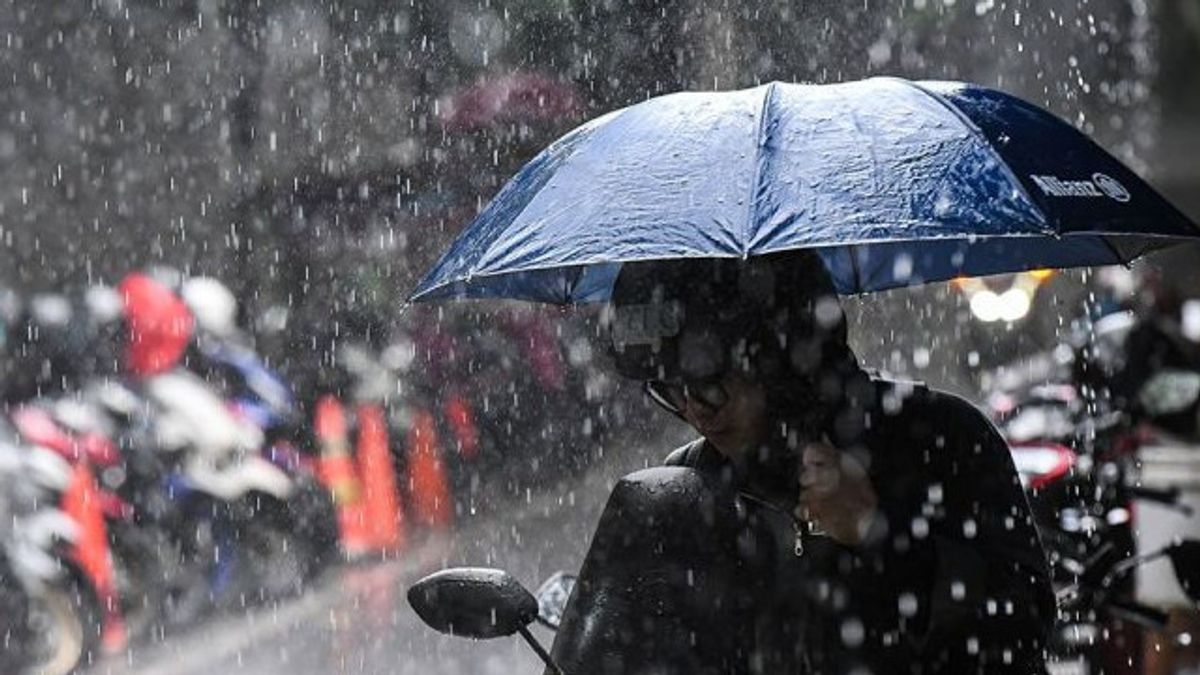


JAKARTA - Worried findings approaching the capital city. Rainwater in Jakarta turns out to contain microplastics (MP), triggering new concerns about worsening urban environmental pollution.
This phenomenon, although it sounds surprising, scientifically it is considered very likely. Professor of IPB University from the Department of Water Resources Management, Faculty of Fisheries and Marine Sciences (FPIK), Prof. Etty Riani, explained that very small plastic particles, especially nanoplastics, have a light mass and are easily lifted to the atmosphere.
Air Laundering Under Clean Rain
According to Prof. Etty, the source of these particles is very diverse. Starting from the friction of car tires, the weathering of dry plastic waste flown by the wind, to the fiber of clothing made from synthetic materials on the mainland.
"This particle can come from various sources on land such as car tire friction, dry plastic waste weathering and being carried away by the wind, to fibered clothes made from synthetic materials," he said.
When floating in the air, microplastics were carried away by the wind currents and finally returned to earth with rainwater droplets. Prof. Etty analogized the role of rain as air washing.
Rain plays a role like an air wash. Microplastics floating in the atmosphere will blend with raindroplets. Because the size is very small, the particles are invisible, so it's as if the rainwater is clean," he explained.
In addition, Jakarta's environmental factors such as high temperatures and dry air are accelerating plastic weathering, making it easier for these fine particles to fly into the atmosphere.
From Waking Up To Sleeping Again, We Can't Be Free From Plastic
Prof. Etty emphasized that the root of the problem is the high daily use of plastic.
The high use of plastic in everyday life is also the root of the problem. From waking up to sleeping again, humans cannot be separated from plastic. Finally, plastic will decay into microplastics and nanoplastics," he said.
SEE ALSO:
This situation is not only a matter of the environment, but also a serious health issue.
"Plastics are not only environmental problems, but also health. Inside there are dangerous additive ingredients that can trigger hormonal disorders and increase the risk of cancer," he concluded.
Changes In Lifestyle And Urgent Strict Sanctions
Seeing this urgency, Prof. Etty urged the government and society to take concrete steps. He encourages lifestyle changes that are more environmentally friendly.
"We need to live simpler and return to nature. Reduce the use of plastic, avoid body care products that contain microplastics, and make it easier to sort waste from home," he said.
In addition, the application of the 3R principle (reduce, reuse, recycle) and the imposition of strict sanctions for those who violate the plastic reduction policy are considered very crucial to reduce the rate of microplastic pollution in the capital city.
The English, Chinese, Japanese, Arabic, and French versions are automatically generated by the AI. So there may still be inaccuracies in translating, please always see Indonesian as our main language. (system supported by DigitalSiber.id)
Popular


