
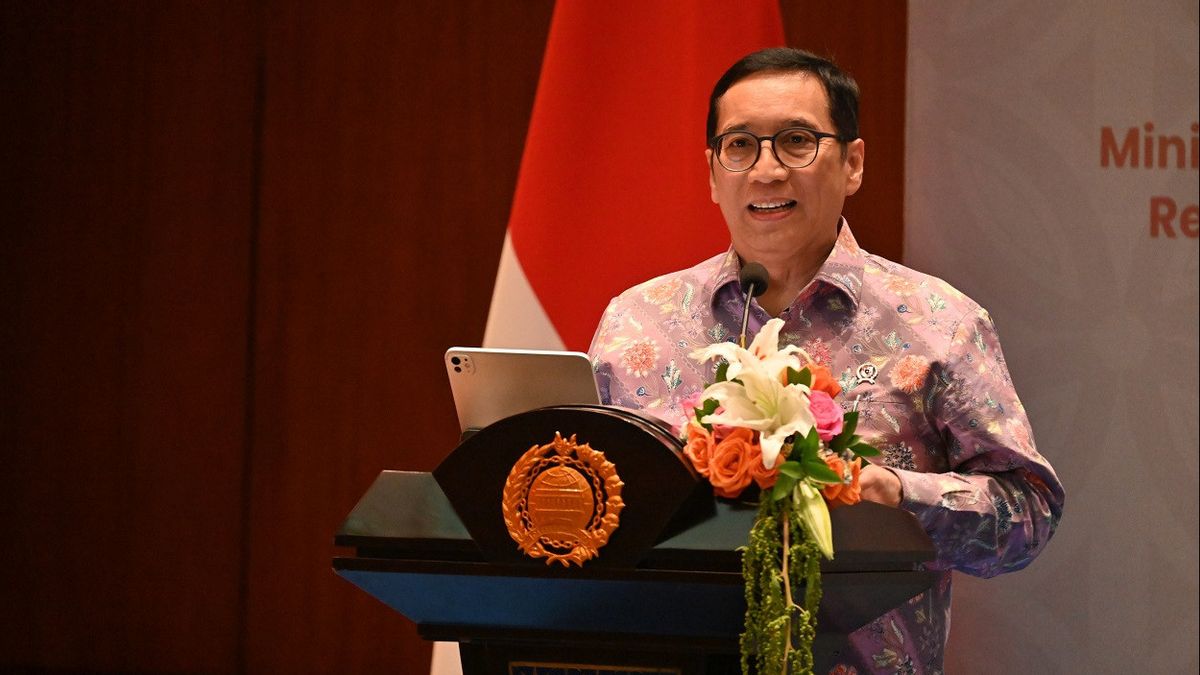


JAKARTA - Security Council Reform is at the heart of United Nations reforms, Ambassador Febrian Alphyanto Ruddyard said Monday.
Speaking at the "Debriefing Forum Head of Representative of the Republic of Indonesia, Multilateral Diplomacy: Efforts to Improve Indonesia's Leadership at the Global Level", Ambassador Febrian said the Security Council has a big responsibility to resolve peace issues.
"Peace is not only a conflict problem, that people live properly. Peace does not mean stopping the war, but what about after stopping the war, how can people be protected, how their rights are fulfilled," he explained at the Indonesian Ministry of Foreign Affairs, Jakarta, Monday, October 13.
Calls for the United Nations reform and the Security Council are being voiced even more, amid various unresolved crises in the world. Indonesia is one of the countries that support this reform.
The Deputy Minister of National Development Planning/Deputy Head of Bappenas explained that the architecture of the Security Council with veto and five permanent members made the mechanism unable to solve the problem.
Highlighting the protracted state of genocide in the Palestinian Gaza Strip, Ambassador Febrian said the mechanism on the council made it impossible for a decision to be made.
The latest Veto took place on September 18, when the United States vetoed the draft resolution bill demanding an immediate, unconditional and permanent ceasefire in Gaza and for Israel to lift all restrictions on aid deliveries to the Palestinian territories.
The draft resolution also demands immediate, dignified, and unconditional release of all hostages held by Hamas and other groups.
Getting support from 14 countries, the draft resolution ran aground due to veto from the US as one of the five permanent members of the council. The UN Security Council itself consists of 15 countries, of which five other countries, the United States, Britain, China, France, and Russia are permanent members with veto rights.
"It is impossible because the structure of the decision-making must not have veto. Even though what can make the Security Council move using its power, yes resolution, there should be no veto. If there is a veto, there is no resolution, that's the problem," he said.
"The UN reform is essentially a Security Council reform," he said.
On the other hand, Indonesia's Permanent Envoy for the United Nations, WTO and International Organizations in Geneva Switzerland for the 2021-2025 period explained that in the UN Security Council there are members who have veto rights to be problematic. In the Human Rights Council, all members have veto rights as well.
"That is the challenge of the multilateral world. As bad as the multilateral world, we still need it. As bad as the UN, the Security Council which is said to be unable to function properly, is even more dangerous if it doesn't exist. There are many things that are difficult to agree on. But, there are also many things that can be agreed upon," he explained.
"It's just that we have to manage expectations. Because it's the architecture of 1945. UN reforms cannot be done alone, it must be a movement," he continued.
"If we do a discourse, it is necessary to reform, these ideas are not now. We must be able to enter the younger generation. When they enter the decision maker position, they are well informed," said Ambassador Febrian.
"If you're now trying to change, change the behavior of world leaders now, forget it," he said.
Meanwhile, Indonesian President Prabowo Subianto during a speech at the United Nations 80th General Assembly Debat Session last month said Indonesia remains committed to multilateralism and every effort to strengthen the United Nations.
"Without the United Nations, we can feel safe. Without the United Nations, no country would feel safe," he said.
"We need the United Nations and Indonesia will continue to support the United Nations. Even though we are still fighting, we know the world needs a strong UN," said President Prabowo.
Last February, UN Secretary-General Antonio Guterres lamented the failure of the UN Security Council in responding to the Hamas-Israeli conflict and Russia's invasion of Ukraine, saying reforms were necessary on the agency, assessing the conflicts had weakened its authorities.
Speaking at the opening of the UN Human Rights Council in Geneva, Secretary General Guterres said the UN Security Council was often deadlocked and "cannot act on the most important issues of peace and security today".
"The lack of unity of the Security Council in Russia's invasion of Ukraine, and in Israel's military operations in Gaza following the horrific terror attack by Hamas on October 7, has been very, perhaps fatally, damaging to its authorities," Secretary General Guterres said.
"The board needs serious reforms to its composition and work methods," he continued.
In a post on social media X last August, Secretary General Guterres said the top global body was designed by World War II winners.
"The world has changed but the composition of the Council is not following developments," Secretary General Guterres tweeted, adding that it is unacceptable that Africa with more than one billion residents does not have permanent members.
"Vocations, African insights and participation must be voiced in the considerations and actions of the Council," continued Secretary General Guterres.
Indonesian Foreign Minister Sugiono in a series of meetings at the 80th UN General Assembly last month stressed UN reforms and multilateral order to be more inclusive, effective and practical.
Meanwhile, the Deputy Minister of Foreign Affairs of the Republic of Indonesia, Arrmanatha Ch. This year's Nasir twice highlighted the UN Security Council. In January, Indonesia loudly voiced that UN DK was able to affirm its relevance in the open UN DK session with the agenda of "Middle East," including the Palestinian Quest" at the New York United Nations Headquarters.
SEE ALSO:
-
 | BERITA
Presiden Trump Belum Yakin Soal Penerimaan Blair di Dewan Perdamaian Gaza
13 Oktober 2025, 12:15

On this occasion, the Deputy Minister of Foreign Affairs of the Republic of Indonesia, Arramanatha Ch. Nasir, called on the UN DK to affirm its relevance. In the midst of increasingly complex global situations, the Indonesian Deputy Minister of Foreign Affairs called for, especially the permanent member state of the UN DK, to stop the deadlock and encourage the reform of UN DK.
"History will assess whether UN DK is able to rise up to face challenges or it becomes irrelevant," said the Deputy Foreign Minister of the Republic of Indonesia at that time.
Last July, Deputy Foreign Minister Tata also urged that no UN DK member use veto rights to prevent a full Palestinian membership at the United Nations, while following the "High Level International Conference for the Peaceful Settlement of the Investigation of Palestine and the Implementation of the Two-State Solution" which was also held at the New York United Nations Headquarters.
The English, Chinese, Japanese, Arabic, and French versions are automatically generated by the AI. So there may still be inaccuracies in translating, please always see Indonesian as our main language. (system supported by DigitalSiber.id)
Most Popular Tags
#Prabowo Subianto #donald trump #2026 World Cup #venezuela #konflik timur tengahPopular


