

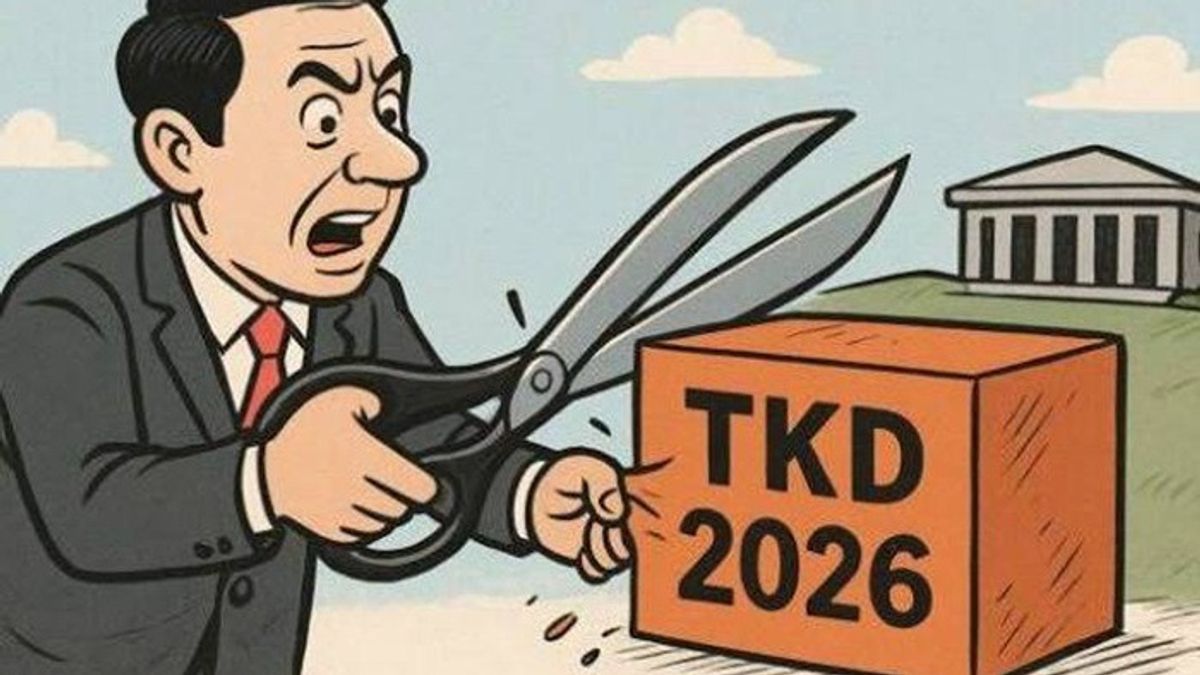


JAKARTA - Jakarta Veterans UPN economist Achmad Nur Hidayat asked the central government to anticipate the emergence of turmoil in the regions after Finance Minister Purbaya Yudhi Sadive reduced transfers to regions (TKD) in 2026 by Rp693 trillion from Rp919.87 trillion in 2025.
The reason is, the reduction in the TKD budget has made regional heads rack their brains to patch it. For example, boosting regional revenue from tax levies which is actually burdensome to the burden on the small people in the regions. This is what is feared to cause turmoil in the regions, such as a massive demonstration that had rocked Pati Regency, Central Java.
"We are worried that the incident in Pati will happen again. Because the regent raised the PBB. Apparently, other regions are the same. Some even rose arbitrarily, up to thousands of percent. There was a wave of protests that could trigger social turmoil. That's what we don't want," said Achmad, Sunday, October 12, 2025.
According to him, currently many regional heads, fiscal bureaucrats to academics, are questioning whether the 2026 TKD budget cuts are in line with Law No. 1 of 2022 concerning Central and Regional Financial Relations (HKPD).
"Or maybe, we are witnessing a shift in the meaning of fiscal decentralization into social assistance (bansos) recentralization wrapped in efficiency jargon? That must be answered," he added.
Achmad highlighted the statement of the Minister of Finance Purbaya which set the TKD allocation in 2026 of IDR 693 trillion, but at the same time claimed to have raised the central program for regions, from IDR 900 trillion in 2025 to IDR 1,300 trillion in 2026.
SEE ALSO:


On paper, it seems as if central funds for regions are increasing. However, if examined more deeply, the composition shifts fundamentally. It is no longer a development fund that is regional fiscal rights (DAU, DAK and DBH), but rather a ministry/institutional and social assistance expenditure fund that is carried out directly by the center. This is the root of the problem that must be watched out for," he explained.
He also questioned the reason why Minister of Finance Purbaya cut the TKD budget was because many regional funds were deposited and not optimally absorbed. Or the area is inefficient in managing the budget. At first glance, it makes sense, like a wasteful person being given a lot of money, it is necessary to be reprimanded to make it more frugal.
"But that's not entirely appropriate. Because, in the national fiscal system, regional funds are not just pocket money given for the mercy of the center. But it is part of the constitutional rights of the region, based on the formula regulated by the HKPD Law," he said.
He emphasized that when the central government assessed that regional financial performance was still poor, then cut its fiscal rights unilaterally, the state was actually punishing the decentralization mechanism it built itself.
This is because most districts and cities rely heavily on General Allocation Funds (DAU) and Revenue Sharing Funds (DBH) for ASN (State Civil Service) and PPPK (Government Employees with Work Agreements) salaries, financing basic education, health services to small infrastructure such as village or sanitation roads.
"When TKD decreases, many regions are fiscal poor, face the risk of failing to pay PPPK salaries, or having to postpone public development projects. APPSI and Apex data show a decrease in TKD reaching 25'30 percent at the provincial level, and 60'70 percent in several districts. This is certainly burdensome for the regions," concluded Achmad.
The English, Chinese, Japanese, Arabic, and French versions are automatically generated by the AI. So there may still be inaccuracies in translating, please always see Indonesian as our main language. (system supported by DigitalSiber.id)
Most Popular Tags
#Prabowo Subianto #donald trump #Febrie Adriansyah #8791 #giias 2026Popular


