

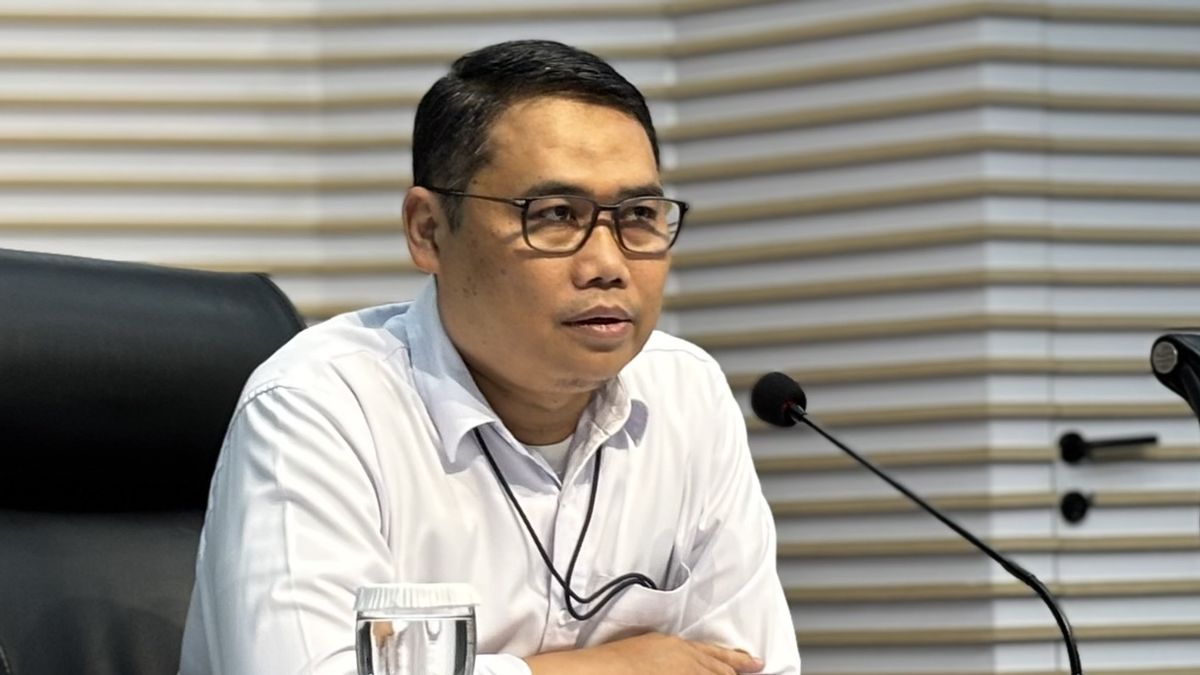


The Corruption Eradication Commission (KPK) revealed that there are employees of the Ministry of Religion who are suspected of offering special hajj quotas to preachers as well as owners of PT Zahra Oto Mandiri (Uhud Tour), Khalid Zeed Abdullah Basalamah or Khalid Basalamah.
Acting (Plt) Deputy for Enforcement and Execution of the KPK Asep Guntur Rahayu said Khalid and hundreds of worshipers would initially depart on a furoda hajj visa in 2024. However, the Ministry of Religion employee came to offer a special pilgrimage which turned out to be the result of the distribution of 20,000 additional quotas from the Saudi Arabian government.
"There are elements from the Ministry of Religion who say that, 'ustaz, this only uses a special hajj quota, this is official," Asep told reporters, Thursday night, September 18.
Asep said the Ministry of Religion employee also promised Khalid to leave immediately in the same year. However, there is a fee that must be paid by the preacher.
"This person from the Ministry of Religion then said, 'Yes, this is also going this year, but there must be acceleration money'. Well, given acceleration money, if I'm not mistaken that's 2,400 US dollars per quota," said Asep, who is also the Director of KPK Investigations.
Khalid then agreed to collect the money from the congregation, said Asep. This group then left using a special hajj quota in the same year.
"The money was collected by Ustaz KB, collected, handed over to the person," he said.
Furthermore, Asep said that this money was later returned by the Ministry of Religion employee. The return was made after the formation of a special committee (special committee) for the DPR hajj due to various problems in the implementation of worship in the Holy Land.
Khalid then handed over the money to the KPK in stages and was included in the list of evidence.
"For fear, because there was fear from this person, then the money was returned, which had been handed over as acceleration money, it was handed back to Ustaz Khalid Basalamah," said Asep.
Meanwhile, Khalid Basalamah admitted that he was examined by the KPK as a witness for leaving as a pilgrim along with hundreds of other people. They said they would initially leave using a furode visa.
However, he shifted to a special pilgrimage whose quota turned out to be problematic because he received an offer from Ibnu Masud who is a Commissioner of PT Muhibbah Mulia Wisata. Khalid also claimed that Uhud Tour could not dispatch pilgrims because it was not a travel agent or travel agent for special Hajj organizers (PIHK).
"The language is Ibnu Masud to us, PT Muhibbah (can, red) an additional quota of 20,000 from the Ministry of Religion. Because we received an official discussion from the Ministry of Religion and I was registered as a congregation at PT Muhibbah," he told reporters after undergoing examination, Tuesday, September 9.
Previously reported, the KPK has issued a general investigation warrant (sprindik) for alleged corruption in the addition of quotas and the implementation of Hajj in 2023-2024. This institution reasoned that the issuance was carried out so that they could make forced efforts such as searches, confiscations and witness examinations.
The general Sprindik uses Article 2 Paragraph 1 and/or Article 3 of Law Number 31 of 1999 concerning the Eradication of Criminal Acts of Corruption as amended by Law Number 20 of 2021 in conjunction with Article 55 paragraph 1 of the Criminal Code. This means that there are state losses that occur due to this corrupt practice.
State losses in the corruption case of quota and Hajj for the period 2023-2024 are said to have reached more than IDR 1 trillion. This amount is still increasing because it is only the initial calculation of the KPK which continues to coordinate with the Supreme Audit Agency (BPK).
This case began with the provision of 20,000 additional Hajj quotas from the Saudi Arabian government for Indonesia to reduce the queues of pilgrims. However, the distribution turned out to be problematic because it was divided equally, namely 50 percent for regular Hajj and 50 percent for special Hajj.
SEE ALSO:
-
 | TEKNOLOGI
Tim Cook Hadiri Jamuan Kenegaraan Inggris Bersama Presiden Trump
19 September 2025, 06:05 -
 | LIFESTYLE
Mengapa Masyarakat Jahiliyah Tidak Mempercayai Adanya Hari Kiamat? Ini Sebab-sebabnya
19 September 2025, 04:25
In fact, based on the law, the distribution should be 92 percent for regular Hajj and 8 percent for special Hajj.
Later, the distribution of problems was allegedly due to money from the Hajj and Umrah travel parties as well as the associations that oversee the Ministry of Religion. After getting the allotment, they sold the additional quota to prospective pilgrims.
The English, Chinese, Japanese, Arabic, and French versions are automatically generated by the AI. So there may still be inaccuracies in translating, please always see Indonesian as our main language. (system supported by DigitalSiber.id)
Most Popular Tags
#Prabowo Subianto #donald trump #2026 World Cup #Febrie Adriansyah #8791Popular


