

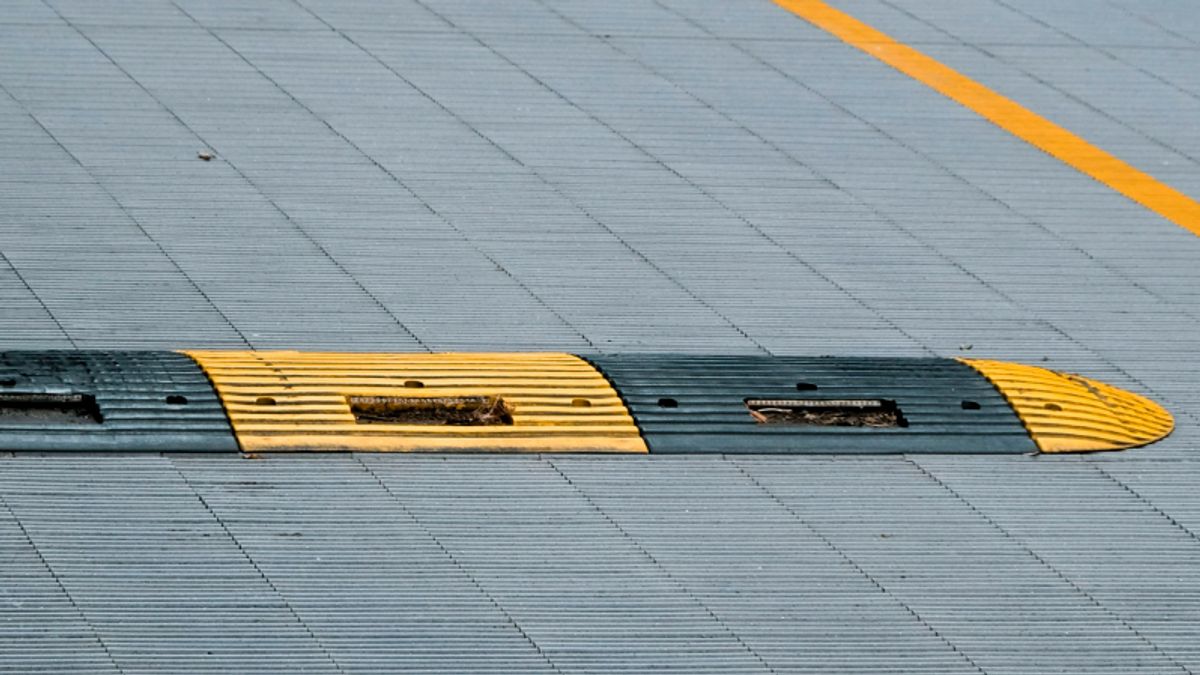


YOGYAKARTA – Speed bumps are obstacles installed on roads. Their purpose is to encourage drivers to slow down. In Indonesia, speed bumps are often installed to minimize traffic accidents. Beyond that, did you know there are many different types of speed bumps with varying specifications? Read the following article for complete information.
Types of Speed Bumps
Speed bumps in Indonesia are usually made of concrete, but some are made of asphalt. The materials used to make speed bumps must be safe and of high quality, and can be cement, asphalt, or rubber. This selection ensures they don't break or tear, which could potentially endanger users and lead to accidents.
In Indonesia, the use of speed bumps is regulated by Article 3 of Minister of Transportation Regulation No. 82 of 2018. This regulation explains the various types of speed bumps used, as follows.
- Speed Bump
The first type is the speed bump. These barriers are used on public roads, parking lots, or private areas. Speed bumps are designed for roads where vehicles travel at speeds below 10 km/h.
Besides their function, these speed bumps also have specific specifications that must be met. The following are the specifications for speed bumps.
- The top surface must be at least 15 cm or 150 mm wide.
- The minimum height must be 12 cm or 120 mm.
- The slope angle must be at least 15%.
- Painting can be done in either black-yellow or black-white. However, the black color must be 30 cm wide, while the combination color must be 20 cm wide.
- The painting must be angled at a 30-45 degree angle to the right.
- Speed Hump
Another type of speed bump is the speed hump, which can be found on local roads. These road barriers are specifically designed for roads with a vehicle speed of around 20 km/h. Their function is to reduce vehicle speeds on roads prone to pedestrian crossings.
- Maximum top surface width 39 cm
- Height 5 to 9 cm
- Gap angle 50%
- Speed Table
Another common speed bump in Indonesia is the speed bump. This type is typically installed on local or neighborhood roads. Road users may also encounter them before toll gates. Speed bumps have the following requirements.Maximum top surface width: 660 cm (6600 mm)
- Maximum height: 6 to 9 cm
- Slope: 15%
- Painting is done in black and yellow or black and white, with the black color measuring 30 cm and the combination color measuring 20 cm.
That's the information regarding the types of speed bumps. Visit VOI.id for more interesting information.
The English, Chinese, Japanese, Arabic, and French versions are automatically generated by the AI. So there may still be inaccuracies in translating, please always see Indonesian as our main language. (system supported by DigitalSiber.id)
Most Popular Tags
#Prabowo Subianto #donald trump #Febrie Adriansyah #8791 #giias 2026Popular


