
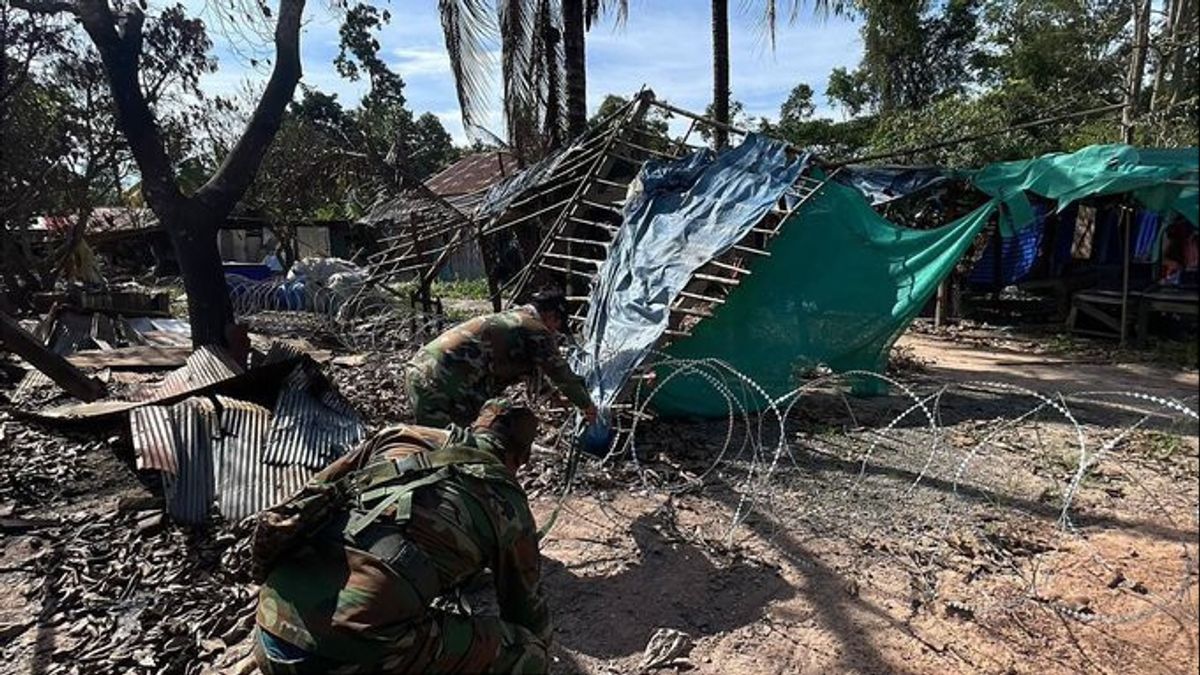


The top defense officials of Cambodia and Thailand agreed to allow ASEAN observers/reviewers to inspect disputed border areas and help ensure hostilities do not happen again.
The two neighboring Southeast Asian countries engaged in fierce fighting for more than a decade last month, including exchanges of artillery fire and fighter jet attacks that killed at least 43 people and displaced more than 300,000 people on both sides of the border.
The fighting continued despite diplomatic interventions from China and Malaysia, the head of the ASEAN regional bloc, both calling for restraint.
Cambodian and Thai leaders only came to the negotiating table when US President Donald Trump told the two countries tariff negotiations would not proceed unless there was peace, Reuters reported exclusively.
Cambodian Defense Minister Tea Seiha and acting Thai Defense Minister Nattaphon Narkphanit met at the headquarters of the Malaysian Armed Forces in Kuala Lumpur on Thursday, August 7, to discuss the requirements for permanent cessation of hostilities.
"There will be an ASEAN military attach monitoring team based in Thailand and Cambodia, led by Malaysia," Nattaphon said.
"Thailand and Cambodia are neighboring countries with separable joint borders. A resolution will allow our people to return to a peaceful life," he continued.
Thailand and Cambodia stated in a joint statement that they would hold further negotiations in two weeks and then return within a month.
SEE ALSO:
-
 | BERITA
Kepulauan Solomon ‘Blokir' AS, China, dan Taiwan dari KTT Kawasan Pasifik
07 Agustus 2025, 20:36 -
 | BERITA
Trump: Negara-negara Timur Tengah Penting Bergabung dengan Perjanjian Abraham
07 Agustus 2025, 20:05 -
 | BERITA
AS Sanksi Artis Hip-hop El Makabelico terkait Kartel del Noreste Meksiko
07 Agustus 2025, 19:55

The peace requirements were formulated for three days of negotiations between senior officials in Kuala Lumpur and were finalized on the fourth day before observers from China and the United States.
"Both sides agreed on the provisions for the implementation of the ceasefire and increased communication between the two troops," Cambodian Prime Minister Hun Manet said on social media.
Thailand and Cambodia have been at loggerheads for decades over their unbounded land border region of 817 km (508 miles), which France first mapped out in 1907 when France was still its colony.
The English, Chinese, Japanese, Arabic, and French versions are automatically generated by the AI. So there may still be inaccuracies in translating, please always see Indonesian as our main language. (system supported by DigitalSiber.id)


