
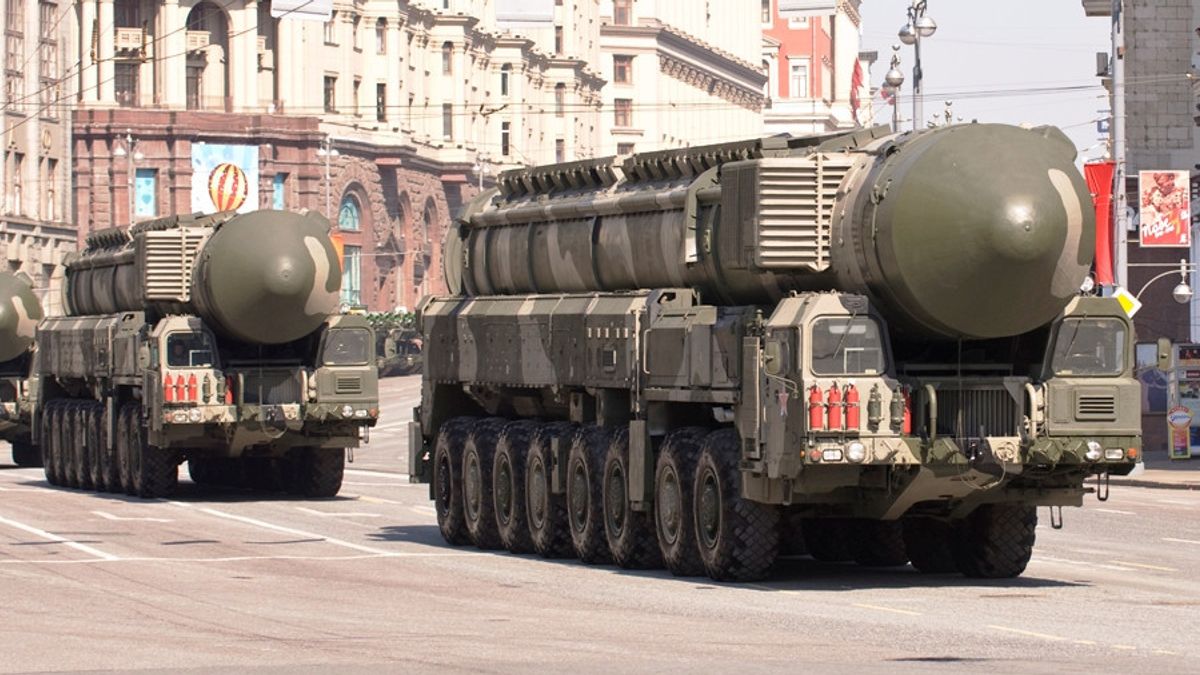


Kremlin spokesman Dmitry Peskov said Russia was now free to take steps on missile deployments, following an announcement canceling the moratorium on short- and medium-range nuclear missiles referring to the Intermediate-Range Nuclear Forces (INF) Treaty.
Peskov said Russia was entitled to take any relevant steps regarding the deployment of medium and short-range missiles because they were no longer restricted.
"Russia no longer has any boundaries in this regard. Russia no longer considers itself limited by anything. Russia considers itself entitled to take relevant steps if needed," Peskov said, launching TASS Aug. 5.
In this regard, Peskov said Russia would not share details about this, given its sensitivity and secret due to defense issues.
Previously, Peskov said Russia had the right to deploy medium- and short-range missiles in the event of a NATO provocation near the country's borders.
Russia's Foreign Ministry on Monday announced Moscow no longer considers itself bound by self-restrictions related to the deployment of medium and short-range missiles, as the requirement to comply with the moratorium has been lost.
The ministry noted certain steps taken by the West collectively in terms of such missile proliferation, stressing these measures create a direct threat to Russia's security.
"With our repeated warnings regarding this and the evolving situation towards the deployment of a US-made medium and short-range land missile de facto in Europe and the Asia-Pacific region, the Russian Foreign Ministry must state that any requirement to maintain a unilateral moratorium on the deployment of similar weapons no longer exists, and is subsequently authorized to state that the Russian Federation does not consider itself bound by the relevant self-restrictions that have been previously approved," the Russian Foreign Ministry said Monday.
The ministry noted that since 2023 Moscow has observed a US system capable of launching medium and short-range missiles from the ground has been moved to NATO European countries and the Asia-Pacific region for testing during military exercises with an explicit anti-Russian orientation.
The INF Agreement, signed in 1987 by Soviet leader Mikhail Gorbachev and US President Ronald Reagan, abolished the entire class of missile weapons launched from land with a range of 500 to 5,500 kilometers (311 to 3,418 miles), quoted from Reuters.
SEE ALSO:
-
 | BERITA
Sekjen NATO Serukan Sekutu Ikuti Jejak Belanda Beli Senjata untuk Ukraina
05 Agustus 2025, 19:00 -
 | BERITA
Kecam Provokasi di Masjid Al-Aqsa, Menlu Sugiono: Pelanggaran Status Quo
05 Agustus 2025, 16:15


The US withdrew from the Intermediate-Range Nuclear Forces Treaty in 2019, citing Russia's non-compliance. Moscow later stated it would not deploy such weapons provided Washington did not.
However, Foreign Minister Sergey Lavrov hinted last December that Moscow should respond to what it calls "destabilization measures" by the US and NATO in the strategic field.
The English, Chinese, Japanese, Arabic, and French versions are automatically generated by the AI. So there may still be inaccuracies in translating, please always see Indonesian as our main language. (system supported by DigitalSiber.id)
Most Popular Tags
#Prabowo Subianto #donald trump #2026 World Cup #Febrie Adriansyah #8791Popular


