

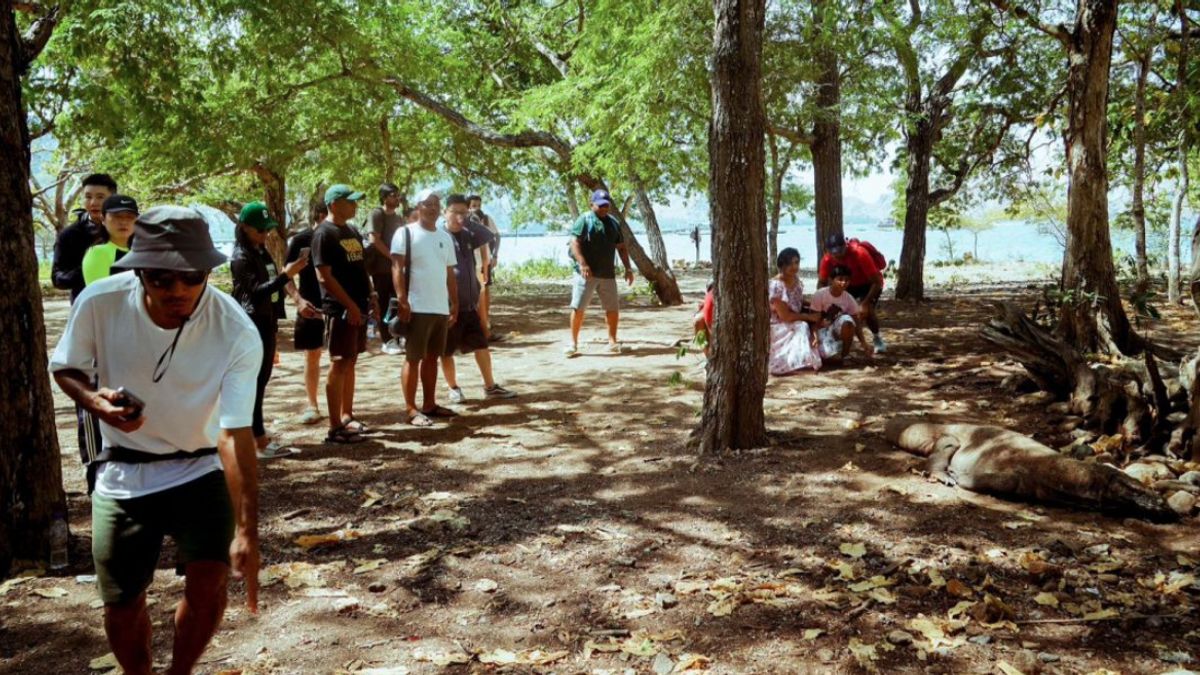


JAKARTA - Deputy Chairman of Commission VII DPR Evita Nursanty asked the Ministry of Forestry (Kemenhut) to review the granting of a Natural Tourism Facilities Provision Business Permit (IUPSWA) in the Komodo National Park (TNK) area in East Nusa Tenggara (NTT).
This was said by Evita in response to protests from indigenous peoples, civil society organizations, local DPRD, and various other parties against the resort construction plan with 619 tourist facilities by PT Kencana Watu Lestari (PT KWT) on Padar Island, as well as other companies operating in the TNK area.
He also urged that infrastructure development in the TNK area be stopped if it is not in line with conservation principles, sustainable tourism development, and has the potential to harm local communities.
"We are aware of the importance of tourism infrastructure support, especially in super priority destinations such as Labuan Bajo and its surroundings. However, if the construction of resorts and infrastructure is carried out massively on Padar Island, Rinca Island, and other islands within the TNK area, then it must be stopped if it is against the spirit of conservation," said Evita, Tuesday, August 5.
"Moreover, this has the potential to damage the Outstanding Universal Value (OUV) of the TNK as reminded by UNESCO. If you want to build, it should be done outside the national park area," he continued.
Evita also asked the Ministry of Transportation to review the zoning changes since 2012. If these zoning changes are proven to disturb the habitat of the Komodo dragon, according to her, then they should have been returned to the previous zoning, namely from the utilization zone to the core zone or jungle zone.
"This means that there should be no construction of resorts or tourist facilities in the national park area, and all activities should be directed outside the area," he said.
Evita reminded that Komodo dragons are wild animals that move freely without knowing the zoning limit. If the development is carried out massively within the area, he assesses that the Komodo living space will be increasingly pressed due to increased human activity.
"Therefore, spatial planning must be carried out carefully and should not be arbitrarily amended. We hear that UNESCO is very concerned about the 2012 zoning change," said Evita.
The head of the commission in charge of tourism affairs also asked the TNK, which is also a UNESCO World Heritage site, to be specifically considered. Evita encouraged the Government to take this world-class Indonesian tourist destination sustainability more seriously.
"The status of this national park cannot be equated with other national parks. Every development project must be thoroughly assessed with an impact analysis approach in the context of world heritage sites," he explained.
Evita also urged the government to conduct an independent audit of all ongoing tourism projects in the TNK. He stressed that every project must be in line with UNESCO's world heritage site protection standards.
"Once again, I ask that UNESCO's voice be properly considered. Do not let the status of Komodo's world heritage be revoked because of business activities that threaten the sustainability of the Komodo dragon and the natural and cultural values of this region," he concluded.
The English, Chinese, Japanese, Arabic, and French versions are automatically generated by the AI. So there may still be inaccuracies in translating, please always see Indonesian as our main language. (system supported by DigitalSiber.id)
Most Popular Tags
#Prabowo Subianto #donald trump #2026 World Cup #Febrie Adriansyah #8791Popular


