


JAKARTA - Russia's Federal Security Service (FSB), the main successor to the Soviet Union-era KGB, will soon have the authority to establish a network of pre-trial detention centers under its own jurisdiction, according to a bill passed by the lower house of parliament.
Members of parliament said the FSB needed such a detention facility due to a surge in intelligence activity and a subversive foreign force since the start of the war in Ukraine - known as a "special military operation" within Russia.
Vasily Piskaryov, chairman of the Lower House Security and Anti-Corruption Committee of parliament, said the law had been passed in his final reading by the assembly, Duma Negara.
"This law regulates the detention of those accused of crimes against state security in separate detention facilities under Russia's FSB jurisdiction," Piskaryov said on Telegram, as reported by Russia July 9.
The accompanying explanatory note of the bill states that military personnel from state security will manage the detention centers.
Piskaryov said cases of betrayal, espionage and terrorism had tripled over the past decade, while the number of defendants had quadrupled.
To become a law, the bill must be approved by the upper house of parliament and then signed into law by Putin, steps that usually follow immediately after the lower house of parliament approved the law. The bill is scheduled to become law on January 1, 2026.
It is known, after the collapse of the Soviet Union in 1991 and in the years after Russia joined the European Council in 1996, the FSB lost its formal control over the network of pre-trial detention centers, despite maintaining significant informal control.
The FSB, headquartered at Lubyanka Square, central Moscow, is one of the strongest intelligence agencies in the world with significant counter-spionage capabilities, counter-terrorism, cyber, human intelligence and special forces.
SEE ALSO:
-
 | BERITA
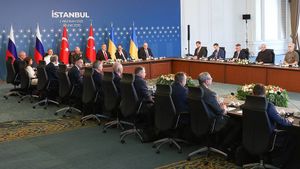
Rusia Masih Menunggu Tanggal Putaran Perundingan Berikutnya dengan Ukraina
09 Juli 2025, 07:00 -
 | BERITA
Kremlin Butuh Waktu untuk Memastikan Senjata Apa yang Dikirim AS ke Ukraina
09 Juli 2025, 04:00

His director, Alexander Bortnikov, reported directly to President Vladimir Putin, who served as a KGB officer in East Germany in the 1980s and led the FSB before being appointed prime minister in 1999.
Opponents of President Putin said he had built a more repressive and highly dependent political system on the FSB. Meanwhile, Putin's supporters said Russia was being attacked in a hybrid manner by Western powers and needed the FSB to ensure security and safeguard Russia's sovereignty.
The English, Chinese, Japanese, Arabic, and French versions are automatically generated by the AI. So there may still be inaccuracies in translating, please always see Indonesian as our main language. (system supported by DigitalSiber.id)


