

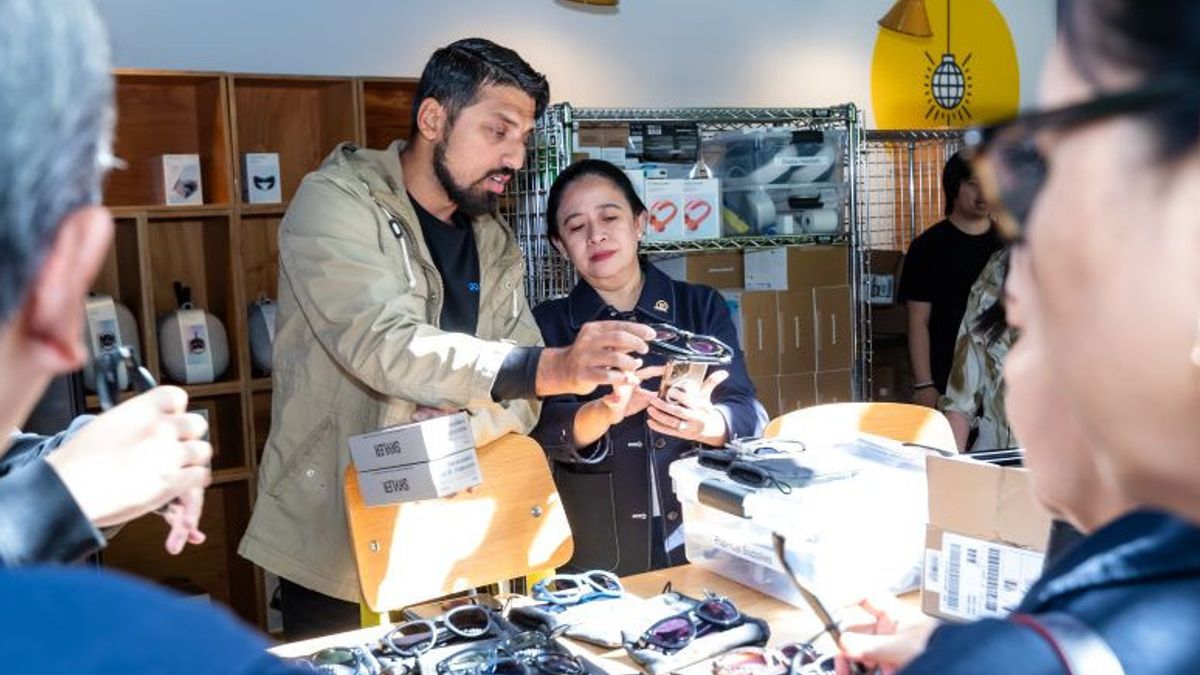


JAKARTA - The chairman of the Indonesian House of Representatives, Puan Maharani, has paid serious attention to the isolated condition of Enggano Island, Bengkulu, due to the shallow flow of the Baai Island Port since March 2025. This situation has caused the disruption of passenger and logistics ship access which has a direct impact on the distribution of basic necessities, health services, and community economic activities.
"This condition cannot be seen as an ordinary technical obstacle, but has developed into a humanitarian crisis that threatens the lives of citizens on one of Indonesia's leading islands," said Puan Maharani, Friday, June 20.
As reported, the Port of Baai Island, Bengkulu City has been silting since the last eight months which has resulted in sea service ships unable to dock at the dock. Even passengers had to be lowered in the middle of the sea.
As a result of silting at the port of Baai Island, as many as 4,000 residents of Enggano Island have been isolated since the last few months. The people of Enggano were forced to face difficult realities, food ingredients were running low, natural products could not be sold, and access to health was almost cut off.
Hundreds of farmers even chose not to harvest their gardens because of the absence of distribution routes and falling selling prices.
The Alliance of Indigenous Peoples of the Archipelago of Bengkulu Region regretted the attitude of the Bengkulu local government which seemed not to care about the crisis situation that is now hitting Enggano Island. They also asked the government to stop spreading the narrative that Enggano had been handled properly, even though what happened was the opposite.
Regarding this situation, Puan emphasized that in Indonesia's constitutional system, the state has a constitutional obligation to protect and serve all citizens without exception, including those on leading and remote islands such as Enggano Island.
"The absence of the state in urgent conditions like this cannot be justified in the perspective of public responsibility," said the grandson of the proclaimer of the Republic of Indonesia, Bung Karno.
"The state must not leave its people, including residents living in the area and the front islands," added Puan.
SEE ALSO:


Puan emphasized that the crisis that was allowed to drag on without a solution not only showed weak coordination between institutions, but also indicated that the collective awareness of the central and regional governments was not yet strong.
According to Puan, the shallow problem with the port flow should be anticipated through measured infrastructure planning and an active emergency response.
"We should be aware that small islands are not marginalized areas, but are a legitimate part of this republic," said the first woman to serve as Chair of the DPR RI.
Puan also mentioned the core principle of the 2030 Agenda for Sustainable Development and Sustainable Development Goals (SDGs), namely No one left behind or 'don't leave anyone behind'.
"Indonesia as a country participating in the 2030 SDGs agenda should apply the principle of 'no one left behind' which emphasizes inclusion and equality in development," explained Puan.
"Ensuring that everyone, especially vulnerable groups, benefits from development and no one is left behind. Moreover, the people shed their own blood," he added.
Puan highlighted how Indonesia continues to fight for the SDGs Agenda. But sadly, in his own country there are still residents who are isolated.
We always scream for the sustainable development agenda at the global level. But the state is still ignorant of the fate of its people in remote parts of the country. This is a warning to all of us," said Puan.
Therefore, Puan asked the central government, especially the Ministry of Transportation, to immediately take concrete steps by sending logistics ships and passengers regularly. This is to ensure the supply of food and mobility of the residents of Enggano Island during the isolation period.
In addition, the former Coordinating Minister for Human Development and Culture asked the Government to accelerate port dredging and develop an alternative shipping scheme for areas prone to cut off transportation routes. Then, said Puan, activating emergency interventions through the Ministry of Social Affairs, the Ministry of Health, and the National Disaster Management Agency to ensure the basic rights of citizens.
"As well as optimizing the Village Fund and APBD so that it can be used flexibly to rent a local logistics fleet to revive the community's economy," he said.
Furthermore, Puan emphasized the importance of accelerating the implementation of regulations that favor the archipelago, including the Archipelago Regional Bill so that national development policies truly reflect spatial justice and regional solidarity.
"What happened on Enggano Island must be a reflection momentum that the measure of successful development is not only a big infrastructure project, but to what extent the state is present in the most urgent situations for its people, the slightest and to what extent they are from the center," said Puan.
Puan ensured that the DPR will continue to monitor and supervise the handling of the Enggano Island crisis so that problems that touch the lives of many people on islands rich in natural resources and unique culture will be resolved fairly.
"The DPR RI will continue to oversee and ensure that state policies do not forget its citizens who are at the forefront of Indonesia's sovereign territory," concluded Puan.
The English, Chinese, Japanese, Arabic, and French versions are automatically generated by the AI. So there may still be inaccuracies in translating, please always see Indonesian as our main language. (system supported by DigitalSiber.id)
Most Popular Tags
#Prabowo Subianto #donald trump #2026 World Cup #Febrie Adriansyah #8791Popular


