


JAKARTA - Iran has reportedly transferred its ballistic missile to the country's central region to avoid damage from Israeli airstrikes in Iran's western region.
The transfer led three of Iran's eight medium range ballistic missiles to reduce its ability to reach targets in Israel.
In addition to a streak of 20 missiles that hit Israeli hospitals on Thursday, Iran was unable to launch a large or effective scale attack.
The military was forced to fire fire from the Isfahan area in central Iran, about 1,600 km from Israel's target, quoted from The National June 20.
Quoted from the Institute Study of War via The National, Iran has eight medium-range missed, including Haj Qasem (distance from 1,400km), Fatah (1,400km), Kheibar Shekan (1,450km), Ghadr-H (1,650km), Paveh (1,650km), Emad (1,700km), Ghadr-F (1,950km) and Seijal-1 (2,000km).
Its more advanced missiles, Fatah-1 and Haj Qasem, will now not be able to reach the target with a range of just 1,400 km, as well as Kheibar Shekan, which can reach a distance of 1,450 km.
Fatah-1 is touted as a hypersonic missile with the ability to fly at very high speeds approaching 18,600 km/h as well as being able to maneuver in the middle of the flight, making it difficult to intercept.
"This missile is also a more precise medium-range weapon and, because it is solid-fueled, it is easier to transport," said Behnam Ben Taleblu, an Iranian-American analyst living in the US.
"Iran doesn't have many medium-range ballistic missiles with a higher range of solid fuel, so they are now using liquid-fuel missiles," he said.
It is known that the liquid-fuel missile is less accurate and takes longer to launch, because it must be filled with propellants on site because it carries it which is already loaded with fuel too dangerous.
"It makes them more vulnerable to launch and that's why Israel is so successful that you can actually see these objects being launched. You can destroy them there even before taking off," added Ben Taleblu.
The situation became increasingly difficult after Israel claimed to have successfully destroyed half of all missile launchers and up to 40 percent of Iran's missile supplies.
Iran now has to use Emad (reachables 1,700 km) and Ghadr (reachable 1,950 km) weapons, which use liquid and vulnerable and difficult to transport.
At a distance of 2,000 km, the dense-fueled Seijil-1 has the furthest range and was used in a single attack for the first time on Wednesday, which "may reflect Iran's need to launch long-range missiles within deeper Iranian territory", the Institute for the Study of War think tank said in a report.
"Iran recently used fewer missiles to attack Israel because it was difficult to coordinate a major attack on Israel, not because Iran was storing its remaining ballistic missile supplies," he added.
In its first retaliatory strike in response to Israeli surprise operations on Friday last week, Iran fired 200 missiles, followed by 75 missiles a day later and 94 missiles on Sunday.
On Monday, Iran only managed to fire 22 missiles, 47 other missiles on Tuesday and one missile on Wednesday, before a streak of 20 rockets on Thursday.
SEE ALSO:
-
 | BERITA
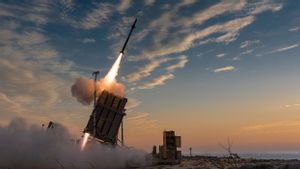
IDF Klaim Menggunakan Sistem Pencegat Baru untuk Menjatuhkan Drone Iran
20 Juni 2025, 20:00 -
| BERITA
IDF Klaim Menggunakan Sistem Pencegat Baru untuk Menjatuhkan Drone Iran
20 Juni 2025, 20:00 -
 | BERITA
Menhan Israel Perintahkan Militer Kacaukan Iran dengan Serangan Intensif
20 Juni 2025, 18:45

Furthermore, Israel has targeted a ballistic missile plant to prevent Iran from recharging its supply of missiles running low.
Analysts believe Iran will now be reluctant to use the remaining long-range missile supplies unless they see the conflict with Israel as an existential threat.
Ben Taleblu argues Iran's missile supply may now be below 1,000, as Tehran "needs to maintain something in terms of their ability and capacity to maintain the regime in their minds, in the post-conflict scenario".
The English, Chinese, Japanese, Arabic, and French versions are automatically generated by the AI. So there may still be inaccuracies in translating, please always see Indonesian as our main language. (system supported by DigitalSiber.id)


