


YOGYAKARTA - A number of countries have chosen cruise missiles and ballistic missiles as their defense arsenal. These two types of missiles have several differences. According to the American Federation of Scientists, the difference between ballistic and cruise missiles lies in the crossing and its maneuvers.
Reporting from the Sandboxx page, Friday (23/8/2024), ballistic missiles have ballistic trajectories in most of their flight lines. In other words, after the missile burns the fuel that drives it, the missile continues to move, as does the bullet after flying from the pistol. After the fuel runs out, the direction of the missile cannot be changed. This object will continue to follow the path determined by its launch speed and gravitational force that tries to pull it back to the earth's surface.
Thus, gravity guides the downward missile towards its target. For example, in 2017, North Korea conducted a new ballistic missile launch test, Pukguksong-2.
The launch was held when Japanese Prime Minister Shinzo Abe was on a state visit to the United States. In May and October 2019, North Korea has launched a total of 12 ballistic missiles or other projectiles. However, all these activities were just test launches.
On January 7, 2020, Iran sent more than a dozen ballistic missiles to two Iraqi military bases housing US troops. This incident was Iran's retaliation for the US drone attack that killed Iranian General Qassem Soleimani on January 3, 2020. There were no casualties and Iranian Foreign Minister Mohammad Javad Zarif defended a missile strike against a US base in Iraq, revealing that it was self-defense.
SEE ALSO:
-
 | BERITA
Deretan Senjata Terbaru Iran yang Digunakan untuk Membalas Gempuran Israel
20 Juni 2025, 01:06

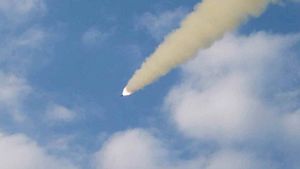
Ballistic missiles have differences with cruise missiles. Cruise missiles can move on their own for most of their time in the air, flying in relatively straight lines and at lower altitudes due to rocket propellants. You can envision ballistic missile flight trajectories as large arches up and down again, while cruise missile trajectories are fired from warships, for example closer to straight lines.
Ballistic missiles were used for the first time during World War II, when Germany used a ballistic missile called V-2 to attack London. The British air defenses designed to stop the aircraft were unable to stop the V-2, as the rocket flew too high into the upper atmosphere and moved too fast.
After the war, with the help of German technology and scientists captured, the US built its own arsenal consisting of a much stronger intercontinental ballistic missile (ICBM) capable of releasing nuclear destruction against targets on the other side of the world. Countries that have intercontinental ballistic missiles operating include Russia, the United States, China, North Korea, France, India, and Britain.
Meanwhile, most of the cruise missiles fly with their own driving force, flying in relatively straight lines and at lower altitudes due to rocket propellants. In contrast, ballistic missile flight trajectories such as large bows are up and down again. Ballistic missiles follow "ballistic flight lines", which often cover long bow-long trips, while cruise missiles tend to follow a straighter and lower trajectory. Ballistic missiles are also more like rockets, while cruise missiles are more like airplanes or drones.
Ballistic missiles are launched into the air by rocket motors, or often (as is the case with the ICBM) of rocket-graded motors. The ICBM has a striking resemblance to rockets carrying astronauts into space for the right reasons, in addition to the payloads this platform carries, both are mechanically very similar. Unlike long arch-tailed ballistic missile trajectories, cruise missiles move at lower altitudes and on much more straighter trajectories. In other words, cruise missiles such as a kind of self-flying unmanned aircraft to their intended targets and then hit them.
The most popular and frequently discussed cruise missile is Tomhawk, which has become the United States' preferred weapon to strike targets at large enough distances without deploying troops to a conflict area. During its flight, cruise missiles did not leave the atmosphere at any point, nor did they fly without power for a significant duration.
Instead of using rocket engines, cruise missiles are driven by turbofans like most tactical aircraft, and most often, even have expanding wings after launch. Some cruise missiles can even be directed to their targets with long-range operators using cameras on the nose of a weapon, unlike piloting an unmanned aircraft or UAV. Modern cruise missiles are known for their excellent range and accuracy. In fact, general rules regarding these weapons can fly as far as 1,609 kilometers and target car garage-sized targets.
That's a review of differences in ballistic missiles and cruises. Hopefully this information will be useful! Visit VOI.id to get other interesting information.
The English, Chinese, Japanese, Arabic, and French versions are automatically generated by the AI. So there may still be inaccuracies in translating, please always see Indonesian as our main language. (system supported by DigitalSiber.id)


