

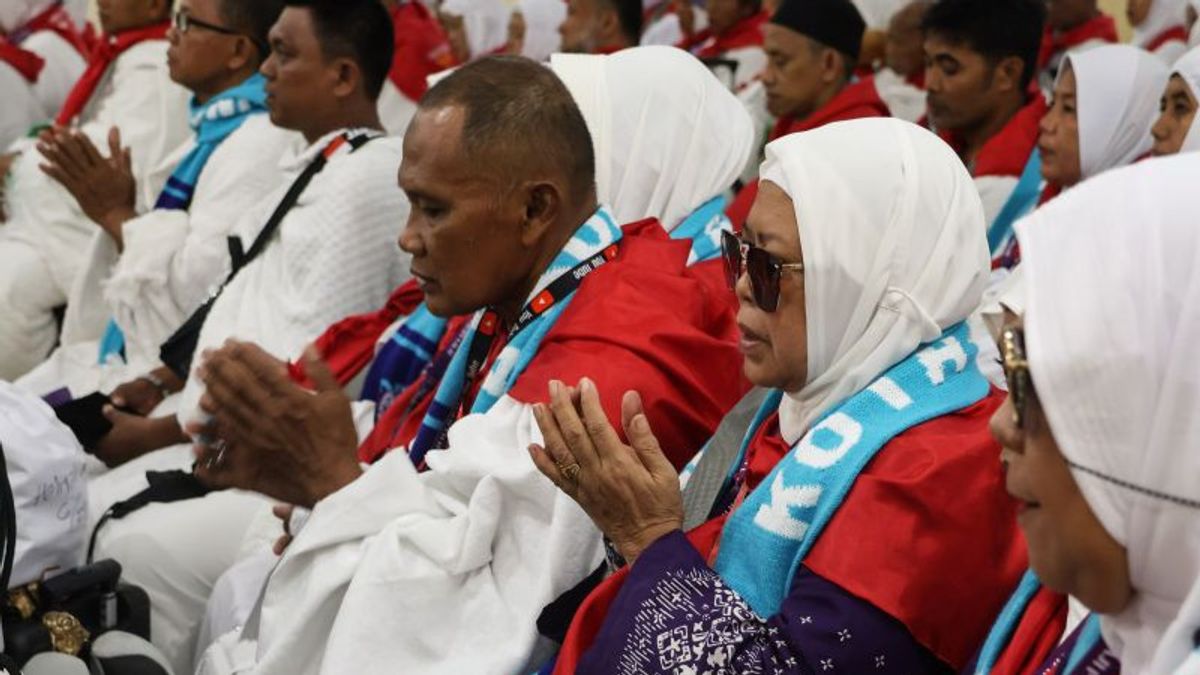


JAKARTA - Member of Commission VIII DPR RI Maman Imanulhaq highlighted the thousands of candidates for Indonesian furoda pilgrims who failed to leave for the holy land after the Kingdom of Saudi Arabia confirmed that they would not issue a furode hajj visa for the 2025 M/1446 H Hajj season.
Maman also encouraged the issue of the furoda hajj mechanism to be further clarified in the Law on the Implementation of Hajj and Umrah (PIHU) in order to strengthen the protection of the congregation.
The Saudi Arabian government's decision not to issue a furoda hajj visa triggers confusion in the country. In addition to the furoda pilgrims, which cost between Rp. 300 million to Rp. 1 billion, they cannot leave this year, private travel also suffered heavy losses.
Maman Imanulhaq revealed several reasons for the issuance of furoda Hajj visas. First, the Government of Saudi Arabia does not issue a mujamalah visa. Second, there are digital reforms and arrangements for organizing the hajj. Third, the limited quota and prerogative of the kingdom of Saudi.
"Because it is Saudi prerogative, we cannot negotiate," said Maman Imanulhaq, Wednesday, June 4.
Referring to Law Number 8 of 2019 concerning the Implementation of Hajj and Umrah (PIHU), Furoda Hajj is a Hajj visa whose quota is directly from the government of Saudi Arabia without depending on the official government quota. Or in other words, furoda hajj is a pilgrimage through an invitation route from the Saudi government.
The furoda hajj visa can also be referred to as a mujamalah or hajj visa without queues. The furoda visa is different from the regular visa and also the plus hajj visa. The amount is also uncertain and usually the hajj departure company directly relates to Saudi Arabia without going through the government.
Previously, the Chairman of Komnas Haji Mustolih Siradj stated that the failure of thousands of prospective furoda pilgrims to the holy land was purely a business between travel and the congregation. So according to him, the government cannot be blamed.
But in the future, Mustorih assessed that the requirements, mechanisms, and standards of furoda hajj services must be better regulated in the revision of the PIHU Law (RUU). This is done to protect prospective pilgrims from material and immaterial losses.
Maman assessed that the revision of the PIHU Law or the Hajj Law was indeed needed to regulate in detail about this furoda hajj. Moreover, every year there are quite a lot of Indonesian pilgrims departing on a furoda hajj visa, in the range of 3,000-5,000 pilgrims.
"The revision of the Hajj Law will provide space for this furoda arrangement, especially regarding the rights of the congregation and their safety," explained Maman.
Furthermore, Maman also highlighted that travel companies that have not yet received a vote regarding refunds for prospective furoda hajj pilgrims who fail to depart.
To note, some travel companies are discussing full returns, but some have imposed discounts on refunds considering that some have been used to pay for accommodation such as hotels, some even stating that payment is charred.
SEE ALSO:





Related to this, this member of the House of Representatives Commission of Religion stated that his party would urge Hajj and Umrah to communicate and transparency in finance with the congregation. Maman also encouraged the Government to mediate this issue.
"Don't let the congregation who are already disappointed not go to worship Hajj, instead they are harmed again because the money is gone," said Maman.
For information, the Indonesian Hajj quota given by the Government of Saudi to Indonesia this year is 221,000 people, consisting of 203,320 regular hajjes and 17,680 special hajjes. This total quota is lower than last year's 241,000 pilgrims.
The PKB legislator from the West Java IX electoral district also asked the Government to pay more serious attention to the implementation of this year's Hajj. Starting from the issue of Hajj visas, both regular, Hajj pluses and furodes, nusuk cards or some kind of identity for pilgrims to get services while in Saudi Arabia, to sharia or Hajj service systems.
"The government must pay more attention to all the dynamics of organizing this year's Hajj. Starting with visas, nusuk, sharia and furodes," said Maman.
The English, Chinese, Japanese, Arabic, and French versions are automatically generated by the AI. So there may still be inaccuracies in translating, please always see Indonesian as our main language. (system supported by DigitalSiber.id)
Most Popular Tags
#Prabowo Subianto #donald trump #2026 World Cup #venezuela #konflik timur tengahPopular


