

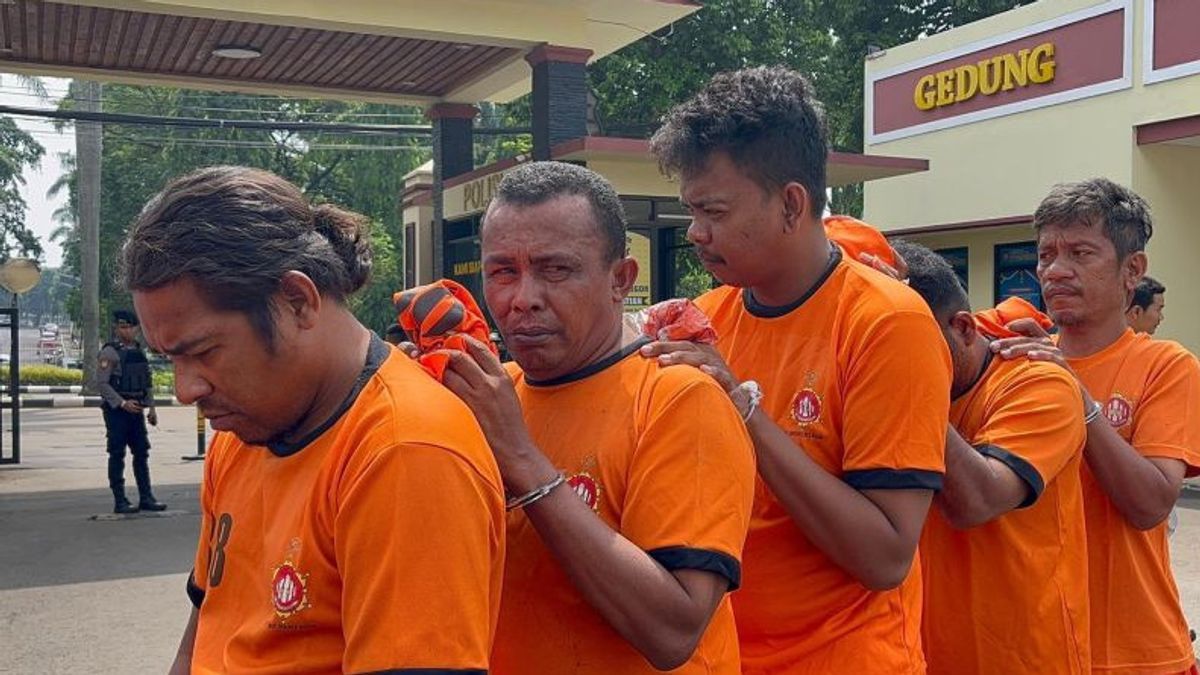


JAKARTA - Member of Commission II DPR RI PKB faction, Ali Ahmad asked the government to act decisively against community organizations (Ormas) involved in thuggery. He said, if you learn from developed countries, thugs under the guise of mass organizations should be punished and dissolved.
"The state must not tolerate acts of thuggery. If there is a group of people or individuals who commit acts of violence, intimidation, or extortion that cause fear and discomfort in society, then it is not an act of mass organizations, but thuggery," said Ali Ahmad, Saturday, May 10.
"International law calls thuggery a crime against humanity which if carried out on a large and systematic scale becomes a war crime," he continued.
SEE ALSO:

According to Ali Ahmad, the national law against thuggery is regulated, among others, in Article 170 of the Criminal Code, especially in relation to the persecution carried out by a group of people. Then Article 368 of the Criminal Code regulates extortion that is carried out with threats of violence.
"The sentence varies, imprisonment can be, fines in addition to prison terms, and social work as an alternative to prison sentences," he explained.
The legislator from the Malang Raya electoral district, East Java, said that acts of thuggery that were being viral by a group of people did not show the behavior of mass organizations.
"The government must not remain silent, if the group has organizational legality, then it is appropriate to revoke or disband. There is no compromise for organizations that create trouble," he said.
According to Ali Ahmad, Indonesia can learn from countries that have succeeded in controlling its mass organizations. Among other things, the United States uses anti-terrorism laws and criminal law to take action against mass organizations that commit violence.
Next, Germany dispersed several mass organizations that were considered extremists or committed violence. law. Then Australia uses anti-terrorism laws and criminal law to crack down on mass organizations that commit violence. Furthermore, the British Government has dissolved several mass organizations that are considered extremists or commit violence.
"The name of the mass organization is the main vision of maintaining social values, empowering the community, providing services, and participating in increasing community participation in the creation of national unity, unity, and justice," he explained.
Ali Ahmad said that the state's interests towards mass organizations have been read since the old order, mass organizations as part of the struggle for independence. At the New Order, the government controlled along with the establishment of mass organizations.
"Ormas that are considered "dangerous" have been dissolved or their activities restricted. The reform era has until now been even more free of establishment, but it is unfortunate that some mass organizations are involved in conflict and violence," he explained.
He considered, Indonesia needs to imitate countries that successfully manage mass organizations. Like Singapore, which has clear and strict regulations for mass organizations, so as to create a stable and controlled environment.
"Japan also has a structured and effective organization management system. The Japanese government has clear regulations for mass organizations, and organizations in Japan generally have good relations with the government," concluded Ali Ahmad.
The English, Chinese, Japanese, Arabic, and French versions are automatically generated by the AI. So there may still be inaccuracies in translating, please always see Indonesian as our main language. (system supported by DigitalSiber.id)
Most Popular Tags
#Prabowo Subianto #donald trump #2026 World Cup #venezuela #Bhayangkara hut #konflik timur tengahPopular


