

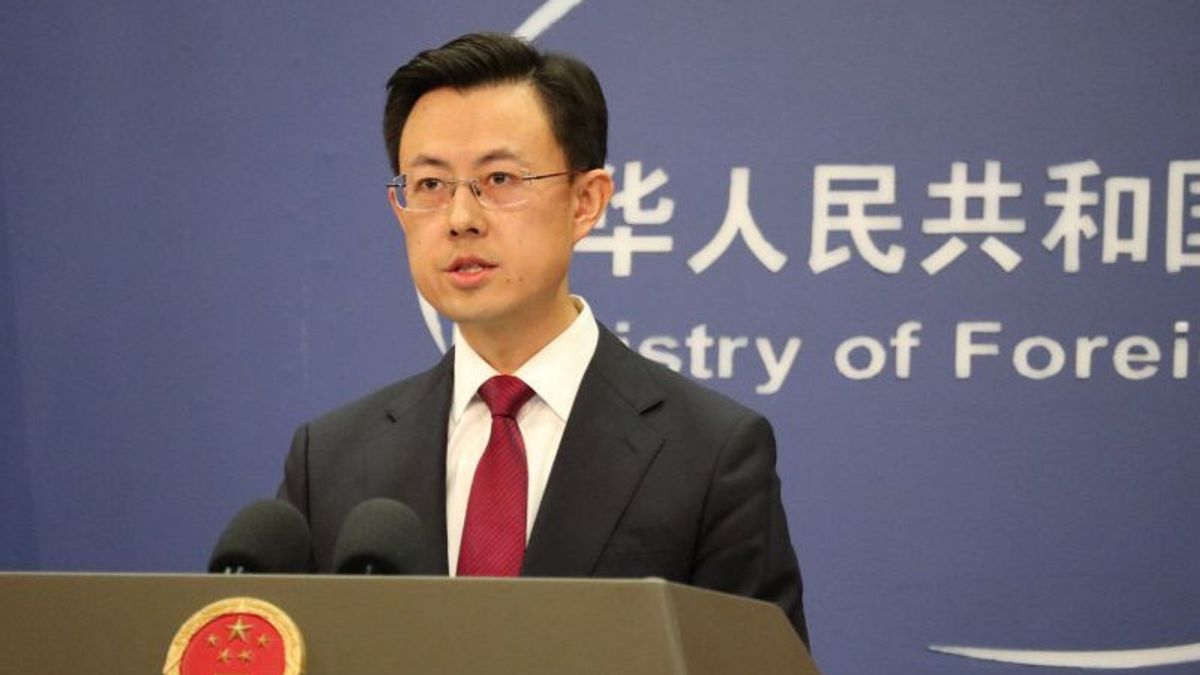


JAKARTA - China's Ministry of Foreign Affairs has responded to the expectations of United States President Donald Trump who proposed reducing the number of nuclear weapons as well as the US, Russian and Chinese defense budgets.
"China follows the policy of 'not using nuclear weapons first' and nuclear strategy for self-defense. China has always maintained its nuclear power at the minimum level required by national security and has never been involved in an arms race with anyone," Chinese Foreign Ministry Spokesman Guo Jiakun told a news conference in Beijing on Friday, February 14.
US President Donald Trump said on Thursday (13/2) he wanted to restart nuclear arms control negotiations with Russia and China and hoped the three country's leaders could agree to cut their very large defense budget by half.
Trump lamented the hundreds of billions of US dollars used to rebuild nuclear weapons in the US and said he hoped to gain commitment from US enemies to also cut their nuclear weapons spending.
"China is ready to cooperate with all parties to firmly support the multilateral arms control regime with the United Nations as a point and contribute to world peace and security," said Guo Jiakun.
Guo Jiakun said the US and Russia together had more than 90 percent of the world's nuclear weapons.
"Distribution of nuclear weapons must follow basic principles of 'maintaining global strategic stability' and 'not reducing security for all'. As owners of the world's largest nuclear arsenal, the US and Russia must seriously fulfill the responsibility of dismantling their nuclear weapons," added Guo Jiakun.
The US and Russia are also expected to carry out drastic and substantive cuts to their nuclear arsenal and create conditions needed for other nuclear weapons-owning countries to join the nuclear weapons dismantling process.
"Regarding the defense budget, allow me to emphasize that US military spending will reach 40 percent of the total world spending by 2024, which is the highest in the world, and higher than the combined eight countries," said Guo Jiakun.
The US National Defense Authority Law for the 2025 fiscal year, Guo Jiakun said, increased the military budget to around $895 billion.
"The US recommends 'America First', then it is the US who should be the first party to cut the military budget," added Guo Jiakun.
SEE ALSO:
-
 | BERITA
Paus Fransiskus Masih Jalani Pengobatan di Rumah Sakit, Kondisinya Stabil
15 Februari 2025, 08:54 -
 | BERITA
3 Warga Israel yang Disandera Hamas Bakal Dibebaskan, Ditukar 369 Tahanan Palestina
15 Februari 2025, 08:24
Meanwhile, China's national defense spending, said Guo Jiakun, in the annual budget is relatively low.
"China's per capita defense output and per service member are also relatively low. China is committed to peaceful development and following defensive national defense policies," said Guo Jiakun.
Guo Jiakun also said that China is playing a role in maintaining stability in a volatile world, a positive power for international security, and the perpetrators in maintaining peace.
China's national defense spending is said to be limited to safeguarding sovereignty, security, development interests and to uphold world peace.
During his first term of office, Trump tried to bring China into negotiations to reduce nuclear weapons when the US and Russia were discussing the extension of the The New START (Strategic Arms Reduction Treaty) pact, which was an intercontinental-distance nuclear weapons restriction, but US efforts failed.
Russia suspended its participation in the agreement during the Biden administration as the US and Russia continued a massive program to extend their Cold War-era nuclear arsenal.
The Stockholm International Peace Research Institute (SIPRI) report in 2023 states that the number of nuclear warheads worldwide will increase to 9,576 in 2023 from the previous 9,440 in 2022.
There are nine countries in the world that have nuclear warheads, namely the United States, Russia, Britain, France, China, India, Pakistan, North Korea and Israel.
Of the 9,576 warheads, 3,844 of them are in an installed position on missiles or aircraft and are ready to attack at any time. While the rest are reserve. About 90 percent of the world's nuclear weapons are owned by the US and Russia, two rivals who cannot be separated from the legacy of the Cold War era.
Countries recorded to increase the number of nuclear warheads are Russia, China, India, Pakistan, and North Korea.
China is said to have experienced rapid growth in nuclear weapons, by increasing the number of nuclear warheads to 410 from 350. The country is also said to have the potential to have US or Russian intercontinental ballistic missiles by the end of the decade.
The English, Chinese, Japanese, Arabic, and French versions are automatically generated by the AI. So there may still be inaccuracies in translating, please always see Indonesian as our main language. (system supported by DigitalSiber.id)
Most Popular Tags
#Prabowo Subianto #donald trump #Febrie Adriansyah #8791 #giias 2026Popular


